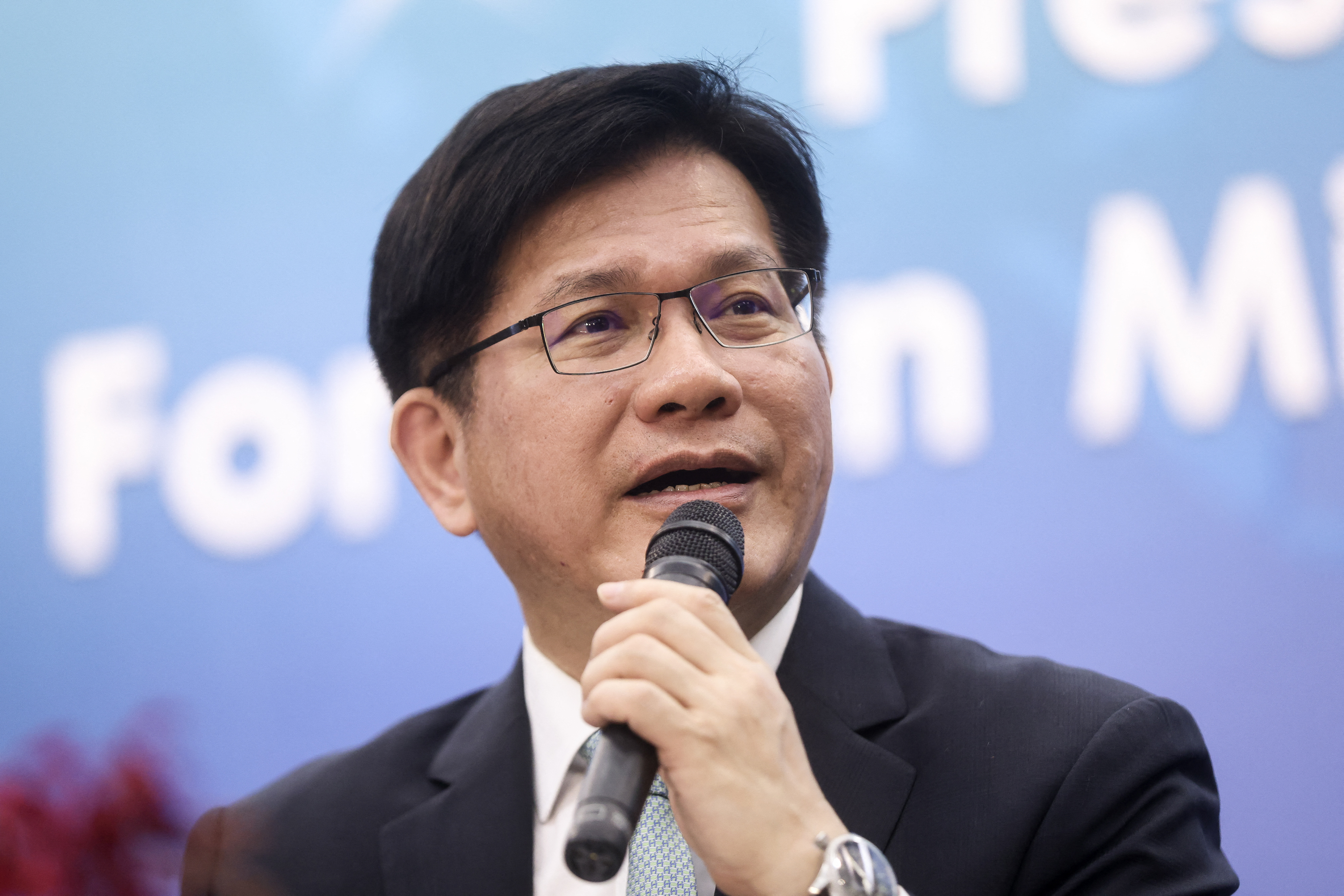

TAIPEI, Taiwan—Countries should treat the first island chain in the Western Pacific as a single theater and coordinate closely to deter China, Taiwanese Foreign Minister Lin Chia-lung has said.
Speaking at a forum hosted by the Taipei-based Formosa Republican Association on April 11, Lin said the strategic island chain stretching from Japan through Taiwan to parts of the Philippines and Indonesia “is no longer just a line on a map.”
“It has become a major front line for global freedom, democracy, and order,” Lin said.
Lin’s remarks come amid China’s rapid military build-up, which is threatening not only Taiwan but also fueling tensions with Japan and the Philippines.
Aside from military threats, the Chinese regime—which sees Taiwan as a part of its territory and has not renounced the use of force to seize it—is also targeting Taiwan with cognitive warfare, influence campaigns, and gray-zone tactics to sway public opinion in Beijing’s favor and erode people’s trust in the island’s democratic institutions.
The first island chain is considered a strategic barrier to prevent China from having easy access to the Pacific Ocean for its naval and air forces.
To deter challenges posed by the Chinese regime, Lin said countries should understand the first island chain “through the lens of a single theater.”
“The Taiwan Strait, the East and South China Seas, the Miyako Strait, the Bashi Channel, and their surrounding sea and air spaces may appear to be separate domains and separate issues, but from the perspective of authoritarian expansionism, gray zone tactics, electromagnetic disruption, supply chain coercion, and cognitive warfare, they are increasingly being integrated into the same strategic framework,” Lin explained.
As a result, Lin said countries should carry out joint operations—including monitoring the region, issuing warnings, conducting deployments, and maintaining resilience—to establish what he called a “democratic shield.”
The shield would be built primarily with asymmetric capabilities—particularly unmanned aerial vehicles and low-cost, long-endurance unmanned vessels—to defend sea lanes and other maritime infrastructure, Lin said.
Doing so would “raise the cost of invasion” and enhance resilience, Lin added.
In November last year, Taiwan President Lai Ching-te announced a special defense budget totaling $40 billion. Part of the budget would be used to procure 200,000 unmanned aerial vehicles and more than 1,000 unnamed surface vehicles, Taiwan Defense Minister Wellington Koo said in March, according to Taiwan’s Central News Agency. The budget proposal has so far stalled in the opposition-controlled parliament.
To procure the necessary unmanned systems, Lin said the process should begin now and proceed step by step.
“The key to a democratic shield for the first island chain does not depend on how many platforms we can acquire,” Lin said. “It comes down to whether we can build a comprehensive framework that links research, development, manufacturing, validation, training, maintenance, and deployment into one coherent system.”
In April, a bipartisan group of U.S. senators introduced the Blue Skies for Taiwan Act of 2026, a bill aimed at expanding U.S.–Taiwan cooperation on drone development. The legislation would also establish a framework with Indo-Pacific allies to build drone supply chains independent of China.
Drones’ importance to Taiwan’s asymmetric defense was also highlighted in a March report by the Washington-based Center for a New American Security. The report argues that Taiwan should adopt a “hellscape” strategy—one centered on deploying tens of thousands of unmanned systems in the event of a Chinese amphibious invasion. Such a strategy, it said, would inflict heavy losses on invading forces and strengthen deterrence against an attack.
Lin stressed that his vision is not aimed at provoking war.
“When we speak today about the first island chain, a single theater, unmanned systems, and a democratic shield, we are not calling for war,” Lin said. “On the contrary, we want to prevent conflict.
“We emphasize deterrence not because we want confrontation, but because we know that peace is more likely to endure when aggressive [authoritarian] leaders understand that they cannot prevail.”