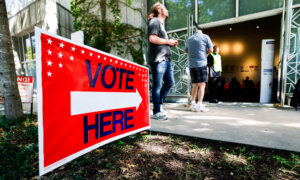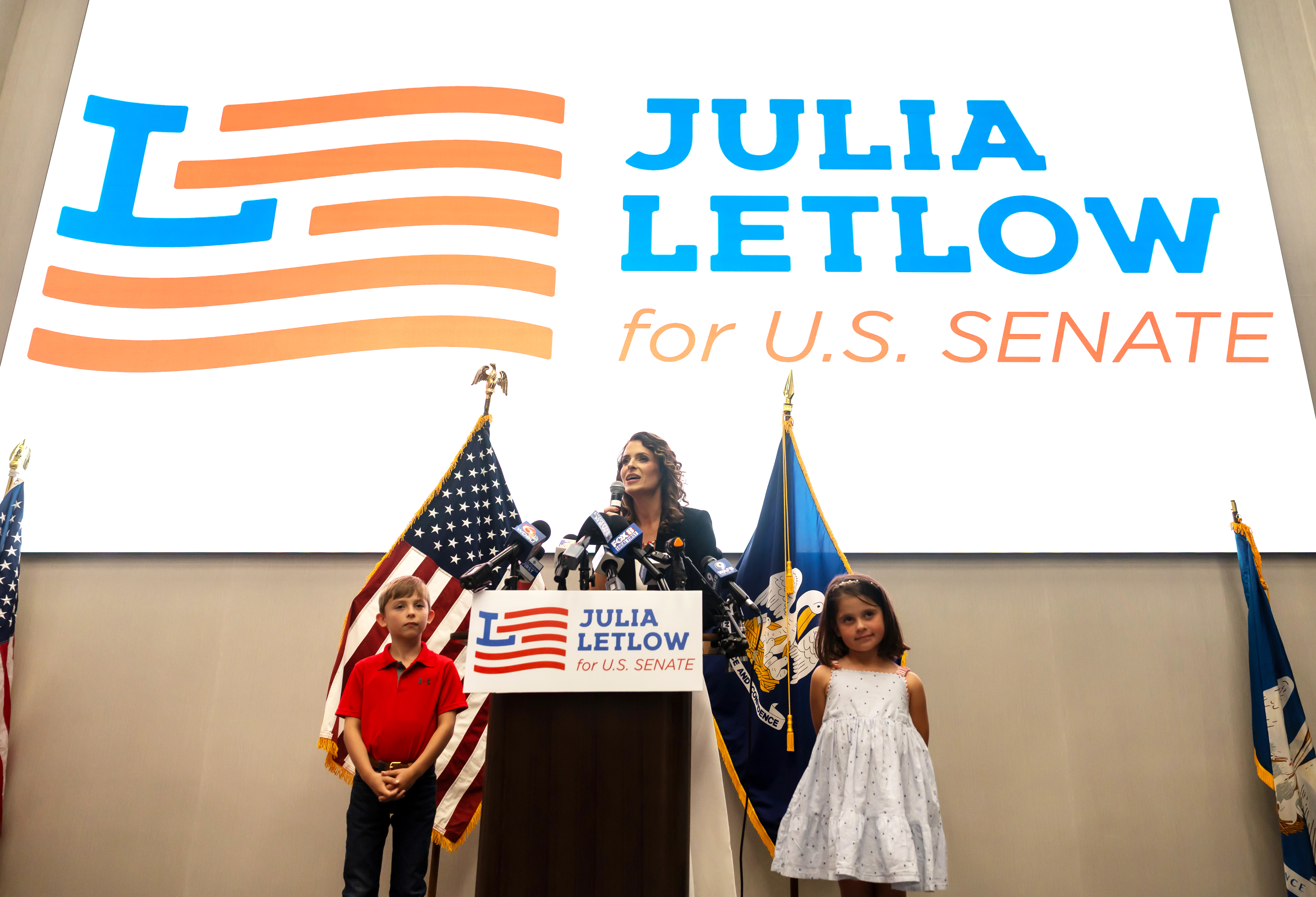
Rep. Julia Letlow (R-La.) and Louisiana Treasurer John Fleming ousted incumbent Sen. Bill Cassidy (R-La.) in the Republican primary election in Louisiana on May 16.
Letlow won more than 44.8 percent of the vote, while Fleming received 28.3 percent and Cassidy received 24.8 percent, according to the results after 99 percent of the votes were tallied.
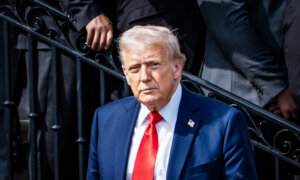
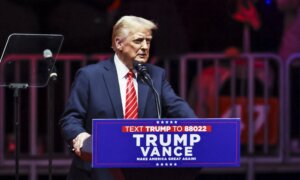
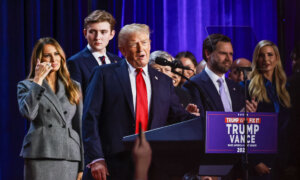
“Congratulations to Congresswoman Julia Letlow on a fantastic race, beating an Incumbent Senator by Record Setting Numbers,” President Donald Trump wrote on Truth Social on the night of May 16.
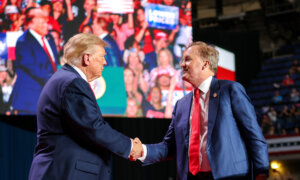
Trump endorsed Letlow in January, before she launched her campaign, in a bid to dislodge Cassidy. He called the incumbent senator disloyal in a social media post on the morning of May 16 for running on a Trump platform and then voting to impeach the president.
Letlow, Fleming Advance
Letlow and Fleming will face off in a runoff election on June 27 since neither received more than 50 percent of the vote.
The winner of the runoff will likely go on to represent the state in the U.S. Senate. The Republican-leaning state has not had a Democratic senator since 2015.
Both candidates have emphasized their alignment with the White House.
During the campaign, Letlow described herself as a “conservative fighter” who would be more loyal to administration priorities than Cassidy had been perceived to be due to a series of high-profile splits with Trump over the past several years.
“Louisiana made it clear tonight: we are ready for strong conservative leadership that will stand with President Trump and never waver,” Letlow’s campaign said in a statement after the election.
Speaking at her victory party after the primary, Letlow described Trump as “the best president this country has ever had.” Cassidy’s past vote to impeach him, Letlow said, was “a sign that he had turned his back on the Louisiana voters.”
Likewise, Fleming cited positive comments from Trump—who called Cassidy’s primary opponents “two great people”—in a post on X, writing, “Thanks for the kudos President Trump.”
Fleming has framed his campaign as being the most conservative in the race.
However, Letlow’s endorsement from the president offers a steep advantage, and Letlow is seen as the race’s front-runner.
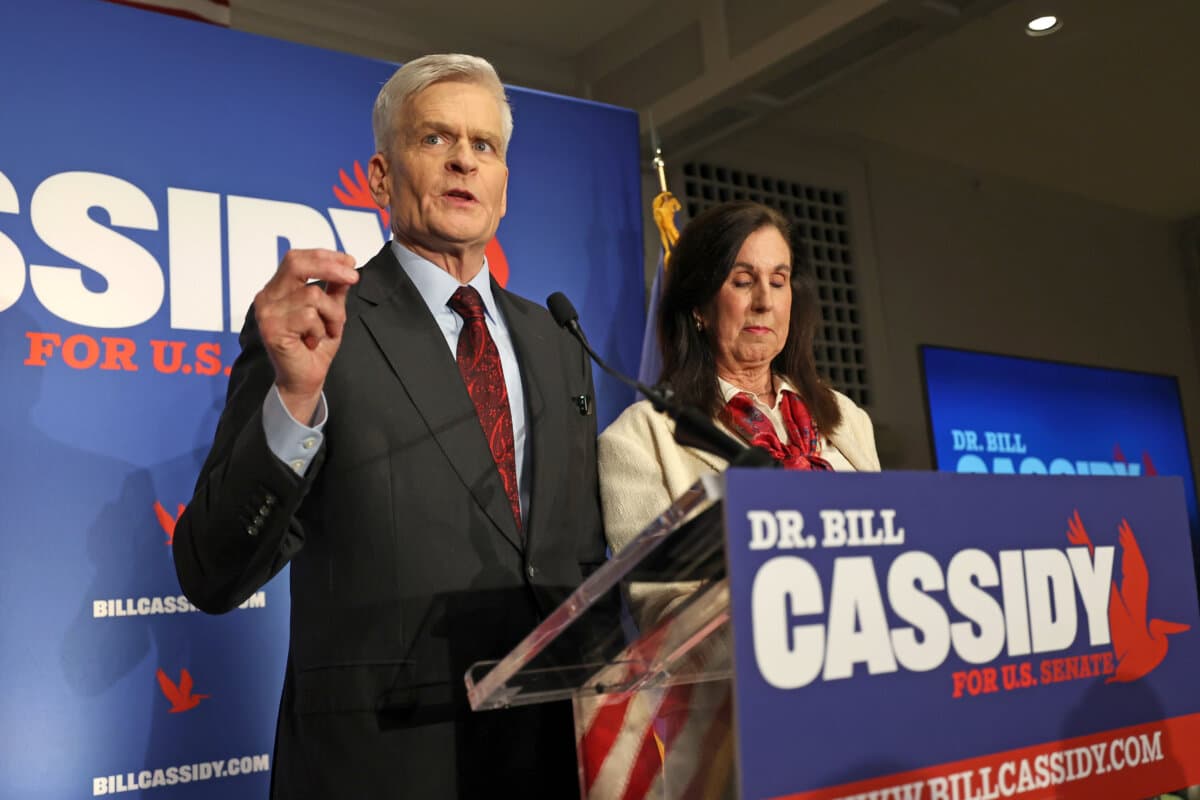
Sen. Bill Cassidy (R-La.), with his wife, Dr. Laura Cassidy, by his side, addresses his supporters as he concedes his primary election contest during an event at Boudreaux's Caterers in Baton Rouge, La., on May 16, 2026. (Michael DeMocker/Getty Images)
Cassidy and Trump
Although Trump endorsed Cassidy’s previous reelection bid in 2020, the two men have been politically divided—often publicly—since January 2021.
Cassidy was one of seven Republican senators who voted to impeach Trump after the breach of the U.S. Capitol on Jan. 6, 2021. Trump was ultimately acquitted by the Senate, and Cassidy has maintained that he is an effective ally to the president and the party despite their past differences.
Aside from Cassidy, only two of those seven—Sens. Lisa Murkowski (R-Alaska) and Susan Collins (R-Maine)—are still in the Senate. Others have left office rather than face the long odds of a head-to-head contest against a Trump-backed opponent.
However, Cassidy—who entered office in 2015—has also had more recent disputes with the president.
Cassidy is chairman of the Senate Health, Education, Labor, and Pensions Committee, leading the panel during Health Secretary Robert F. Kennedy Jr.’s confirmation hearing.
Cassidy, a doctor, had long sparred with Kennedy over the safety of infant vaccinations and whether they can lead to the development of an autism spectrum disorder. During Kennedy’s confirmation hearing, Cassidy considered opposing Kennedy, but voted to support him after the two agreed on several commitments.
One of those was a demand from Cassidy that the Centers for Disease Control and Prevention retain language on its website stating that vaccines do not cause autism.
Late last year, the Centers for Disease Control and Prevention altered its autism and vaccines page to add a statement that reads, “The claim ‘vaccines do not cause autism’ is not an evidence-based claim because studies have not ruled out the possibility that infant vaccines cause autism.”
The pre-Kennedy phrase “vaccines do not cause autism” remains at the top of the page with an asterisk. A note at the bottom of the page states, “The header ‘Vaccines do not cause autism’ has not been removed due to an agreement [with Cassidy].”
Cassidy was also accused by Trump of blocking former surgeon general nominee Casey Means, whose nomination the president withdrew in favor of radiologist Nicole Saphier. Trump questioned Cassidy’s loyalty following that swap.
A group aligned with Kennedy committed $1 million to help Letlow defeat Cassidy.
Cassidy Concedes
Several Republicans who have sparred with Trump in the past—including former Sen. Pat Toomey (R-Pa.), former Sen. Mitt Romney (R-Utah), and Sen. Thom Tillis (R-N.C.)—have forgone a reelection bid entirely.
Cassidy, meanwhile, outraised both of his opponents during the election cycle.
However, he always faced long odds in a state that Trump won by 22 points in 2024.
Speaking after the election, Cassidy defended his past votes and conflicts with the administration, saying that his primary focus was his obligation to the people of Louisiana.
He told his supporters: “Our country is not about one individual. It is about the welfare of all Americans, and it is about the Constitution.
“It is the welfare of my people and my state and my country and my Constitution to which I am loyal. And if someone doesn’t understand that and attempts to control others through using the levers of power, they’re about serving themselves. They’re not about serving us. And that person is not qualified to be a leader.”
The Louisiana primary was upended by an April 29 U.S. Supreme Court decision that invalidated part of the Voting Rights Act.
Although state leaders decided to postpone the U.S. House primaries until the district lines are redrawn, the U.S. Senate primary proceeded as planned.