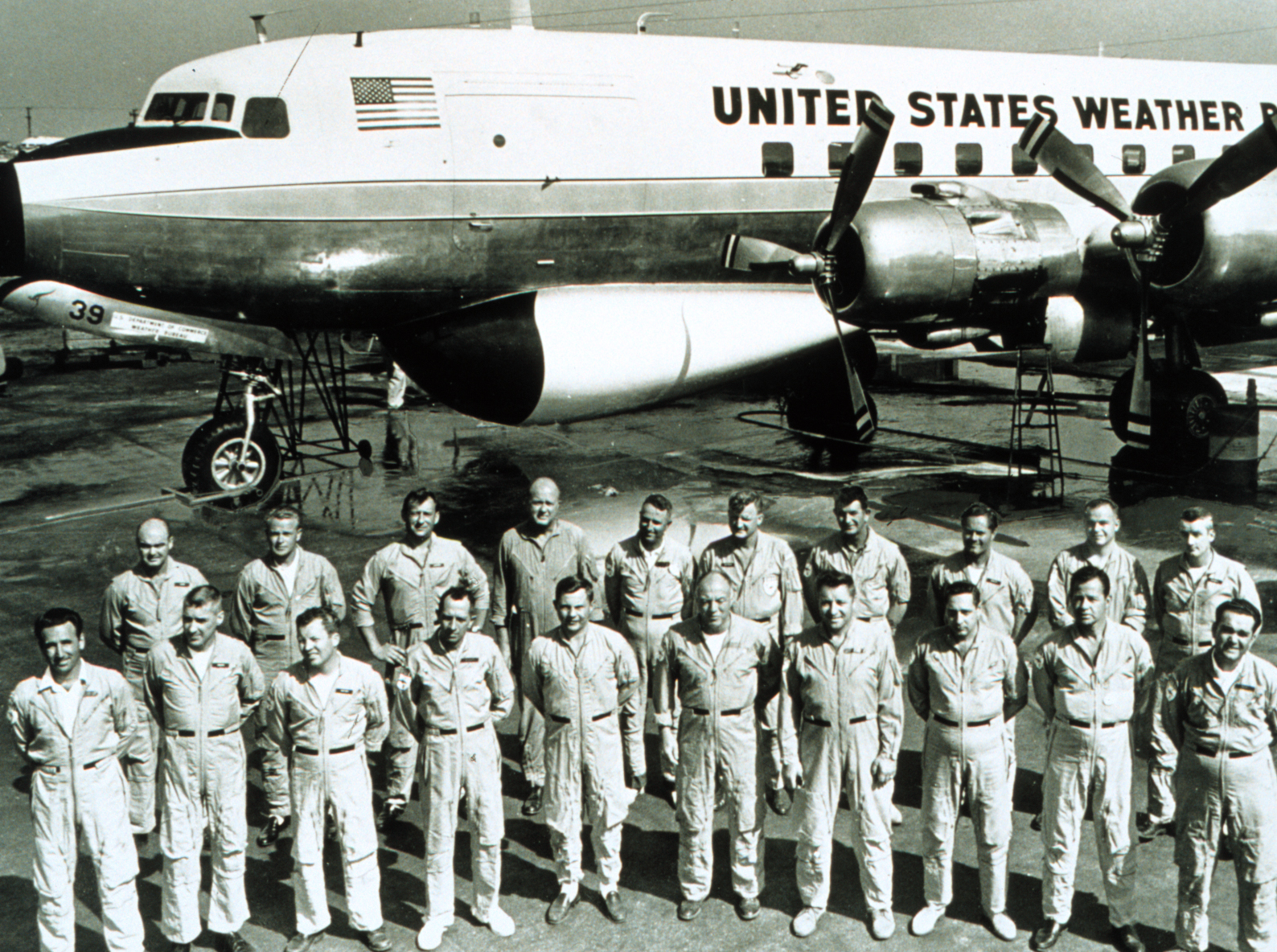
“There was a roaring hammering of the rain on the airframe, a wild roar.” That is how one United States Navy pilot described flying into a hurricane. The hurricane is one of the most destructive of all natural phenomena and one that pilots would seem to avoid at all costs. For a select number of pilots, though, piercing the violence of the hurricane was their mission.
In 1943, the U.S. Navy, Army Air Forces, and Weather Bureau coordinated to establish Miami Joint Hurricane Central in order to track and study hurricanes as they developed. It was an early form of an early warning system. For about the first two years, crews flying the four-engine bomber Privateer were sent to conduct reconnaissance missions to surveil the storms. In 1945, Navy Patrol Bomber Squadron 114 was tabbed to be the first designated hurricane reconnaissance squadron.
Considering the danger of flying into a hurricane, flying over the storm would be the most logical route. But these crews were sent for scientific purposes, and, in order to obtain the most meteorological data, the plane needed to fly low. The pilot kept the plane between 300 feet and 800 feet above the ocean.
‘The House of Magic’
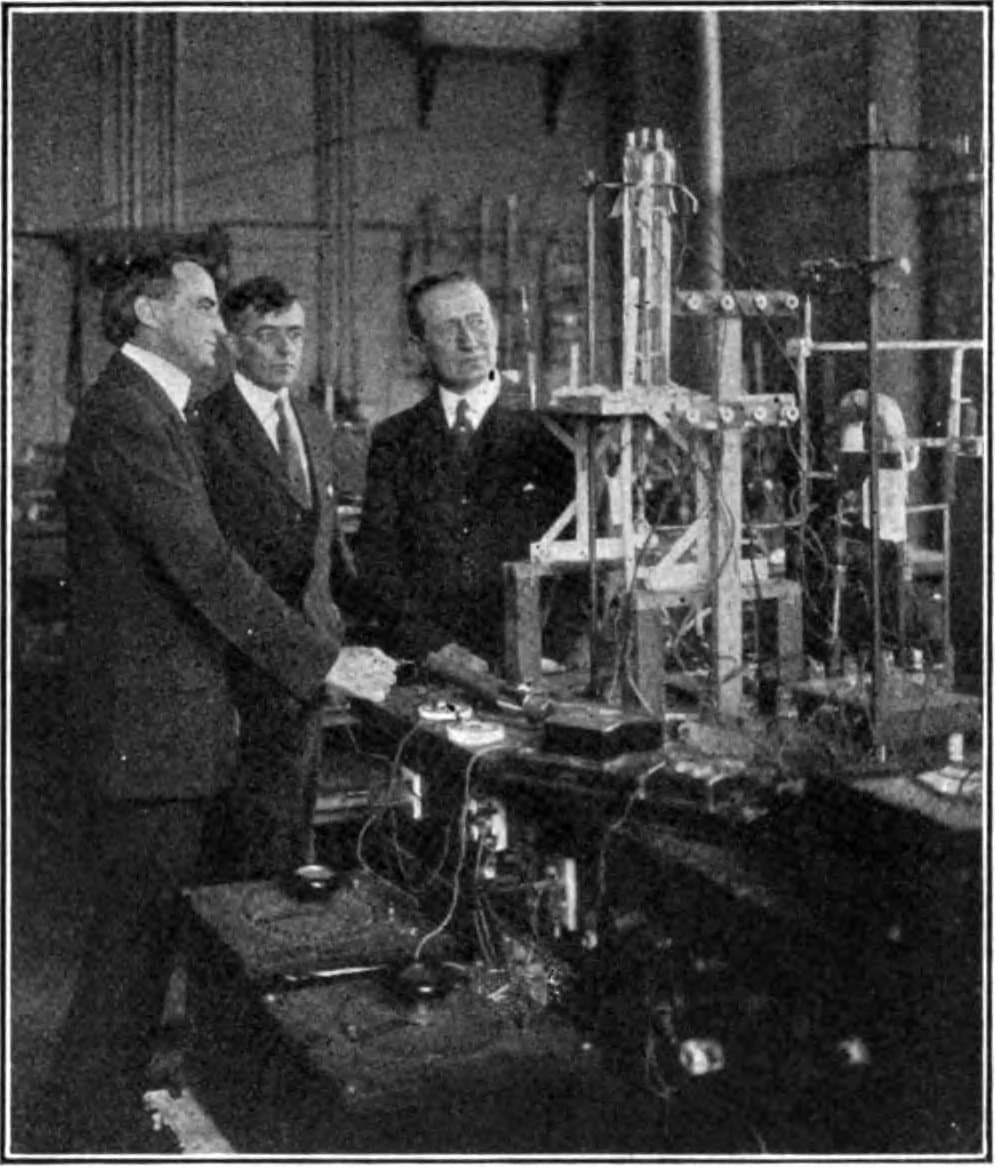
Langmuir (C) in 1922 in his lab at GE, showing radio pioneer Guglielmo Marconi (R) a new 20 kW triode tube. (Pubic Domain)
During this period, three scientists, Irving Langmuir, Vincent Schaefer, and Bernard Vonnegut, were conducting meteorological experiments at the General Electric Research Laboratory. The lab was also called “The House of Magic,” and, from the results of these experiments, it appeared magic was happening. In 1946, Langmuir and Schaefer had successfully converted liquid into ice by inserting dry ice into a cloud containing supercooled water. The same year, Vonnegut was able to produce ice crystals by using smoke that contained silver iodide. Via two different methods of cloud seeding, they made it snow.
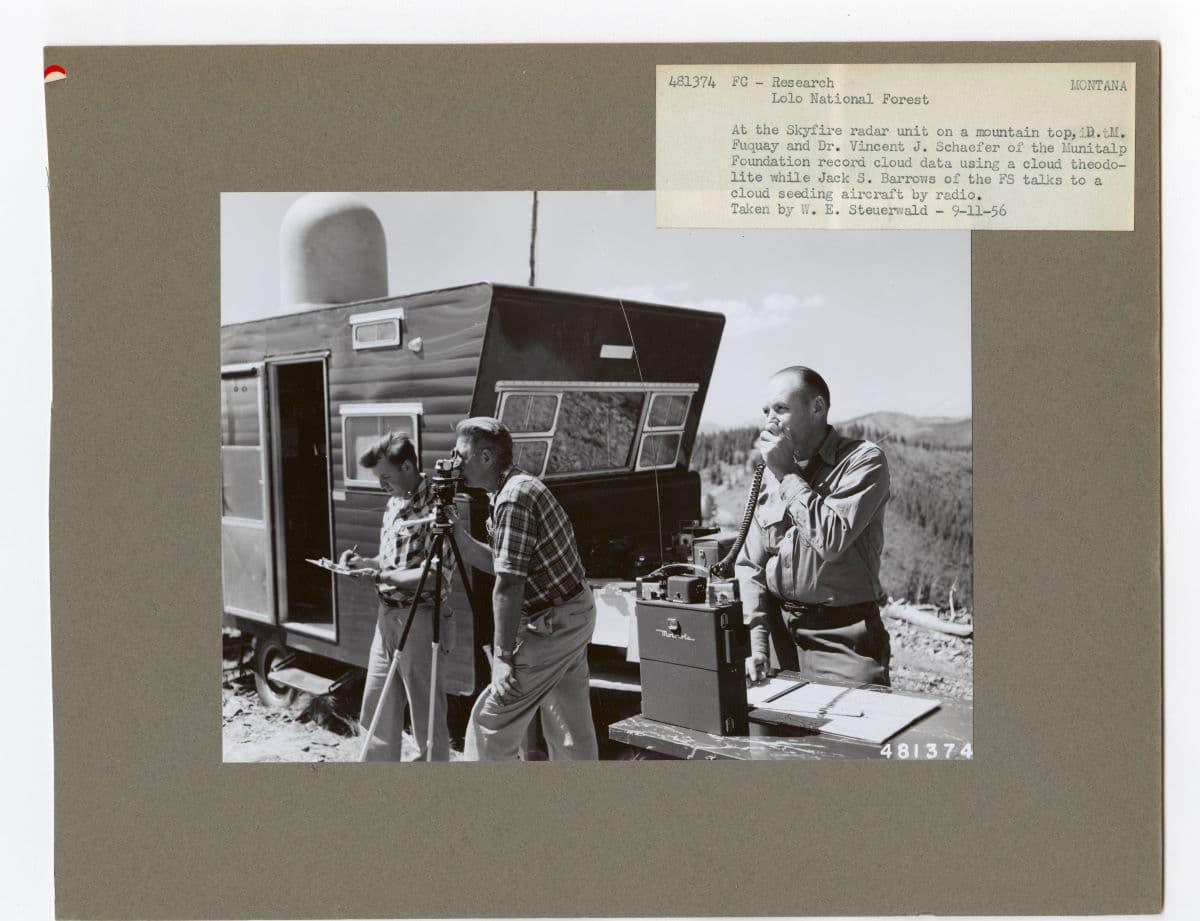
Donald Fuquay and Vincent J. Schaefer (C) record cloud data using a cloud theodolite, while Jack S. Barrows talks to a cloud seeding aircraft by radio. National Archives and Records Administration. (Public Domain)
The door to weather manipulation had been opened.
Schaefer and Langmuir encouraged General Electric (GE) to coordinate with the U.S. military in an effort to seed clouds in the real world. An agreement was made between GE and the Naval Research Laboratory and Army Signal Corps. The agreement was called Project Cirrus, and, for about a year, the focus was on cloud seeding. But as the 1947 hurricane season approached, the scientists broached the possibility of seeding a hurricane.
Losing the King
In October 1947, a hurricane had moved up from the Caribbean Sea through the Florida Straits. Hurricane King had nicked the western portion of Cuba and the southern tip of Florida but was now moving away from the coast into the Atlantic. Monitoring the hurricane’s movements, the scientists believed it was far enough away from land and were given permission to pursue the storm.
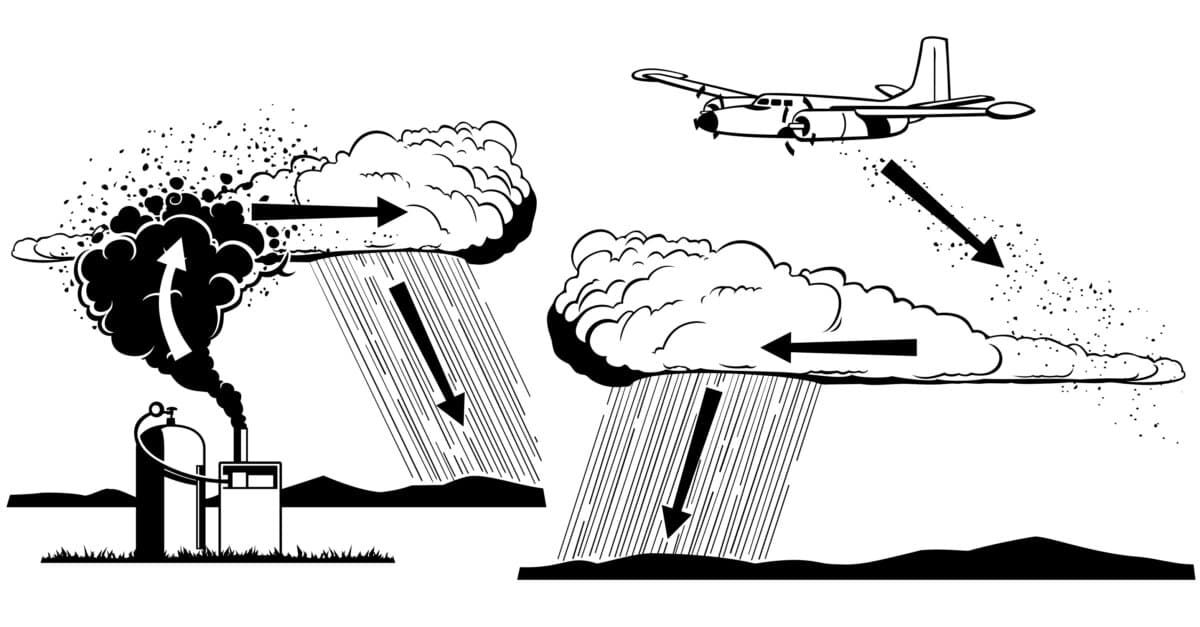
Cloud seeding can be done by ground generators or planes. (Public Domain)
On Oct. 13, 1947, two B-17s and a B-29 bomber soared toward Hurricane King, which was, by this time, about 400 miles off the Florida coast. Instead of “low-level penetration,” one of the B-17s would fly at cloud-top level, open a hatch, and pour 80 pounds of crushed dry ice into the hurricane. After the first run, the B-17 conducted a second run, dropping two 50-pound loads of ice.
The other B-17 was stationed about a half-mile behind and 3,000 feet above the seeding plane, with its crew watching for any cloud changes. The B-29, where Schaefer was stationed, kept an eye on the storm. After the first run, clouds on the lower deck of the storm seemed to break apart. The second run seemed to cause the cloud top to grow. Satisfied with their efforts, the crews returned to base and planned to revisit the storm the following day.
When the three bombers flew out into the Atlantic, tracing the course they had predicted the hurricane would take, Hurricane King was nowhere to be found. What had happened was the thing of nightmares. The hurricane had completely altered course and instead of continuing out over the ocean, it stormed toward Savannah, Georgia, where it caused about $2 million in damage (about $30 million today) and caused one death due to the storm surge. The storm finally died out in Alabama.
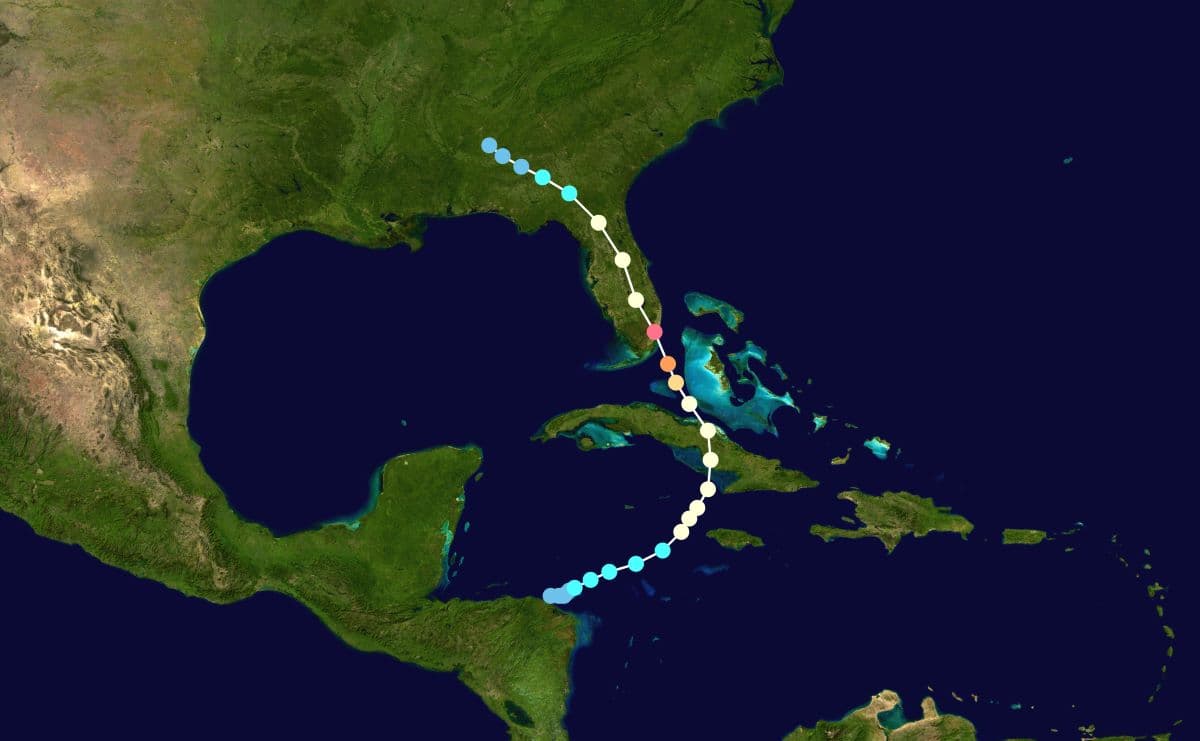
Track map of Hurricane King of the 1950 Atlantic hurricane season. The points show the location of the storm at six-hour intervals. (Public Domain)
All-In for Cirrus
The country, specifically the South, was outraged by reports that the government had conducted seeding experiments on the hurricane. Lawsuits were threatened. Southern media called it a “low Yankee trick.” Project Cirrus received more bad publicity when Langmuir, a 1932 Nobel laureate, issued a statement saying he was “99 percent sure” the hurricane’s alteration was due to the experiment. Fortunately for the project and GE, Francis Reichelderfer, chief of the Weather Bureau, was able to provide charts of previous hurricanes that had followed King’s path.
Project Cirrus continued. Bad publicity and erroneous media stories forced the Department of Defense (DoD) to issue its first official explanatory statement on July 19, 1950. This official statement came five days after Langmuir wrote an article in Science magazine, in which he claimed that if a single pellet of dry ice was shot into a cloud, it would produce rain. Producing rain was one thing, but stopping a hurricane?
“I believe the time is ripe for an intensive study of tropical hurricanes,” Langmuir wrote. “It is highly probable that by using silver iodide generators at sea level in regions where large clouds first begin to grow into incipient hurricanes, the hurricanes can be modified and even prevented from reaching land.”
Langmuir began barnstorming for Project Cirrus, even resigning his position as a trustee of New York’s State University, in which he explained in his Feb. 7 resignation letter to Gov. Thomas Dewey that “Project Cirrus has grown very greatly in importance, and now I believe that the best service that I can render to the national welfare is to increase rather than decrease my activities in this field.”
Replacing Cirrus
GE and the DoD may or may not have been in complete agreement with Langmuir’s hurricane claims, but they apparently agreed that more intensive study was needed. They acknowledged the difficulties that lay ahead,
stating that “atmospheric processes are in a continual state of flux and it is difficult, if not impossible, to obtain two identical weather situations for a control experiment.” They would need more time and more hurricanes.
Between 1948 and 1950, Project Cirrus had conducted more than 150 flights. But those numbers soon dwindled. The project’s scientific progress had slowed, public support had waned, and the Korean War, which began in June 1950, required many of the nation’s pilots. By September 1952, GE had pulled its support, citing its “House of Magic” had gone as far as it could.
In July 1953, the Korean War ended. Pilots returned home. This freed up federal monies. But there was still little public support. That is until six hurricanes—Carol, Edna, Hazel, Connie, Diane, and lone—made landfall over the course of 1954 and 1955. The hurricanes caused nearly 400 deaths and $1.7 billion in damages (more than $21 billion today).
Congress decided to put more money into hurricane research, mandating the Weather Bureau establish the National Hurricane Research Project (NHRP).
Although Langmuir died shortly after Congress provided the funds, his work, as well as that of Schaefer and Vonnegut, were useful, especially in NHRP’s efforts to decrease the strength of hurricanes by seeding. The NHRP theorized that the seed target should be the eye wall of the storm. The theory suggested that the eye wall contained supercooled water, and that if silver iodine could be placed in the wall, it would perturb to “trigger the inertial instability and cause outward migration of the eye wall, leading to reduction of the maximum wind.” The theory was called Stormfury.
The Promise of Stormfury
In 1961, the NHRP got its chance to test the theory. On July 12, NASA launched TIROS III, a meteorological satellite. Although one of its two cameras failed after 12 days in flight and was only operational for 230 days, it hovered above Earth long enough to send back images of Hurricane Esther on Sept. 10.
The U.S. Navy and the Weather Bureau prepared their planes to meet the storm. It was during this week in history, on Sept. 16, 1961, that the aircraft soared to Hurricane Esther. As the crews dumped eight canisters of silver iodide into the hurricane’s eye wall, the radar on one of the Weather Bureau’s planes detected a weakening in the eye wall and a decrease in wind speed of 10 percent. The following day, the Navy planes made another attempt, but happened to pour the silver iodide into the eye, missing the wall. No change in the storm’s behavior was detected.

Eye of Hurricane Esther viewed from Hurricane Hunter Plane. National Oceanic Atmospheric Administration. (Public Domain)
Both the Weather Bureau and the Department of Defense were satisfied with the experiment and began formal cooperation in 1962 called Project Stormfury. In 1963, Project Stormfury got its first official opportunity with Hurricane Beulah. The results were again promising, as there was a 20 percent decrease in wind speed after seeding.
The meteorological project continued until 1983. Altogether, Project Stormfury conducted eight days of testing on four hurricanes: Esther (1961), Beulah (1963), Debbie (1969), and Ginger (1971).
A 1970 report by the NHRB stated, “Results from Hurricane Debbie modification experiments on 18 and 20 August 1969 are so encouraging as to offer hope that man may one day exert a degree of control over the intensity of these devastating storms that originate over the tropical oceans.”
Not for Nothing
But as the 1970s gave way to the 1980s, and as more data was collected on seeded and unseeded hurricanes, scientists observed that most hurricanes do not have enough supercooled water to make seeding effective and concluded that seeded and unseeded hurricanes acted too similarly to suggest seeding had any transformative effect.
“Though most scientists remain skeptical about controlling weather, Projects Cirrus and Stormfury still made important contributions to the field of meteorology,” noted Sam Kean, a prominent science writer. “The thousands of seeding runs helped scientists piece together how storms behave, work that has produced better forecasts and thus saved innumerable lives: Despite an exploding U.S. coastal population, the likelihood of dying from a hurricane now is 1/100th the likelihood in 1900.”
Never miss a This Week in History story! Sign up for the American History newsletter here.
What arts and culture topics would you like us to cover? Please email ideas or feedback to features@epochtimes.nyc.