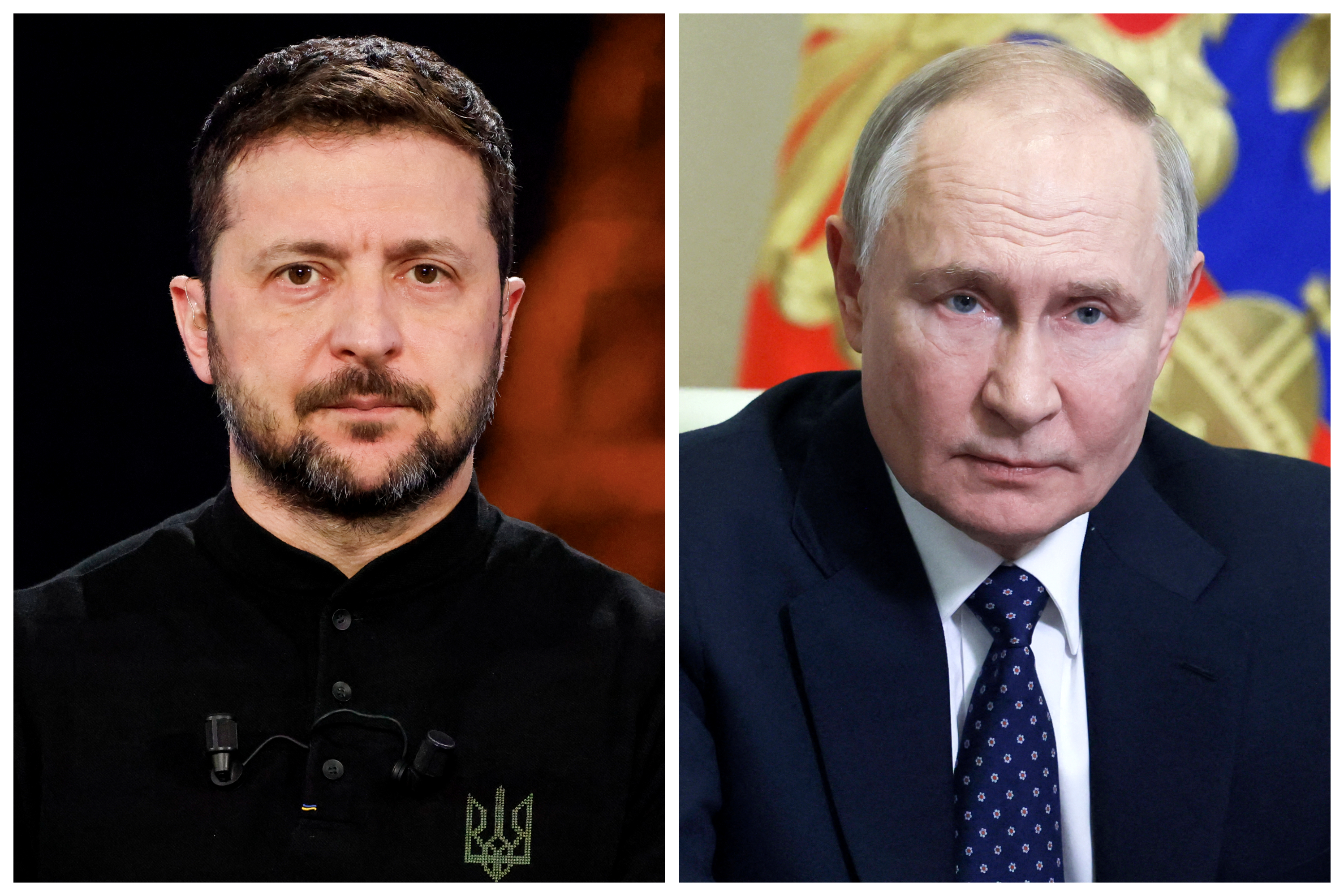
Discussions involving Washington, Moscow, and Kyiv have continued apace since U.S. President Donald Trump unveiled his proposed peace plan in November to bring the war between Russia and Ukraine to a close.
Meetings in Florida, Geneva, and Moscow have taken place as the parties try to thrash out acceptable terms for a cessation of hostilities that has raged since 2022.
Here’s what we know about where the talks stand so far.
The Original Plan
The
original plan was drafted by the U.S. special envoy for peace missions, Steve Witkoff, and Secretary of State Marco Rubio, who have been working on it quietly for the past month, White House press secretary Karoline Leavitt
told a Nov. 20 news briefing.
It had 28 points covering an array of topics, including territory, the military, future international relations, post-war reconstruction funding, and internal politics, according to The Associated Press.
The first three points confirm Ukraine’s sovereignty, a comprehensive non-aggression agreement to be concluded between Russia, Ukraine, and Europe, the expectation that Russia will not invade its neighbors, and an end to NATO expansion.
Parts of the plan included provisions for Ukraine to cede the regions of Crimea, Luhansk, and Donetsk to Russia, and for Kherson and Zaporizhzhia to be frozen along the line of contact, effectively granting de facto recognition.
It also included a provision that Ukraine would enshrine in its constitution a commitment not to join NATO, and that the alliance would add a statute barring Ukraine from future membership. Kyiv would still have the opportunity to join the European Union, should it meet the entry requirements.
Both points run counter to the previously stated aims of Ukraine and several NATO member states. The plan would also cap the size of Ukraine’s armed forces at 600,000 and allow Russia to rejoin the G8.

Ukrainian servicemen fire with a French self-propelled 155 mm/52-calibre gun Caesar towards Russian positions at a front line in the eastern Ukrainian region of Donbas on June 15, 2022. (Aris Messinis/AFP via Getty Images)
Negotiations
After the draft plan was revealed on Nov. 20, bilateral negotiations between Washington and Moscow, and between Washington and Kyiv, have taken place, but no direct meeting between Russia and Ukraine has occurred.
American and Ukrainian representatives met for discussions in Geneva, Switzerland, in November. They also met in Florida in December. Ukrainian President Volodymyr Zelenskyy did not attend either event.
Separately, a meeting was held in Moscow on Dec. 2 with representatives from Washington. Russian President Vladimir Putin was in attendance.
Russia’s Position
Putin
described his meeting with Witkoff and Trump’s son-in-law Jared Kushner as “very useful” in comments reported by Russian state news agency TASS on Dec. 4, but added that reaching a consensus would be difficult.
“Getting the conflicting parties to reach some kind of consensus is no easy task,“ he said. ”But President Trump is really, I am sure of this, sincerely trying to do this.”
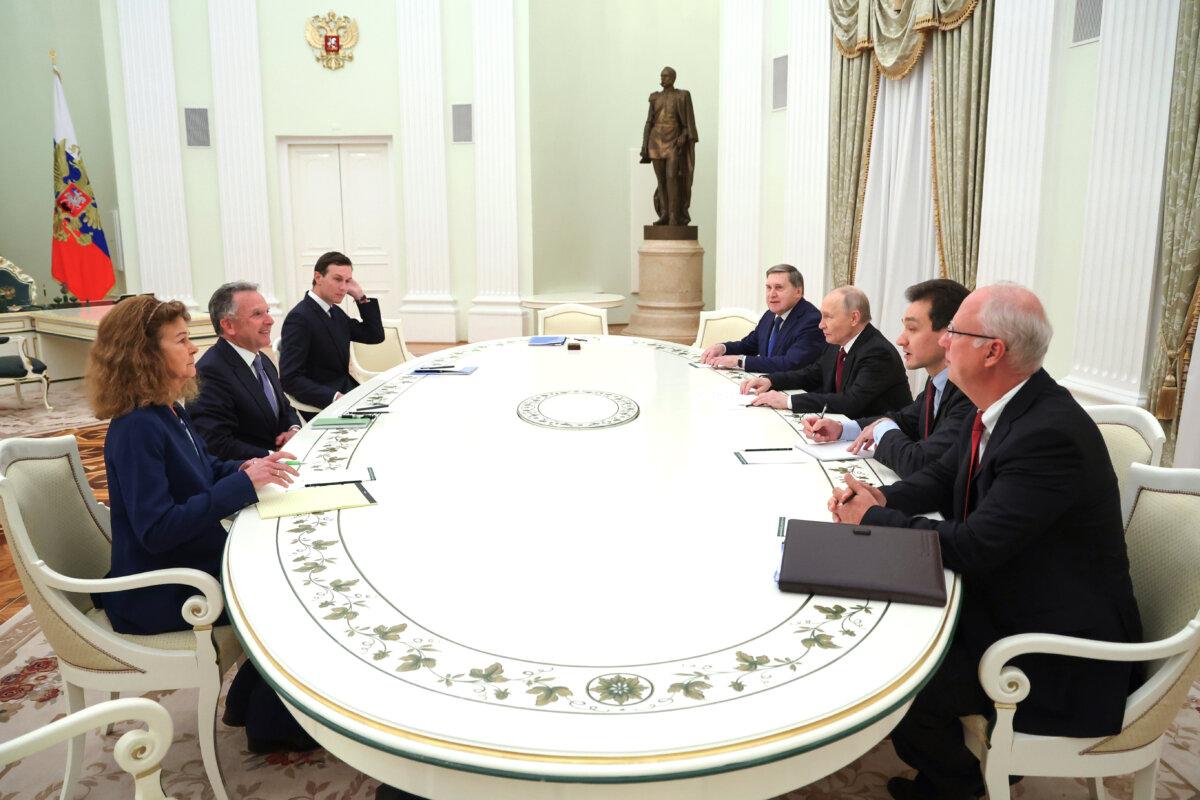
Russian President Vladimir Putin (3rd R), Russian Presidential foreign policy adviser Yuri Ushakov (4th R), and Russian Direct Investment Fund CEO Special Presidential Representative for Investment and Economic Cooperation with Foreign Countries Kirill Dmitriev (R) attend talks with U.S. special envoy Steve Witkoff (2nd L), and Jared Kushner, U.S. President Donald Trump's son-in-law (3rd L), at the Senate Palace of the Kremlin in Moscow, Russia, on Dec. 2, 2025. (Alexander Kazakov/Sputnik via AP)
Putin said that the 5-hour Kremlin meeting, which included himself, Witkoff, Kushner, and a couple of the Russian president’s aides, lasted so long because they went through each of the 28 points the United States has put forward in its proposed peace plan.
He said that the plan was broadly based on the agreements he and Trump had made during their August summit in Alaska, but that the issue of territory remained a prominent sticking point.
Discussing the issue of the Donbas territories of Donetsk and Luhansk in Ukraine, Putin said that Moscow had proposed that Kyiv withdraw its armed forces from the region before the full-scale war broke out, which he argued would have prevented the war.
“Everything comes down to this. Either we will liberate these territories by military means, or Ukrainian forces will leave these territories and stop fighting there,” Putin said on Dec. 4, according to TASS.
Ukraine views the territories as its own, as does the bulk of the international community.
Ukraine’s Position
Ukraine, and many of Kyiv’s European allies, initially greeted the news of the peace plan with some surprise and discomfort.
“Ukrainians want peace - a just peace that respects everyone’s sovereignty, a durable peace that can’t be called into question by future aggression,” French Foreign Minister Jean-Noel Barrot said on Nov. 20. “But peace cannot be a capitulation.”
On Nov. 23, Washington and Kyiv said they had “updated and refined” the peace framework to end the war during talks in Geneva, Switzerland, following criticism that the initial proposal was too favorable to the Kremlin.
Those talks were followed by further meetings in Miami, Florida, on Dec. 5 and Dec. 6, just days after Witkoff and Kushner met with Putin in Moscow.
During the discussions, Witkoff said both parties agreed that real progress toward an end to the war depends on Russia’s readiness to commit to long-term peace, such as deescalation and cessation of attacks.
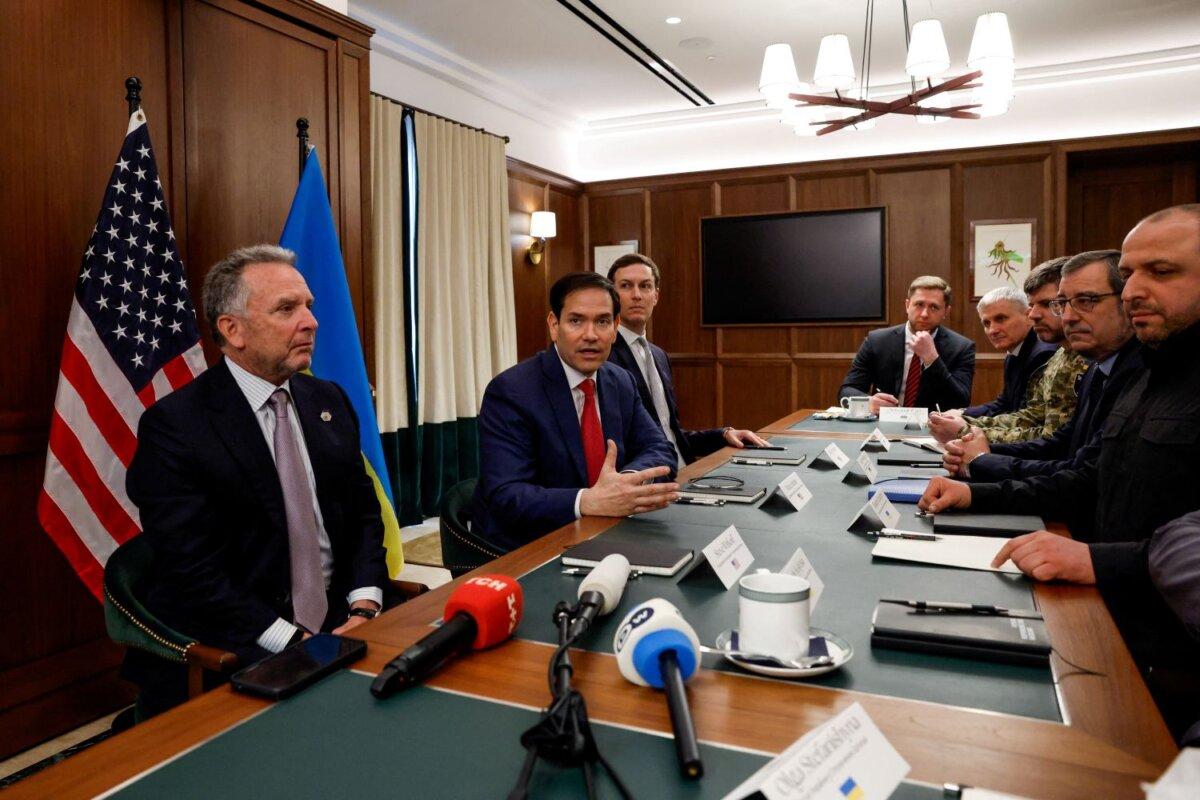
U.S. Special Envoy Steve Witkoff (L), U.S. Secretary of State Marco Rubio (2nd L), and U.S. President Donald Trump's son-in-law Jared Kushner (3rd L) meet with Secretary of Ukraine's National Security and Defence Council Rustem Umerov (R) and other members of a Ukrainian delegation in Hallandale Beach, Florida, on Nov. 30, 2025. (Eva Marie Uzcategui/Reuters)
Zelenksyy was briefed on the Dec. 8 discussions by Ukraine’s top negotiator, Rustem Umerov. He said later that day that Kyiv would share its revised peace plan with the United States on Dec. 9.
He said that the current 20-point version differs from earlier iterations because “obvious anti-Ukrainian points” were removed.
“The mood of the Americans, in principle, is for finding a compromise,” he said. “Of course, there are complex issues related to the territory, and a compromise has not yet been found there.”
Trump’s Remarks
Regarding Russia, Trump
said on Dec. 3 that he had spoken with Witkoff and Kushner about their meeting with Putin, and had come away believing Russia wanted to bring hostilities to a close.
“Their impression was that ... he would like to see the war ended,” he told reporters. “I think he’d like to get back to dealing a more normal life. I think he’d like to be trading with the United States of America, frankly, instead of ... losing thousands of soldiers a week.”
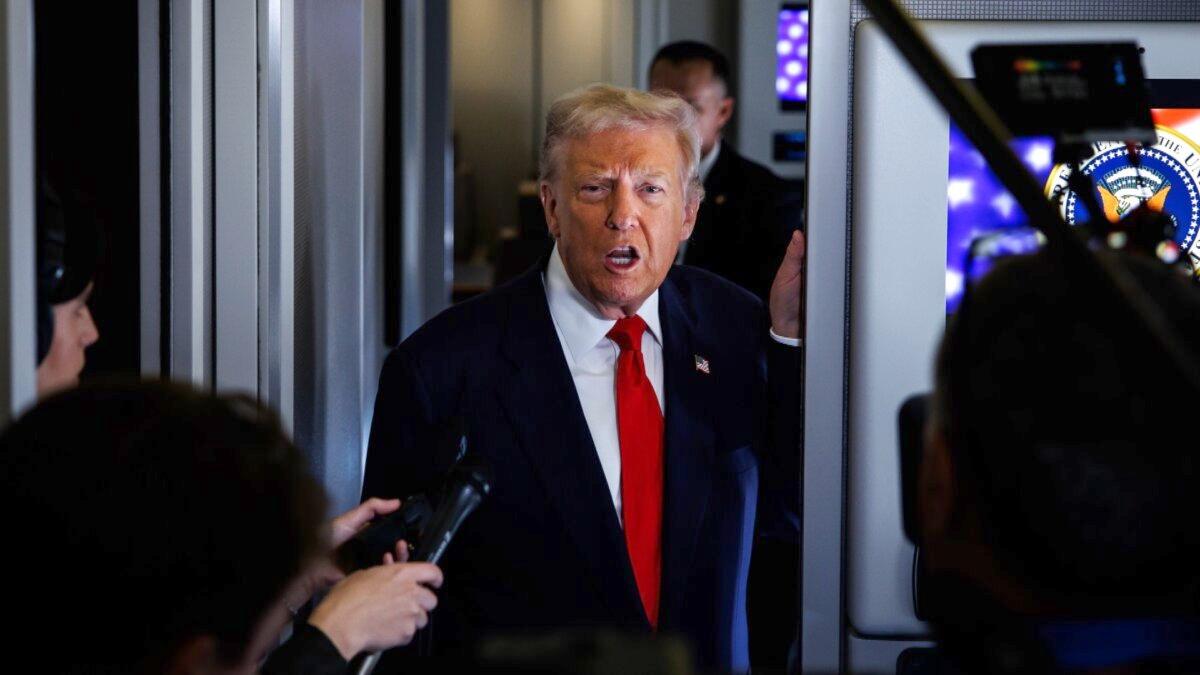
U.S. President Donald Trump speaks to members of the media on board Air Force One at Joint Base Andrews, Md., on Oct. 31, 2025. (Samuel Corum/Getty Images)
Trump said on Dec. 7 he was “a little bit disappointed” Zelenskyy had not, at that point, read the proposal that had been written in Miami during the previous weekend.
“Russia is, I believe, fine with it, but I’m not sure that Zelenskyy’s fine with it. His people love it, but he hasn’t read it,” he said ahead of hosting the Kennedy Center Honors in Washington.