
International attention has turned to the island nation of Cuba as tensions surrounding the nation and its communist regime rise.
Our latest poll shows that readers largely support U.S. intervention on the part of the Cuban people.
On March 17, U.S. Secretary of State Marco Rubio called for a dramatic change in Cuba’s communist leadership, as the nation suffers its third nationwide blackout in four months.
“Cuba has an economy that doesn’t work and a political and governmental system that can’t fix it,” said Rubio, who is of Cuban descent. “So we’ve got some big decisions over there.”
A Cuban official said the day before Rubio’s comments that the country is open to trading with U.S. companies, but Rubio responded that “they have to change dramatically” for a trade deal to move forward.
Gen. Francis Donovan, head of U.S. Southern Command, said on March 19 that the U.S. military is not rehearsing for an invasion of Cuba or actively preparing to take over the island.
However, according to Donovan, the United States is ready to defend its naval base at Guantanamo Bay in Cuba, to address any threats to the U.S. Embassy, and to support White House efforts to address any mass migration from the island, if needed.
Readers support freedom and regime change in Cuba, and believe it could be advantageous for the United States.
Help for Cuba
President Donald Trump recently floated the idea of possibly taking over the country, which is home to roughly 11 million people and sits less than 100 miles from Florida’s nearest point.
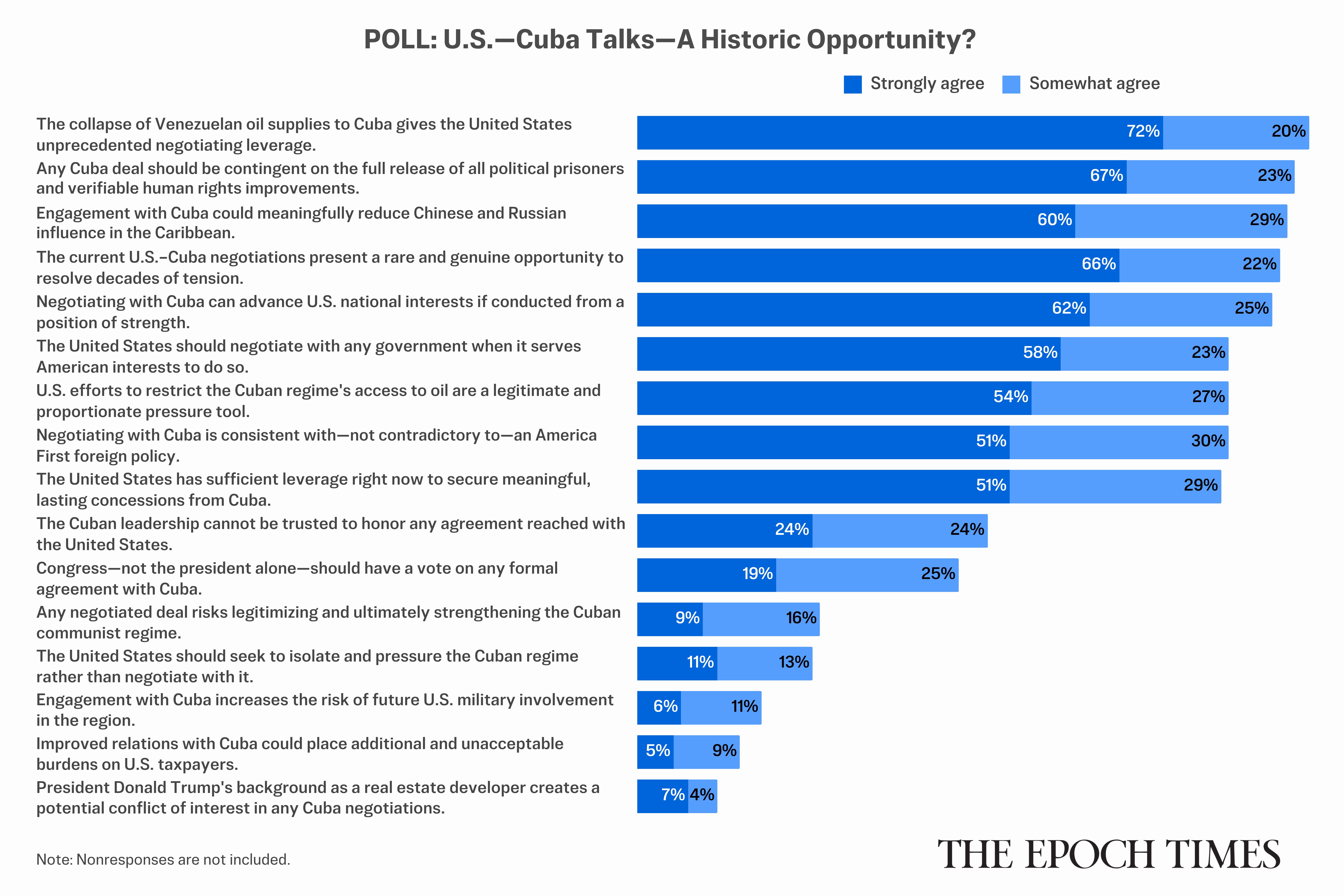
Fully 88 percent of those polled believe that the current U.S.-Cuba negotiations present a rare and genuine opportunity to resolve decades of tension.
Around 37 percent disagreed that any negotiated deal risks legitimizing and ultimately strengthening the Cuban communist regime. Another 28 percent are mixed or neutral on the subject.
Almost half (48 percent) of readers believe that the Cuban leadership cannot be trusted to honor any agreement reached with the United States. Thirty percent have neutral or mixed opinions on the subject.
A whopping 90 percent of those polled think that any Cuba deal should be contingent on the full release of all political prisoners and verifiable human rights improvements.
Eleven percent think that Trump’s background as a real estate developer creates a potential conflict of interest in any Cuba negotiations. Another 10 percent had mixed or neutral opinions, while 71 percent didn’t see this as a concern.
US Interests
Many of those polled believe it is most important that the United States government put the interests of the American people first.
A large majority (87 percent) believes that negotiating with Cuba can advance U.S. national interests if conducted from a position of strength.
Eighty-one percent of readers believe that negotiating with Cuba is consistent with—not contradictory to—an America First foreign policy. The same percentage thinks that the United States should negotiate with any government when it serves American interests to do so.
Around 44 percent of those who took the poll believe that Congress—not the president alone—should have a vote on any formal agreement with Cuba. Another 21 percent are mixed or neutral on the subject.
Meanwhile, 14 percent of respondents said they believe improved relations with Cuba could impose additional, unacceptable burdens on U.S. taxpayers. Nearly half of respondents (49 percent) disagreed with this sentiment, while 24 percent were neutral.
A further 17 percent said they are concerned that engagement with Cuba increases the risk of future U.S. military involvement in the region. Over half (51 percent) disagreed with this as a concern, while 25 percent were neutral on the matter.
A large majority (89 percent) believes that engagement with the island nation could meaningfully reduce Chinese and Russian influence in the Caribbean.
Timing of Intervention
In addition to persistent electrical outages, Cubans are also suffering from a commodities supply crisis, including a gasoline shortage.
About 92 percent of respondents agreed that the collapse of Venezuelan oil supplies to Cuba gives the United States unprecedented negotiating leverage, while 24 percent agree that the United States should seek to isolate and pressure the Cuban regime rather than negotiate with it.
The large majority of poll takers (81 percent) believe that U.S. efforts to restrict the Cuban regime’s access to oil are a legitimate and proportionate pressure tool.
And 80 percent believe the United States has sufficient leverage right now to secure meaningful, lasting concessions from Cuba.
When asked, in their view, what the United States’ single most important demand should be in any Cuba negotiation, the responses centered largely on a push for democracy, an end to the communist regime, and concern for human rights and political prisoners.
“The U.S. must demand regime change in any negotiations with Cuba,” one reader stated. “If the communists are left in control following an agreement with the U.S., nothing inside Cuba will change.”
Another wrote that the United States should “demand the exit of current ministers or anyone exercising power in the Cuban government, [specifically] anyone related to the Castro family. This is essential for Cuba to transition to a capitalist economy.”
A number of readers agreed that freedom for the Cuban people should be the top priority: “Freedom for all Cuban people. No more misery and despair,” said one reader, while another said the United States should prioritize the “release of political prisoners and human rights improvements, including allowing freedom of religious practice for Christians.”
Ninety-six percent of respondents reported no direct heritage, personal tie, or connection to Cuba.
The Epoch Times conducted this reader survey on March 18–19, by email and social media, generating 790 responses.