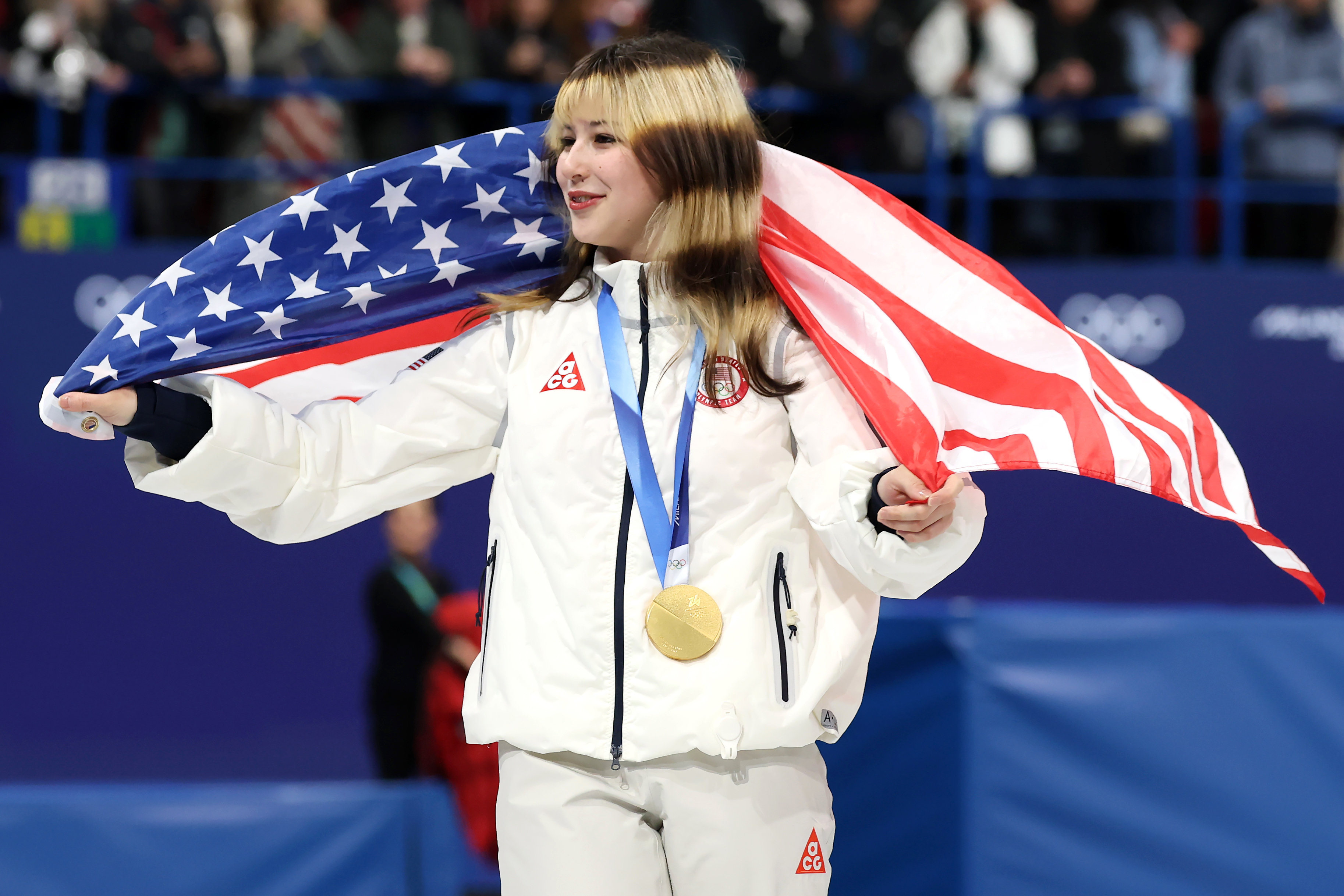

At the Milano Cortina Winter Olympics this month, two U.S.-born athletes of Chinese descent—Alysa Liu representing the United States and Eileen Gu competing for China—have become the focus of an online political storm that extends far beyond sports.
A resurfaced video circulating on X shows the two celebrating their athletic achievements together at a community event when they were young in California.
At the time, Liu was 12 and Gu was 14. Years later, both have become elite athletes, but they now compete under different flags, and increasingly, in the eyes of some commentators, different political camps.
Gu is a freestyle skier, and Liu is a figure skater. Although the two have never faced off in competition, their contrasting paths have taken on symbolic weight amid heightened U.S.–China tensions. Online debates have framed their choices as reflections of broader ideological divides between Washington and Beijing.
Controversy Among Team USA Athletes
The latest stage of the controversy was sparked not by Liu or Gu, but by American freestyle skier Hunter Hess. Hess said publicly on Feb. 6 that representing the United States at the Olympics was complicated for him because he disagrees with President Donald Trump’s immigration policies.
Trump responded on Truth Social on Feb. 8, calling Hess a “real loser.” Gu later expressed support for Hess during an interview, saying that she felt “so much sympathy and empathy” for him.
Her remarks triggered backlash on social media and from some U.S. commentators, who questioned her stance, given that she competes for China. A widely shared post on X by former Trump administration official Theo Wold reads: “In a world of Eileen Gu’s, who sell out their country for cash, be an Alysa Liu.” The post received tens of thousands of likes and reposts.
American columnist and China expert Gordon Chang suggested on X that Gu’s U.S. citizenship can be stripped for declaring her allegiance to China.
Contrasting Careers
Gu was born in San Francisco and competed for Team USA early in her career, winning a gold medal at a 2019 FIS Freestyle Ski World Cup event.
In mid-2019, she announced that she would represent China. At the 2022 Beijing Winter Olympics, she won two gold medals and one silver medal for China. The 22-year-old is competing for China again at the 2026 Winter Olympics and has won a silver medal in slopestyle.
Liu, born in 2005 in Clovis, California, became the youngest U.S. women’s national figure skating champion at age 13. After briefly stepping away from competition at 16, she returned and helped Team USA win gold in the team figure skating event at the Milano Cortina Olympics.
Liu’s father, Arthur Liu, came to the United States in the 1990s after participating in the 1989 Tiananmen Square protests in Beijing and later receiving political asylum. He had publicly revealed that Chinese authorities had approached the family with offers of funding and endorsement opportunities if his daughter would represent China—an offer they declined.
Some Chinese American commentators have praised the Liu family’s decision as an embrace of American values.
Lily Tang Williams, a Chinese American political activist and former Republican congressional candidate in New Hampshire, told NTD, a sister outlet of The Epoch Times, that Chinese Americans broadly fall into two camps: those who strongly identify with American values and those who align more closely with the Chinese Communist Party (CCP) in Beijing.
“It’s about if you embrace American ideals—that we love this country,” she said, suggesting that Gu should live in China and see what it is like over there.
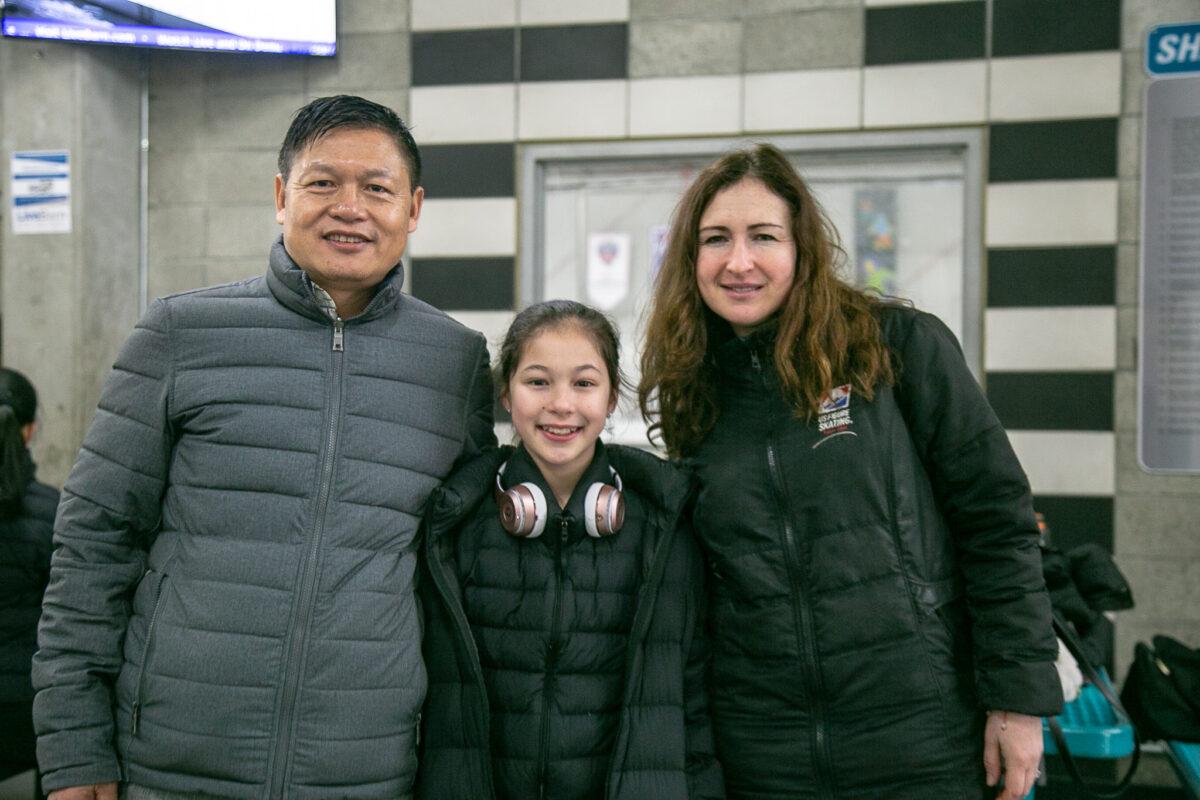
U.S. Olympic figure skater Alysa Liu (C) and her father, Arthur Liu (L). (Cao Jingzhe/The Epoch Times)
Accusations of Double Standards
Gu has faced criticism from some American commentators who accuse her of selectively speaking out.
They note that while she voiced support for anti-Immigration and Customs Enforcement comments from American athletes, she has generally avoided commenting on human rights issues in China, including the detention of Uyghurs or the sexual assault allegations against officials, including those made by tennis star Peng Shuai against former senior CCP official Zhang Gaoli.
Enes Kanter Freedom, a former NBA player known for his human rights activism, wrote in a post on X on Feb. 11 that Gu is a “traitor.”
“She was born in America, raised in America, lives in America, and chose to compete against her own country for the worst human rights abuser on the planet, China,” he wrote. “She built her fame in a free country, then chose to represent an authoritarian regime while cashing in on endorsements linked by watchdog groups to mass detention and forced labor camps.
“When human rights come up, she disappears. That’s not neutrality. That’s a choice.”
Michael Sobolik, a senior fellow specializing in U.S.–China relations at the Hudson Institute, said on X that it is very common for athletes to criticize the U.S. president. However, he questioned the rationale behind Gu’s silence about abuses in China and suggested that she “leverages the freedom [the United States] has given [her] to represent an authoritarian regime.”
“If you criticize America but won’t say a word about the CCP, that says a lot about you,” he wrote.
Gu has previously said that balancing ties between the two countries can be challenging. After narrowly missing gold in Milan, she said she was “carrying the weight of two countries.”
Within China, public criticism of Gu has become increasingly restricted online. Posts on the Chinese microblogging platform Weibo questioning her nationality have been removed quickly, and discussions of her status are considered politically sensitive.
China does not recognize dual citizenship, and the Olympic Charter requires that athletes be nationals of the country they represent. There is no public indication that Gu has renounced her U.S. citizenship.
In China, Gu remains a major celebrity and endorses various brands. In December last year, Forbes ranked her fourth among the world’s highest-paid female athletes, earning a total of $23.1 million behind tennis stars Coco Gauff, Aryna Sabalenka, and Iga Swiatek.
The debate surrounding Alysa Liu and Gu has evolved into something larger than sports performance. Online discussions frequently frame their stories as reflections of loyalty, identity, and values amid the intensifying U.S.–China rivalry.
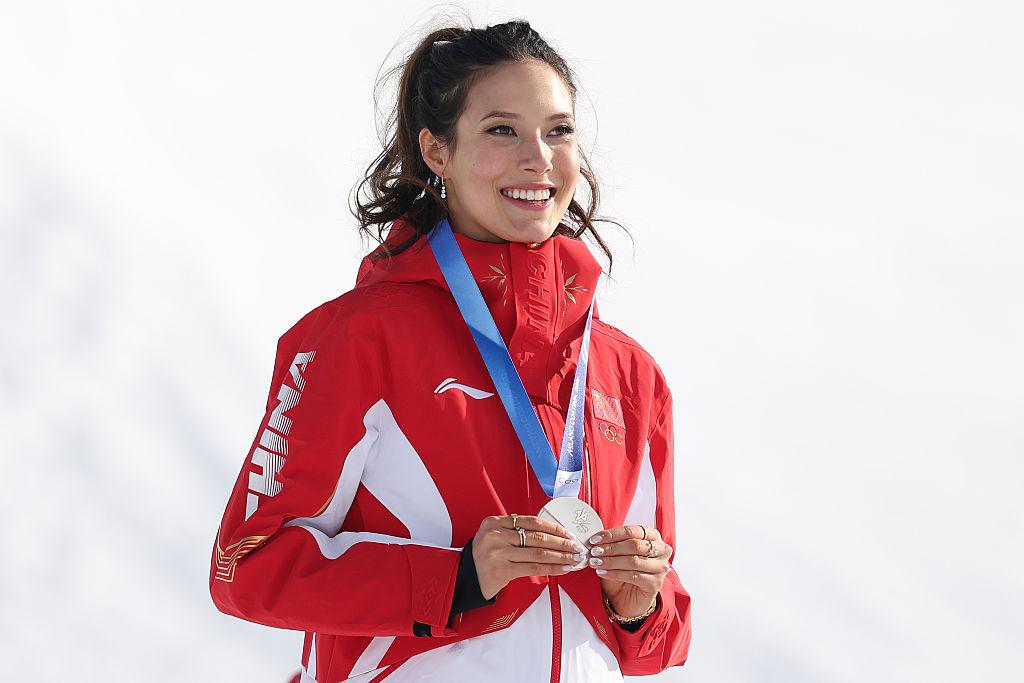
Silver medalist Ailing Eileen Gu of Team People's Republic of China celebrates on the podium after the women's slopestyle final on day three of the 2026 Winter Olympics at Livigno Snow Park in Livigno, Italy, on Feb. 9, 2026. (Michael Reaves/Getty Images)
Lin Yan contributed to this report.