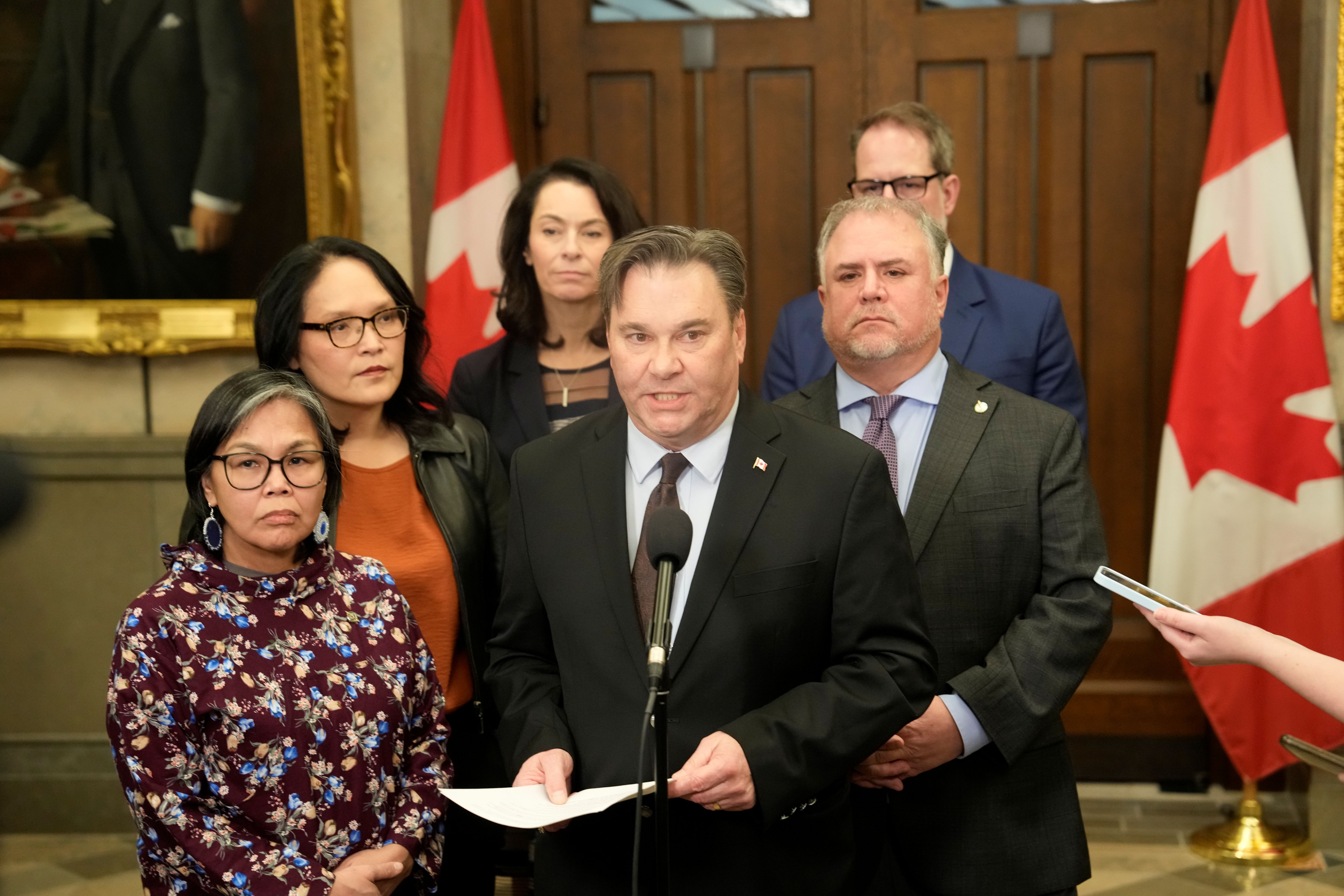

Interim NDP Leader Don Davies says his party received no offers from the Liberals in exchange for two of its MPs abstaining from voting on the federal budget, allowing it to pass with a narrow margin to avoid an election.
“We pushed the Liberals to give us some concrete results, but nothing happened. So we decided to vote ‘no,’ but in order to avoid an election, we did what we had to do,” Davies told reporters on Nov. 17 following the vote.
The minority Liberal government’s budget passed in the House of Commons with a vote of 170 to 168. Since budget bills are considered matters of confidence, failing the vote could have led to the government being defeated, prompting the dissolution of Parliament and a second federal election in 2025.
As the government entered the final weekend before the vote, no opposition party had publicly committed to supporting the budget, leaving the outcome uncertain. With 170 seats in the House of Commons, two short of a majority, the governing Liberals need support from opposition parties to pass legislation.
Davies said that the Liberals didn’t address the NDP’s concern to revise the budget to remove some of the spending cuts and add more climate change initiatives and support programs for indigenous peoples, and therefore his party couldn’t support the budget. At the same time, he said that “Canadians don’t want an election right now,” hence the reason two NDP MPs abstained to allow the budget’s passage.
“We have decided to put the interests of our country first, to vote against the budget, but to help prevent an election,” Davies said.
He added that the party’s seven-member caucus decided on the final course of action on the morning of the voting day.
The NDP forged a supply-and-confidence agreement with the Trudeau Liberals in the last session of Parliament, supporting the minority Liberals on confidence votes in exchange for the government introducing key support programs including the national dental care and the pharmacare programs.
The agreement lasted from March 2022 to September 2024, but the NDP continued supporting the Liberals on key confidence votes initiated by the Conservatives even after the deal ended. This continued until former Prime Minister Justin Trudeau announced his plan to resign and prorogued Parliament in January, which was followed by Mark Carney becoming Liberal leader and prime minister in March, calling an election shortly thereafter. In the April 28 election, the NDP’s 24-member caucus was reduced to seven, causing the party to lose official status in the House of Commons.
Davies told reporters that the fact that his party didn’t vote for the Liberal budget is a clear sign that they’re not “propping up” the Liberal government, and that his party would be ready to help bring down the government in the spring if needed.
NDP MP Lori Idlout, who represents Nunavut, said she had to abstain as she couldn’t vote against the budget since it has a number of commitments related to her constituency. The other NDP MP who abstained, Gord Johns, said he didn’t want to send the country to another election.
Also abstaining were two Conservative MPs, Shannon Stubbs and Matt Jeneroux. Stubbs’s office told The Epoch Times that she is recovering from surgery, and that her surgical team has ordered “several weeks of strict bedrest, no speaking, and limited movement to ensure a safe recovery.” It wasn’t immediately clear why Jeneroux abstained from voting.
Jeneroux, an Edmonton MP, announced on Nov. 6 that he is resigning from Parliament following rumours that he was going to join Nova Scotia MP Chris d’Entremont in leaving the Tories and joining the Liberals. Jeneroux, who denied the rumours, had said he wanted to spend more time with his family, and that he would likely leave Parliament in the spring.
Voting in favour of the budget was Green Party Leader Elizabeth May, her party’s sole MP. May had initially said she would vote against the budget since it didn’t have enough environmental commitments, but after receiving confirmation from Carney that he’s committed to the Paris Climate Agreement targets, she said she would vote with the Liberals.
Since the Liberals had a two-vote lead in the budget vote, the House speaker, Liberal MP Francis Scarpaleggia, didn’t need to vote to break the tie in favour of the Liberals.
Conservative Leader Pierre Poilievre said his party didn’t support the budget because the high expenditures and $78 billion deficit would lead to inflation and higher cost-of-living for the country.
“On behalf of the Canadians that Liberals have priced out of food, homes and life, Conservatives voted no tonight on this costly credit card budget that gambles away Canada’s future,” Poilievre said after the Nov. 17 vote.
Bloc Québécois Leader Yves-François Blanchet, whose party voted against the budget, said the Liberal government “refuses to collaborate with Quebec.” The Bloc had asked the Liberals to meet some of their key requests, including increasing health care funding transfers and raising Old Age Security payments, before they would support the budget.
The Liberals say their budget has necessary expenditures to grow the economy, along with needed cuts to reduce spending while maintaining key programs.
“It’s time to work together to deliver on this plan — to protect our communities, empower Canadians with new opportunities, and build Canada strong,” Carney said after the budget’s passage.