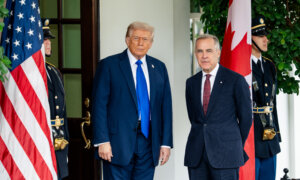

U.S. President Donald Trump says he is terminating all trade negotiations with Canada over a TV ad campaign sponsored by the provincial government of Ontario opposing U.S. tariffs. The ad features the voice and images of the late Republican President Ronald Reagan speaking against protectionist measures.
Trump suggested the ad campaign was meant to interfere with an upcoming U.S. Supreme Court hearing on his administration’s tariffs.
“The Ronald Reagan Foundation has just announced that Canada has fraudulently used an advertisement, which is FAKE, featuring Ronald Reagan speaking negatively about Tariffs. The ad was for $75,000,000. They only did this to interfere with the decision of the U.S. Supreme Court, and other courts,” Trump wrote on Truth Social late on Oct. 23.
“Tariffs are very important to the national security and economy of the U.S.A. Based on their egregious behavior, all trade negotiations with Canada are hereby terminated. Thank you for your attention to this matter!”
The $75 million ad campaign was rolled out by the government of Ontario this month to oppose U.S. tariffs on Canada. The one-minute ad shows images of America’s heartland and the Canada-U.S. border, and features words from Reagan’s 1987 address advocating the principles of free trade.
“You see, at first, when someone says, ‘Let’s impose tariffs on foreign imports,’ it looks like they’re doing the patriotic thing by protecting American products and jobs. And sometimes for a short while it works—but only for a short time,” Reagan says in the ad.
“High tariffs inevitably lead to retaliation by foreign countries and the triggering of fierce trade wars. Then the worst happens: Markets shrink and collapse, businesses and industries shut down and millions of people lose their jobs.”
In his Oct. 23 social media post, Trump featured a statement from the Ronald Reagan Presidential Foundation and Institute, which says that the ad used selective audio and video of Reagan, and that it misrepresents what the late president said. The foundation added that it may pursue legal action against the government of Ontario.
“The Ronald Reagan Presidential Foundation and Institute learned that the Government of Ontario, Canada, created an ad campaign using selective audio and video of President Ronald Reagan delivering his ‘Radio Address to the Nation on Free and Fair Trade,’ dated April 25, 1987,” the foundation said.
“The ad misrepresents the Presidential Radio Address, and the Government of Ontario did not seek nor receive permission to use and edit the remarks.”
The Epoch Times contacted the government of Ontario and the prime minister’s office for comment, but didn’t immediately hear back.
Ontario Premier Doug Ford previously said that the ad is not “nasty,” and that it’s “just very factual and coming from a person like Ronald Reagan,” adding that “he was just the best president the country’s ever seen in my opinion.”
Trump’s tariffs, the centerpiece of his trade policy, have been challenged in court, and the U.S. Supreme Court has agreed to fast-track his administration’s appeal of lower court rulings that struck down most of the tariffs.
The U.S. Supreme Court is set to hear oral arguments on the tariffs on Nov. 5. Trump has said he may attend the hearing in person.
Trump vs. Ford
This is the second time the government of Ontario has found itself in the crosshairs of the U.S. president.
In April, after Ford imposed a 25 percent surcharge on electricity exports to Michigan, New York, and Minnesota in retaliation for 25 percent U.S. tariffs on steel and aluminum imports, Trump said he would double the tariffs on Canadian metal imports to 50 percent. Ford eventually suspended the surcharge, after which Trump canceled the further hike on steel and aluminum tariffs.
Ford has said recently that Canada should further hit the United States with counter-tariffs, while Prime Minister Mark Carney has rejected those calls, saying “right now is the time to talk.”
Trade Negotiations
More recently, the Trump administration said on June 27 that it’s ending all trade negotiations with Canada over Ottawa’s recently introduced digital services tax, which would impose a new levy on revenue generated by digital services operating in Canada, impacting American giants such as Amazon and Netflix. Ottawa canceled the new tax two days later, after which Washington said it would resume trade talks.
Canada has also, more recently, in August, dropped the majority of its counter-tariffs on U.S. products, with Carney saying it was needed to continue trade talks with the United States.
The move has come with political cost for Carney, with the opposition saying it contrasts with his main messaging during the April election campaign, which was heavily focused on standing up to Trump’s tariffs. Carney has said that Canada still has the best trade deal with the United States thanks to the United States-Mexico-Canada Agreement (USMCA).
Washington on Aug. 1 ramped up tariffs on Canadian products not covered by the USMCA to 35 percent from the previous 25 percent. Canada is also subject to sectoral tariffs, including on steel, aluminum, copper, autos, and lumber.
So far, a trade deal with the United States has remained elusive for Ottawa, but the Canadian minister responsible for U.S. trade, Dominic LeBlanc, said earlier in October that he remains hopeful the two sides can reach an agreement on tariffs before the review of the USMCA scheduled for 2026.
Carney’s Remarks on US
In recent remarks made during a televised address about his government’s upcoming budget, Carney repeated some of his comments about Canada’s changing relationship with the United States, which he had stayed away from for the most part in public addresses since the election campaign earlier this year.
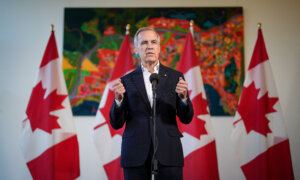
“Our relationship with the United States will never again be the same as it was, even though in this new world of protectionism we have the best trade deal of any other country, and we’re working to make it even better still,” Carney said in Ottawa on Oct. 22, referring to the USMCA.
“Many of our former strengths as a country ... strengths based on close ties to America, have become our vulnerabilities.”
Carney also said that his government has a goal of doubling Canada’s exports to non-U.S. destinations over the next decade as part of a strategy to diversify Canada’s export markets away from the United States.
However, in his address, he avoided any specific mention of the Trump administration, a departure from his comments during the federal election and the Liberal leadership campaign early this year, when he accused Trump of “attacking Canadian families, workers and businesses” with “unjustified tariffs.”
Since taking office, Carney has had a cordial relationship with the U.S. leader, with Trump saying in August, “I like Carney a lot,” and Carney calling Trump a “transformational president.”