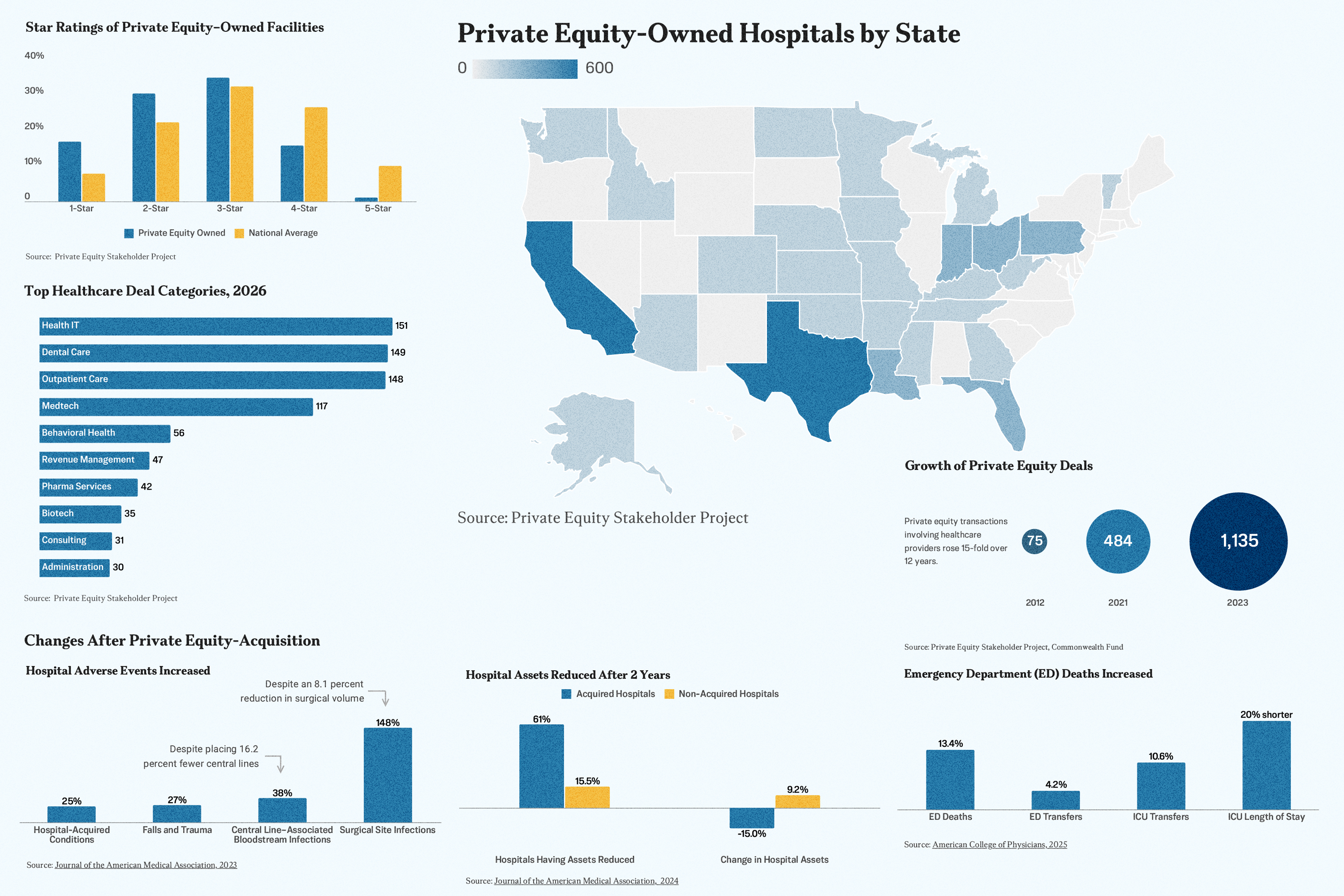


There’s a greater than one in 10 chance your hospital is owned by someone who’s trying to double his money in seven years. If you live in Kentucky, your chances are one in six. In New Mexico, more than one in three.
Walk into an emergency room, and there’s a 40 percent chance the doctor who stitches you up works for a staffing company owned by private investors, not the hospital.
At a time when less than half of Americans report being consistently able to afford healthcare, private investors are looking to hospitals and physician practices as a source of profit.
Private equity firms, which invest money on behalf of pension funds, universities, sovereign wealth funds, and wealthy individuals, buy healthcare providers expecting them to produce a better return than the stock market.
That may be no surprise to the 82 million Americans who make trade-offs such as choosing between buying food and going to the doctor, nor to the nearly half of Americans with healthcare debt who have drained their savings to pay medical bills.
Providers are attractive targets for private investors for the same reasons any business might be, according to analysts.
Hospitals and physician practices are virtually recession-proof. They’re fueled by a steady supply of aging customers. Historically, there have been lots of small, independent operators in the healthcare industry, ripe for consolidation. And they need vast amounts of capital to expand or even maintain complex facilities.
Private investors bring the business savvy and operational know-how that many healthcare providers lack. That has made physician offices and hospitals more efficient and productive, analysts say.
“Private equity has made a tremendous amount of investments in health technologies,” Kelly Arduino, an executive at Wipfli with 25 years of experience in healthcare management, told The Epoch Times. “That’s where we would see the biggest success.”
But that success comes at a price.
Gains in efficiency and value to investors have left some hospitals bereft of real assets, loaded with debt, and struggling to maintain quality care, some studies indicate.
Private investors are buying into the healthcare system to extract profit, which can permanently change the structure of a healthcare institution, sometimes for the worse.
Debt Loading
When private equity firms buy an independent hospital or physician practice, they finance the deal mostly with borrowed money.
Investors typically put in between 10 percent and 40 percent of the funding and get the rest from commercial lenders, institutional investors, or high-yield bonds.
But the actual borrower is the provider. The hospital or physician practice takes on the debt and must repay it, often paying management fees to the equity firm as well.

Hospital staff walk down a hall at the University of California–Irvine Medical Center in Orange, Calif., on Dec. 16, 2020. (John Fredricks/The Epoch Times)
And because the investors typically convert the provider from nonprofit to for-profit status, the provider is also liable for taxes.
When the provider is eventually resold, the debt will likely be paid off from the proceeds. But the new owner, often another private equity firm, may finance its purchase with debt, too.
So hospitals and physician practices can be left with ongoing debt for the sake of generating a profit for private investors.
There’s evidence that debt loading negatively affects the long-term financial health of these institutions.
A 2025 study of more than 200 hospitals owned by private equity firms found that those re-resold to another private equity group saw operating margins decrease by more than 8 percent compared with those sold to other for-profit owners.
Yet even some critics agree that private investment in healthcare can be useful if done responsibly.
“Private investments can sometimes be an important source of capital, especially for small to mid-sized companies that can benefit from the access that this financing provides,” Lina M. Khan, former chair of the Federal Trade Commission, wrote in 2024.
Staff Cuts
Private equity investment in healthcare came under scrutiny by Congress following the 2024 bankruptcy of Steward Health Care, a chain of 31 hospitals. Many attributed Steward’s collapse to its years under ownership by private equity.
Yet overall, hospitals owned by private investors are not more likely to close than are other hospitals, research shows.
A more consistent problem is significant staff reductions, which affect physician morale and patient satisfaction, according to a 2025 report by a team of academic researchers.
After private equity takeover, provider staffing was reduced by 6 percent over four years and stayed that way in the long term, according to a study of hospital acquisitions.
While the number of doctors, nurses, and other care providers did bounce back, support staffing did not. It was cut by an overall 20 percent.
That saved money on wages: about 7 percent in the first four years, and up to 9 percent after eight years.

Patients use a hospital in Irvine, Calif., on July 17, 2026. Overall, hospitals owned by private investors are not more likely to close than are other hospitals, research shows. (John Fredricks/The Epoch Times)
That focus on efficiency has changed the dynamics of the workplace.
“I think where private equity has struggled the most is in dealing with a lot of professional services providers. So that would be physician practices,” Arduino said.
Patients complain of doctors who are overly busy, long wait times for appointments, driving farther for care, and being rushed through their brief visits with physicians.
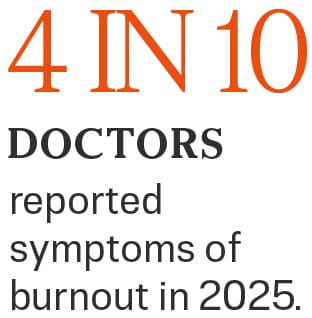
More than four in 10 doctors reported symptoms of burnout in 2025, according to the American Medical Association. That’s despite a recent decline in job stress since the COVID-19 pandemic era.
One reason is the increased pace of work, said Robert Andrews, CEO of the Health Transformation Alliance.
“The doctor who’s had four or five appointments per hour ... now has seven,” Andrews told The Epoch Times. That leads to long days spent catching up on paperwork and feeling fatigued, he told The Epoch Times.

Doctors administer COVID-19 vaccines at NewYork-Presbyterian Lawrence Hospital in Bronxville, N.Y., on Jan. 8, 2021. Despite a recent uptick since the COVID-19 pandemic era, more than four in 10 doctors reported symptoms of burnout in 2025, according to the American Medical Association. (Kevin Hagen, File/AP Photo)
Beyond that, physicians often feel handcuffed by the clock, prevented from spending the extra minutes with a patient that might improve patient care, Andrews said.
“They feel like their professional autonomy has been robbed from them,” he said.
That problem is not unique to private equity-owned hospitals and physician practices.
But it has roots in the rapid consolidation of the healthcare industry that began in the 2010s, which some analysts call a “glorious time” for private investment.
This focus on efficiency changed the mindset of entire hospital systems, said Dr. Patricia Martin, an anesthesiologist in practice for more than 20 years.
“They’re not in the business of providing the best medicine. They’re in the business of providing good-enough medicine for the largest number of people,” Martin told The Epoch Times.
Supporters of private investment say there is no evidence that mortality rates increase under private equity ownership.
Yet hospitals owned by private investors were found to have higher rates of falls and hospital-acquired infections, lower patient satisfaction, and lower scores in standardized quality ratings.
Asset Stripping
One reason the Steward Health Care bankruptcy drew criticism was the allegation that former owner Cerberus Capital Management had sold some of its real assets before selling it in 2020.
Cerberus created Steward Health Care, starting with six financially troubled hospitals acquired from the Catholic Archdiocese of Boston, in 2010.
Cerberus stated that the hospital system was financially sound with more than $400 million in cash when sold to other investors in 2020.
However, critics noted that Steward had earlier sold 13 medical office buildings and the campus of one hospital to a real estate trust, then leased them back.
That tactic is common among private equity investors and is not unique to healthcare.

St. Joseph Medical Center in Houston, on July 23, 2018. The hospital was acquired by Steward Health Care—which was owned by a private equity firm—in 2017. Steward went bankrupt in 2024; the collapse became a national example of private equity and real estate deals draining a hospital chain. (St. Joseph Medical Center/CC BY-SA 4.0)
Many real estate-intensive businesses do this to raise capital and to make the cost of occupying the property more predictable.
While this practice does not affect the provider’s immediate financial picture, researchers found that it does have a longer-term impact.
Hospitals that sold their real estate to a real estate investment trust had a significant decrease in fixed asset value, and were about six times more likely to close or file bankruptcy than other hospitals, according to a 2025 study.
Yet the Center for Economic and Policy Research found a pattern of private equity companies using the proceeds from hospital and nursing home real estate sales to pay dividends to investors rather than make capital improvements. At the same time, the new real estate owners sometimes charged the healthcare providers inflated rents.
Better Incentives
While the dangers of private equity investment in healthcare are real, industry insiders warn against applying blanket solutions.
Not all hospital failures can be laid at the feet of investors, Arduino said.
“When I look at the hospitals that have struggled or failed, it’s not a function of private equity. It’s a function of long-term mismanagement, operational challenges, disconnected systems, and poor reimbursement,” she said. “The hospital business is super hard.”

Khan was critical of what she called “strip and flip” tactics used by some private investors. But, she said, “some private equity firms take a more long-term view and focus on creating real operational improvements to generate value in ways that provide broader benefits.”
Andrews, whose firm works with more than a dozen physician groups owned by private equity firms, said the ownership structure is far less important than the rules by which they operate.

Healthcare professionals and medical students attend the Healthcare is Human rally outside the U.S. Capitol on May 21, 2026. The rally advocated for legislation to relieve short staffing, combat burnout, and protect whistleblowers. (Anna Moneymaker/Getty Images)
“If you incent primary care practices to rush people in and out the door, that’s what they‘ll do,” Andrews said. “If you incent them to spend time, understand what’s going on with the patient, and reward them when the patient’s healthier, that’s what they’ll do.”
Nine states have enacted legislation regarding private equity investment in hospitals since 2024. Most involve notification requirements regarding changes of hospital ownership.
A Connecticut law bars private equity owners from having a majority stake in a hospital or interfering with clinical decision-making, and prohibits hospital sale-and-lease-back transactions.