Three prominent Republican lawmakers are urging the State Department to designate a key Chinese student group as a foreign mission, arguing that the step is necessary to “protect American campuses” from covert Chinese influence.
In a letter to Secretary of State Marco Rubio, the trio expressed “grave concerns” about Chinese Students and Scholars Association (CSSA) chapters advancing Beijing’s interests across U.S. academia, an issue they described as posing “serious foreign policy and national security risks.”
The letter signatories are Reps. John Moolenaar (R-Mich.), Brian Mast (R-Fla.), and Tim Walberg (R-Mich.), who respectively chair the House Select Committee on the Chinese Communist Party (CCP), the House Foreign Affairs Committee, and the House Committee on Education and the Workforce.
Widespread across U.S. colleges, CSSA chapters maintain close connections with the Chinese consulates, organizing events with Chinese officials’ support while receiving the consulates’ funding, the letter states.
It casts CSSA chapters as “nominally student-led groups” that engage in “harmful and disruptive activities that chill free expression, undermine academic freedom, and raise serious national security concerns.”
The lawmakers invoked the Foreign Missions Act, passed by Congress in 1982, to address the issue, urging Rubio to formally determine whether CSSA chapters meet the criteria, which would subject them to disclosure requirements.
Once designated as foreign missions, CSSA chapters must notify the State Department in advance of any meetings with local governments and universities. They would also need to seek State Department approval for public events in the United States.
The act defines a foreign mission as any entity on U.S. soil under the effective control of a foreign state. As a foreign adversary, the activities of Chinese missions require greater scrutiny, the lawmakers said.
As of 2024, 22 Chinese entities have received foreign missions designations. These include one embassy and four consulates, state media such as Xinhua News and People’s Daily, and the now-shuttered Confucius Institute U.S. Center, the de facto headquarters for the Beijing-backed network that perpetuates a sanitized view of China in the name of language teaching.
The designations “do not even begin to scratch the surface” of Beijing’s influence and intelligence networks, the lawmakers stated, pointing to the CSSA’s hold on the hundreds of thousands of Chinese students in the United States.
“The CCP’s exploitation of America’s openness—while refusing adequate treatment for legitimate U.S. diplomatic and consular missions in China—must come to an end,” they wrote.
Unlike the Confucius Institutes, whose presence in the United States has diminished amid heightened U.S. scrutiny, CSSA chapters have remained active.
Amid the U.S.–China summit in late 2023, CSSA leaders in several universities mobilized students to welcome Chinese leader Xi Jinping to California. At least two groups offered to cover trip expenses. They described it as a “glorious mission,” leaked screenshots previously obtained by The Epoch Times show.
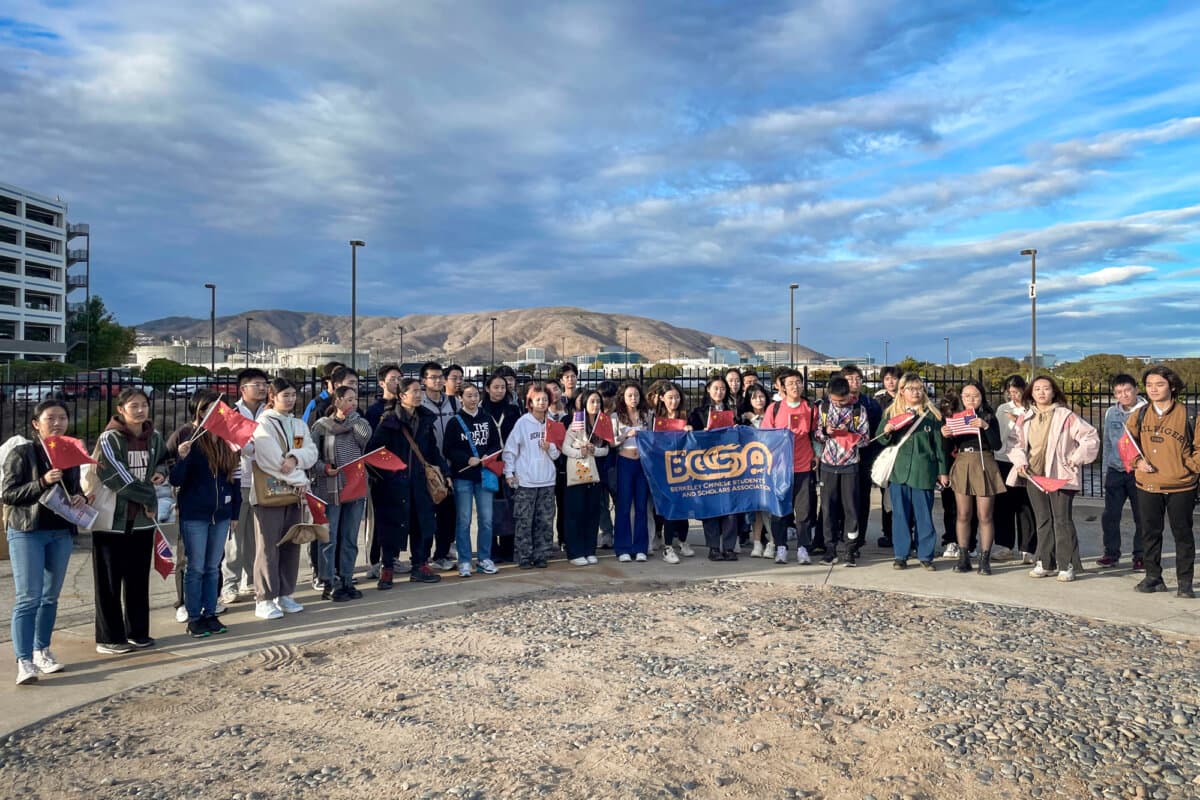
Members of the Berkeley Chinese Students and Scholars Association, welcoming Chinese leader Xi Jinping's arrival for the Asia-Pacific Economic Cooperation summit, pose for a photo in San Francisco on Nov. 14, 2023. (Courtesy of Students for a Free Tibet)
In 2025, the lawmakers said, the Southwestern Chinese Students and Scholars Association became one of the overseas liaisons for recruiting talent back to China. The organization covers dozens of U.S. universities.
Chinese officials often appear at CSSA events and have encouraged attendees to “tell China’s story well,” according to former leaders from the student group and Chinese consulate records.
CSSA chapters for years openly touted their ties with the Chinese consulates, often in Chinese. On Chinese social media, the University of Pittsburgh’s CSSA acknowledged in 2017 that it received an annual budget of $6,000. It later deleted the post.
“They give the money, and you do the work, it’s just that simple,” Steve Tao, who once served as the Northwestern University CSSA’s treasurer and vice president, previously told The Epoch Times.
Rubio had expressed concerns regarding the CSSA during his tenure as a Florida senator.
In 2023, he signed a letter calling for federal attention to the group, warning about the growing role of entities such as the CSSA as an arm of Beijing to influence U.S. academic institutions. With the closure of many Confucius Institutes, the letter said, CSSA chapters are meeting the CCP’s needs.
Moolenaar and the other lawmakers said applying the Foreign Missions Act to CSSA chapters is critical to shed light on their scope and assess the security risks they might pose.
Enhancing transparency about the Chinese student group’s funding, coordination, and direction on U.S. campuses, they said, would help mitigate threats posed by Chinese influence operations.