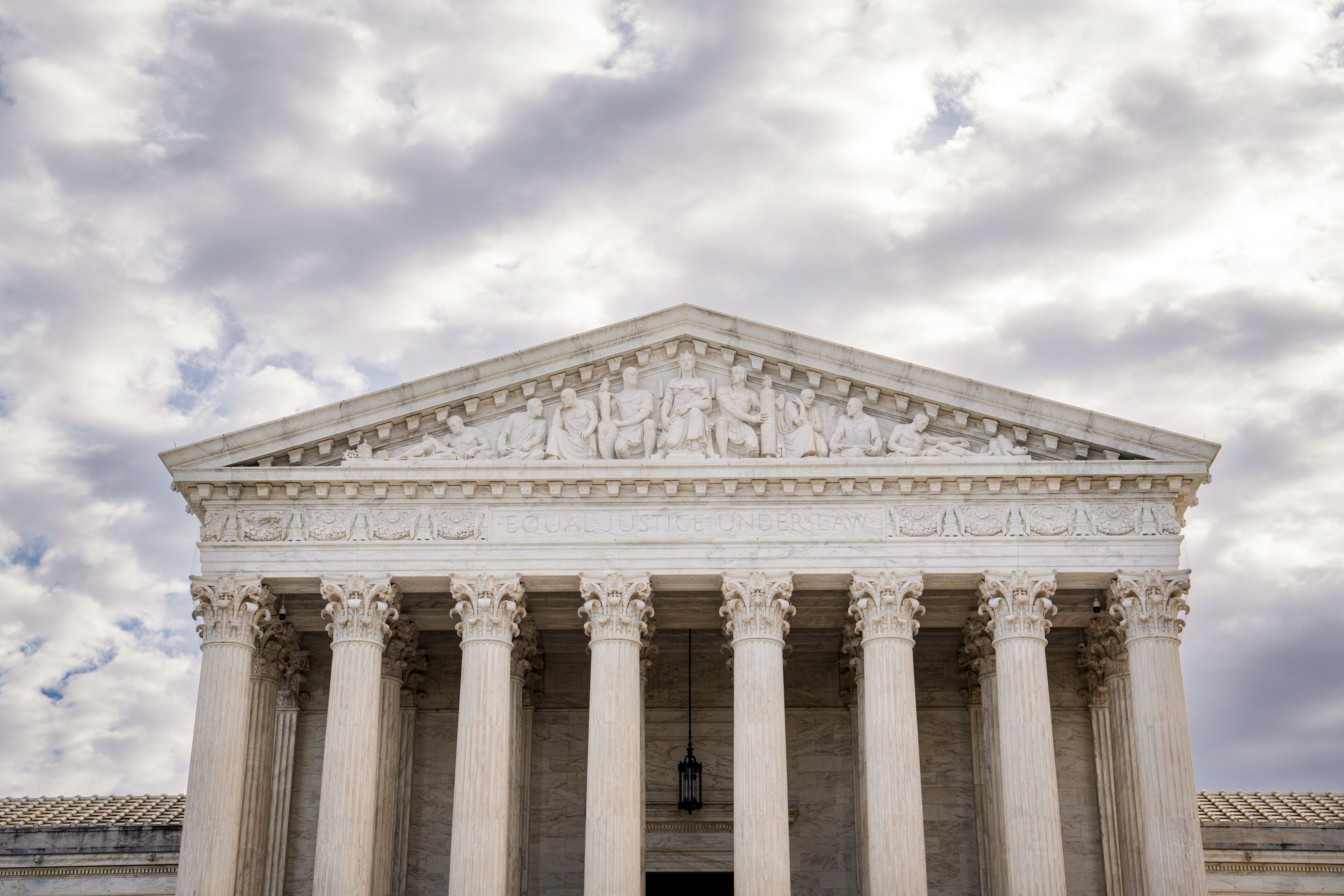
The Supreme Court on March 31 sided with a therapist who challenged on free speech grounds a Colorado law that banned so-called conversion therapy for LGBT minors.
The Colorado law, passed in 2019, forbids therapists from any practice or treatment “that attempts to change an individual’s sexual orientation or gender identity,” or “eliminate or reduce sexual or romantic attractions toward individuals of the same sex.”
Kaley Chiles, a licensed therapist, challenged the law in 2022, saying it violated her First Amendment free speech rights. After losing in lower courts, the Supreme Court ruled in her favor in an 8–1 decision that may impact similar laws in 26 other states.
Here are five takeaways from that landmark ruling.
Therapist’s Work Is Speech, Not ‘Conduct’
Colorado had argued that its law was meant to regulate therapists’ conduct and that any restrictions on their speech were just incidental.
The justices rejected that argument. Justice Neil Gorsuch, writing for the majority, said such reasoning would allow governments to craft laws designating any speech as conduct to “silence speech they disfavor.”
“Her speech does not become ‘conduct’ just because a government says so or because it may be described as a ‘treatment’ or ‘therapeutic modality ... All she does is speak, and speech is all Colorado seeks to regulate,” he wrote.
“The First Amendment is no word game, and ‘the exercise of constitutional rights’ cannot be circumscribed ‘by mere labels,’’’ he wrote, quoting an earlier Supreme Court precedent on the issue of free speech.
Colorado had compared its law to earlier ones that set up standards for licensing health care practitioners. That argument failed, too, Gorsuch wrote, because such laws are traditionally centered on qualifications, not on regulating a professional’s viewpoint.
Law Is Viewpoint Discrimination
The majority opinion also said Colorado’s law was meant to suppress a certain viewpoint regarding conversion therapy, while promoting other viewpoints.
Gorsuch noted that the law prevents therapists from helping youth change their orientation, but allows counselors to affirm teens in a new gender identity, or in their same-sex attraction.
“Colorado may regard its policy as essential to public health and safety,” he wrote.
“Certainly, censorious governments throughout history have believed the same. But the First Amendment stands as a shield against any effort to enforce orthodoxy in thought or speech in this country.”
Justice Elena Kagan, in a concurring opinion, pointed out that it didn’t matter on which side of the issue you stood: A law opposite Colorado’s would also violate the First Amendment.
If there were a law that banned affirming a pro-LGBT viewpoint, “the First Amendment would apply in the identical way,” she wrote.
“Once again, because the State has suppressed one side of a debate, while aiding the other, the constitutional issue is straightforward.”
Neutral Rules May Be Permissible
Kagan, along with Justice Sonia Sotomayor, said it might be possible to craft laws regulating a therapist’s speech, but they would have to be viewpoint-neutral.
“Medical care typically involves speech, so the regulation of medical care (which is, of course, pervasive) may involve speech restrictions,” Kagan wrote.
“But laws of that kind may not pose the risk of censorship” or suppression of ideas “that appropriately triggers our most rigorous review.”
Kagan acknowledged that such a situation might present a “different and more difficult question.” But, she added, the Supreme Court can wait to tackle that question on another day, since Colorado’s law is not viewpoint-neutral.
Jackson Stands Alone
Justice Ketanji Brown Jackson, the sole dissent, pushed back against the majority opinion. In her lengthy opinion, she said she didn’t dispute that the Colorado law restricted Chiles’s speech, and not just her conduct.
She said those restrictions are warranted because the state has the right to protect minors if it deems conversion therapy harmful.
“The United States and the majority just insist that a law that undertakes to regulate speech-based medical treatments is presumptively unconstitutional because the treatment is being administered solely through speech. But that reasoning is maddeningly circular, and it is based on happenstance, not logic.”
Jackson’s assessment of the decision was echoed by LGBT advocacy groups like the Human Rights Campaign. The organization’s president, Kelley Robinson, criticized Tuesday’s ruling.
“Today’s reckless decision means more American kids will suffer,” she said in a statement. “The Court has weaponized free-speech in order to prioritize anti-LGBTQ+ bias over the safety, health and wellbeing of children.”
Implications for Other States
Carrie Severino, president of legal advocacy group JCN, said the court’s 8–1 finding that the law is viewpoint discrimination under the First Amendment is the “death knell” to similar legislation in other states.She noted that, since the decision was only a ruling against Colorado’s law, it doesn’t automatically revoke similar laws in more than two dozen states across the country.
However, “The other states attempting to copy Colorado’s law are are now on notice that that won’t fly with the Constitution,” she said.
“I think it’s going to be fairly quickly that other states realize this is not acceptable, and hopefully we don’t have courts that attempt to get around it. But I think Supreme Court ... was so clear, in an 8–1 fashion, that this is going to have to be adopted.”