In the 19th century, the Moran family was the last word when it came to American art. The family included painters, sketchers, etchers, engravers, and photographers. They specialized in maritime scenes, landscapes, animal pictures, and Colonial America.
It all began with the oldest of four brothers in a family of English immigrant handloom weavers who settled in Philadelphia in 1844 after their textile work dried up back in Lancashire.
One of these artists displayed excellent training as well as a creative eye and worked well into the 20th century—John Leon Moran (1864–1941).
Roots of Art
John Leon was born on Oct. 4, 1864, in Philadelphia. His father was Edward Moran, the oldest of the Moran brothers and the man credited with getting the entire clan into painting and various other artistic disciplines. To avoid confusion with his namesake uncle, John, an innovative landscape photographer, he often went by Leon Moran.
Like his older brother Edward Percy Moran, Leon received his first artistic training directly from his father, practically growing up in his studio. Edward mentored and trained his sons in the arts, just as he’d taught both his younger brothers, Thomas and Peter, the art of oil painting. He even shared a studio with each brother at one point.
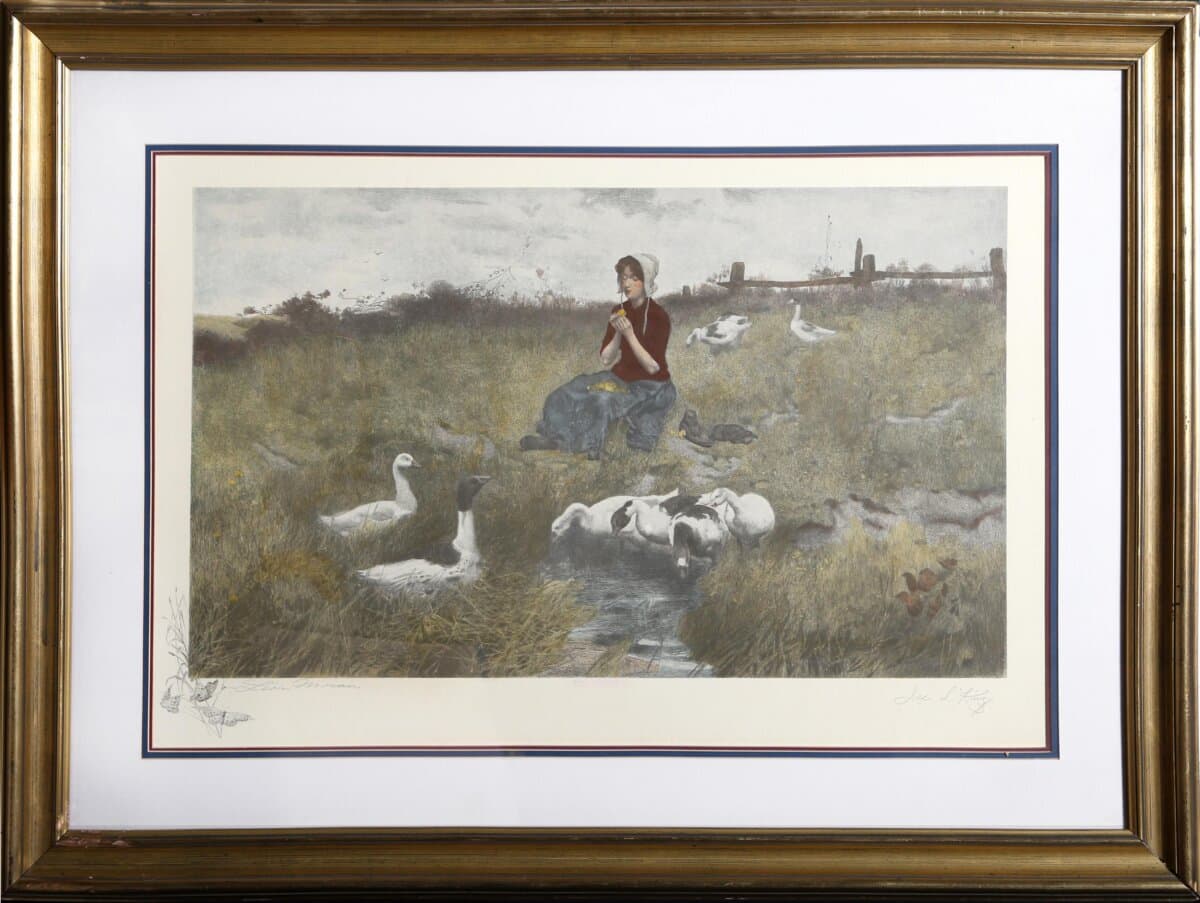
"Maiden With Geese," by John Leon Moran. Etching. (Public Domain)
Leon studied formally under his father’s tutelage at the Pennsylvania Academy of Fine Arts in Philadelphia. In 1878, when Leon was 14 years old, he accompanied his father and older brother Percy to London and Paris to study art technique at the academies there.
While in Paris, he became familiar with the French Barbizon School, an art movement named after a French village. The school emphasized soft and poetic, yet realistic, depictions of picturesque landscapes. Leon’s uncle Peter and aunt Mary also exemplified this style in their etchings.
In 1879, he returned to the United States, where he continued studying under his father in a studio that was separated from the house.
Establishing Himself
It would have been easy to merely ride on his father’s prestige, but Leon began establishing a respectable reputation as an artist in his own right in the early 1880s. In 1881, he exhibited his first watercolor at the National Academy of Design.
At this early stage of his career, watercolors were his medium of choice, and he became a lifelong member of the American Water Color Society. Nevertheless, it was noted that Moran had taken “to drawing as naturally as young birds to flight.”
That same year, the American Art Review wrote of him that “this clever young painter, who has attained a distinct individuality at an age when American artists generally are just beginning to study drawing, may be classed as one of the strongest men of the new art generation.”
This reviewer went on to note how distinctly American young Moran’s art style was, explaining: “With the exception of one year’s study in France Mr. Moran has worked exclusively in America and under American influences.
“His pictures show a happy assimilation of French and American qualities. He has the brilliancy, sparkle, audacity and chic of a Frenchman. His skill of technique and artistic conscientiousness are also Gallic (French), but mingled with these qualities is a strain of American originality, self-reliance and independence.”
Eager to continue improving his technique, in 1883, Leon began studying at the National Academy of Design in New York City, where he eventually opened his own studio. He later shared a studio in the city with his brother and fellow artist, Percy Moran.
They also worked together at the artistic Summer Colony in East Hampton, Long Island. Around 1900, Leon moved to Plainfield, New Jersey, where he had a studio and joined the Plainfield Art Association. In 1906, he began giving drawing and painting classes there.
Advertisement for G. Wiedman Brewing Co. by John Leon Moran. (Public Domain)
A Portraitist
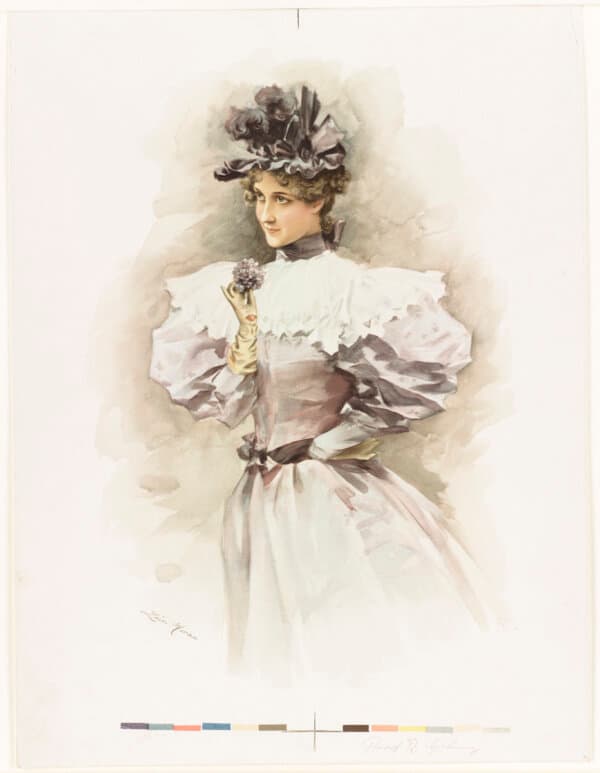
Most of the Morans specialized in landscapes. Whether their preferred art medium was oil paint, watercolor, sketching, etching, or even photography, most family members gravitated toward depicting scenes of nature and wildlife. Although he could render excellent landscapes, Leon specialized in portraits.
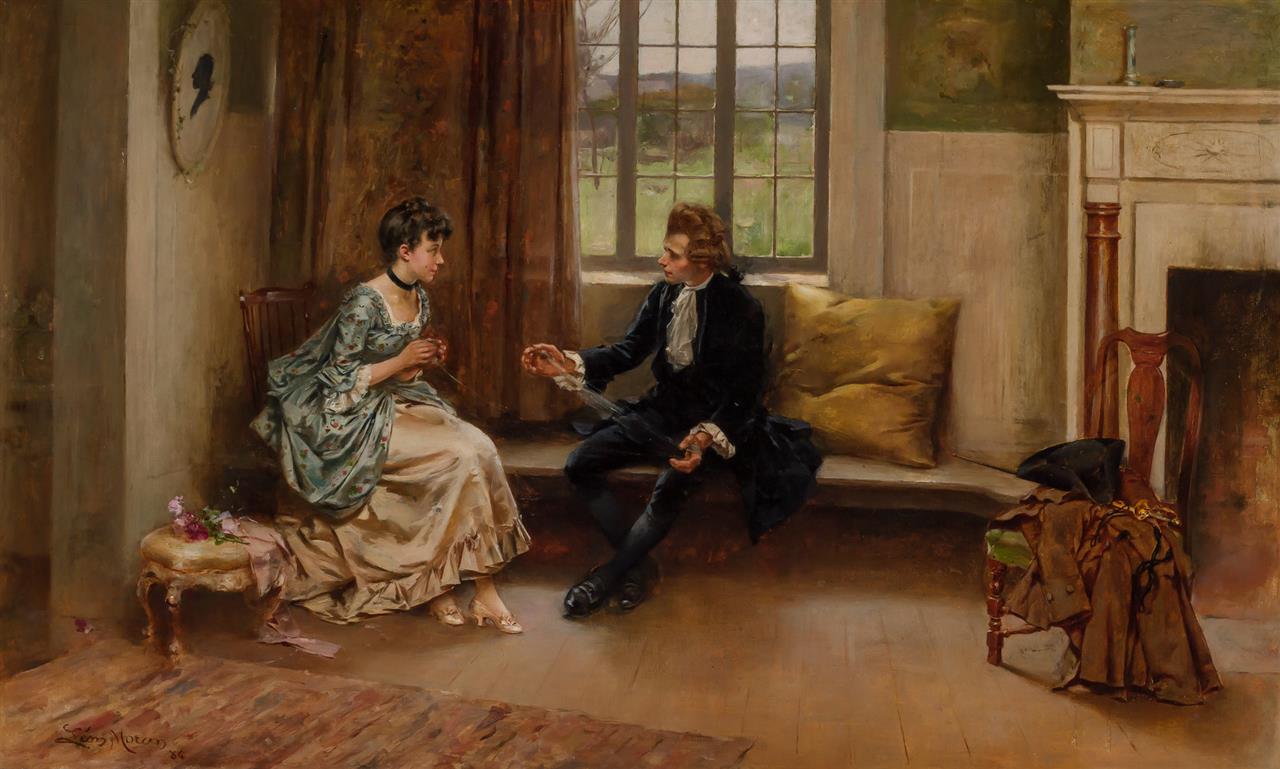
He’d made a study of historical French, English, and American clothing, and he put this knowledge to use in creating historical scenes. He shared this interest in historical subjects with his brother.
While Percy often depicted scenes with many people, Leon usually focused on a single subject. That subject was usually a beautiful young woman with a lovely face and detailed costume. He created these charming portraits as both paintings and etchings.
During his lifetime, Leon Moran’s paintings were frequently exhibited at a wide variety of galleries, including the National Academy of Design (1881–1898), the Brooklyn Art Association (1881–1885), the Art Institute of Chicago (1888–1920), the Philadelphia Art Club (1893), the Pennsylvania Academy of the Fine Arts (1901), the American Art Society (Philadelphia, 1902, gold), and Independent Artists (1921).
He died in 1941, but his legacy and talent live on through the beautiful artwork he created.
What arts and culture topics would you like us to cover? Please email ideas or feedback to features@epochtimes.nyc.