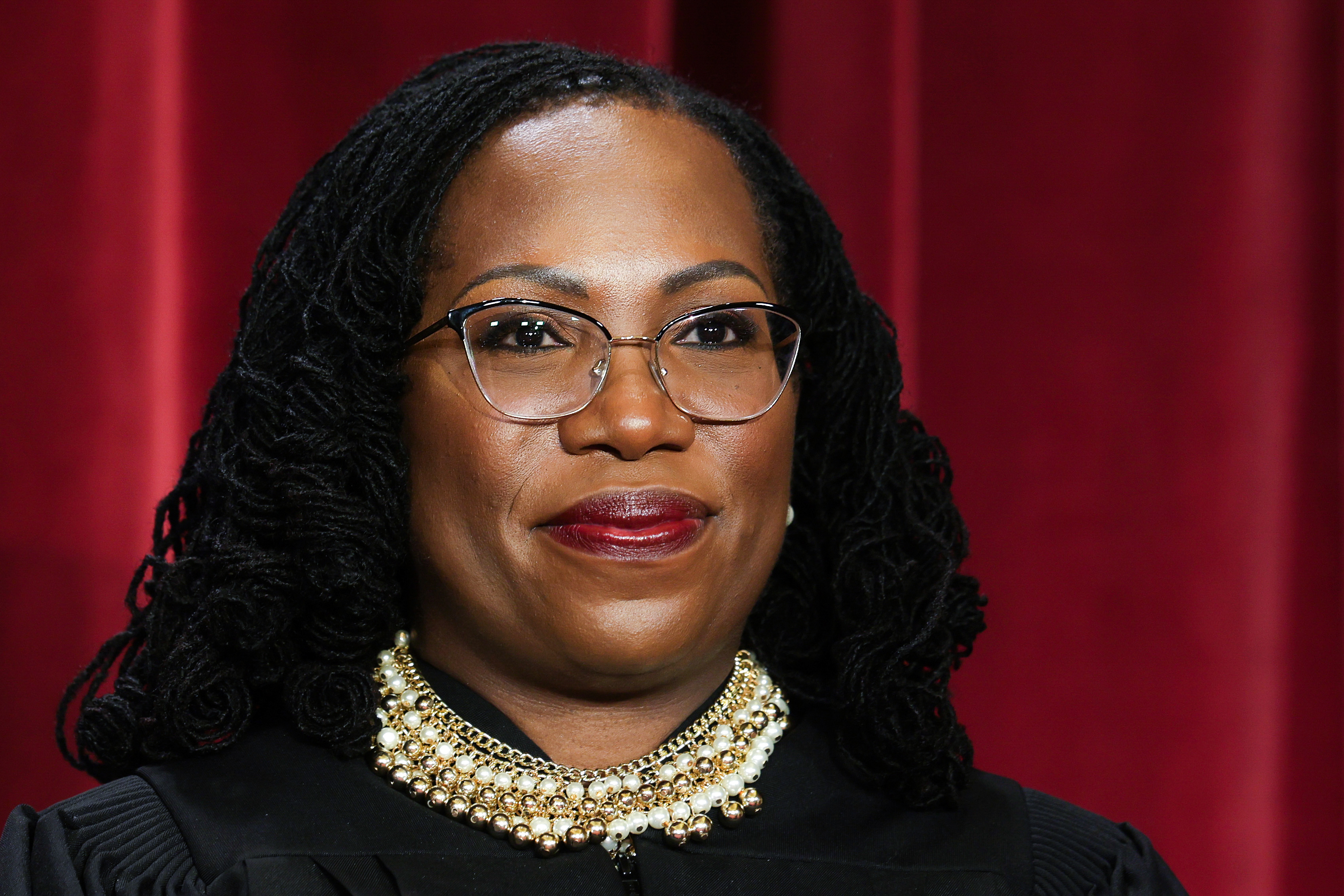
Supreme Court Justice Ketanji Brown Jackson was the lone dissent on a March 31 decision ruling against Colorado’s ban on “talk conversion therapy” for LGBT youth.
Eight out of nine Justices agreed that the law was a form of “viewpoint discrimination” by the state, and rejected Colorado’s argument that it was regulating the “conduct,” not really the speech, of mental health professionals.
Jackson said the other eight Justices, along with the Department of Justice that argued for the plaintiffs, were incorrect.
“The United States and the majority just insist that a law that undertakes to regulate speech-based medical treatments is presumptively unconstitutional because the treatment is being administered solely through speech,” Jackson wrote in her dissent.
“But that reasoning is maddeningly circular, and it is based on happenstance, not logic.”
In 2019, Colorado passed a law that banned licensed therapists from engaging in practices with minors that sought “to change an individual’s sexual orientation or gender identity,” or “to eliminate or reduce sexual or romantic attractions toward individuals of the same sex.”
However, the law allowed therapists to “affirm” patients who felt same-sex attraction, or identified with a gender that did not match their biological sex.
Violators of the law faced a $5,000 fine and loss of license.
Kaley Chiles, a mental health professional, sued to block the law in 2022, arguing that it violated her First Amendment free speech rights. Lower courts sided with the state, and the U.S. Supreme Court heard arguments last October.
Colorado argued that it was regulating Chiles’ conduct as a licensed therapist and that any infringement on her speech was only incidental. The majority rejected that reasoning.
“Her speech does not become ‘conduct’ just because a government says so or because it may be described as a ‘treatment’ or ‘therapeutic modality,’” Justice Neil Gorsuch wrote in the majority opinion.
“All she does is speak, and speech is all Colorado seeks to regulate.”
Brown wrote that she agreed that Colorado’s law curtailed Chiles’ speech rights, and was not only related to her conduct as a therapist. But, she said, restrictions to the therapist’s speech were justified because of the “crucial context,” i.e., possible harm caused to minor patients.
Jackson noted the history of “aversive” conversion treatments like shock therapy, or purposely inducing nausea and vomiting, before conceding that such methods are largely forsaken nowadays.
But, she said, even talk-only conversion therapy has been “discredited” in recent decades because it is “based on a view of gender diversity that runs counter to scientific consensus.”
She wrote that such therapy “stigmatizes the patient, telling them that their gender identity or sexual orientation is something to be fixed, rather than accepted,” leading to further mental distress. She also said it “sets the patient up to fail,” since their goal of changing their orientation is “unattainable.”
Since it was only restricting Chiles’ “professional medical speech,” Jackson said, Colorado’s law was no different from any other law seeking to enforce a proper standard of care for health care professionals.
She also said that the Supreme Court, in Planned Parenthood v. Casey, had upheld a Pennsylvania law that infringed on doctors’ speech rights by compelling them to disclose certain medical information to women seeking abortions.
Justice Elena Kagan, in a separate concurring opinion, said that Jackson was “reimagining” the distinction between speech restrictions based on viewpoint and those based on other content.