
NEW YORK CITY—What a difference 72 hours makes.
On Friday, Jan. 2, Nicolás Maduro was head of Venezuela’s socialist regime, ruling over more than 30 million people and controlling vast amounts of the world’s oil reserves.
But by Jan. 5, the deposed leader was sitting in a foreign courtroom in prison garb and faced the prospect that the remainder of his life would be spent behind bars.
Judge Alvin Hellerstein of the U.S. District Court for the Southern District of New York offered a brief summary of Maduro’s indictment, which also names his wife and others. Maduro declined to hear a full read-out of the indictment, which included four counts related to narco-terrorism, conspiracy, and other offenses.
Although the 63-year-old icon of Latin American communism had lost his power, he did not lose his defiant demeanor. Describing himself as Venezuela’s president, Maduro told the court that he was innocent.
“I am Nicolás Maduro Moros, and I am here, kidnapped, since Jan. 3, Saturday. I was captured at my home in Caracas, Venezuela, by the FBI,” he said.
Cilia Flores similarly pleaded not guilty while describing herself as the first lady of Venezuela.
Maduro’s attorney, Barry Pollack, questioned the validity of the arrest and said he expected voluminous pre-trial motions.
Pollack said his client is the head of a sovereign state, touching on a contested label for the man whose election has been disputed by multiple countries. It was too early, Pollack said, to set a trial date.
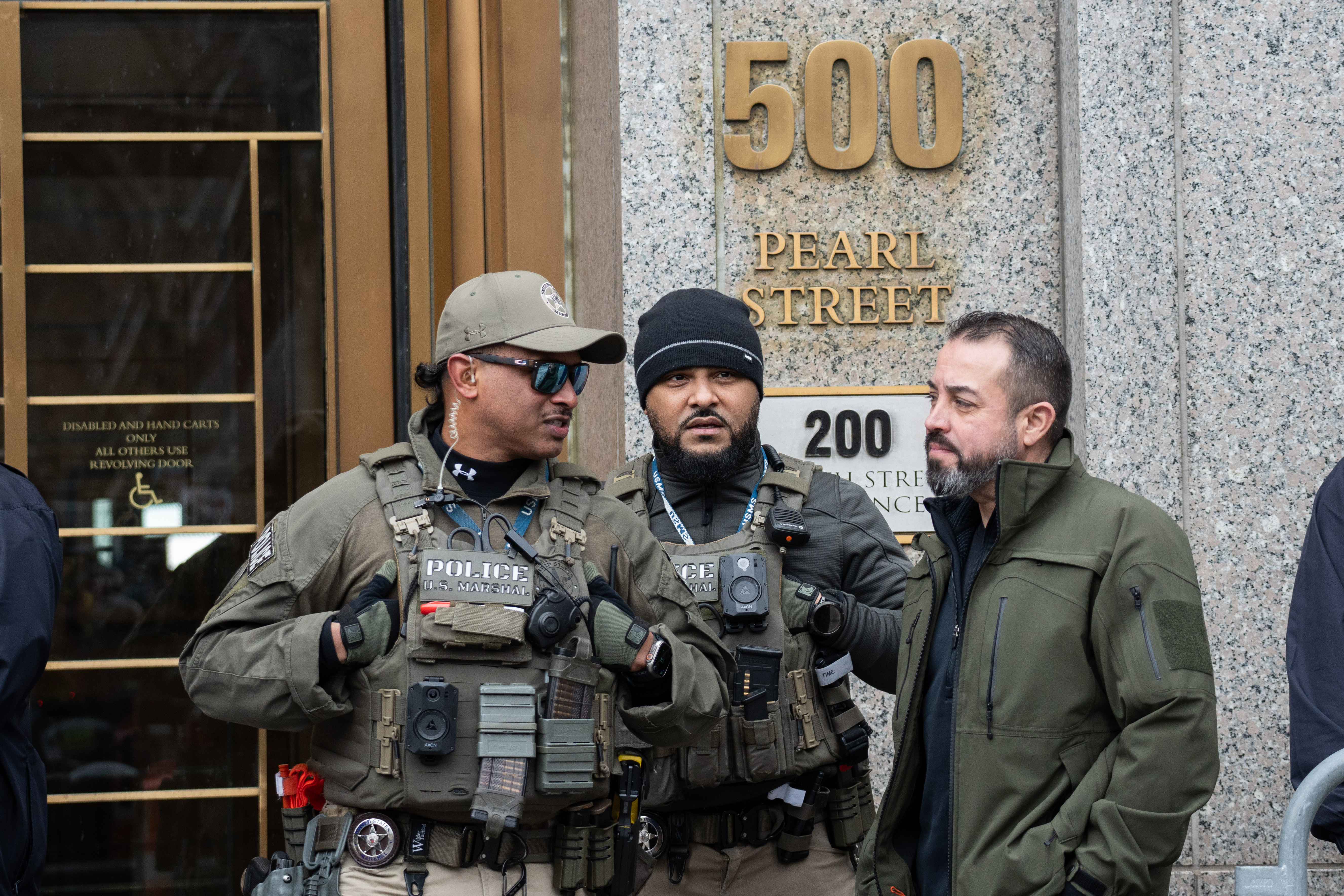
The clinking of Maduro’s handcuffs could be heard as he entered court, wearing khaki-colored pants and a dark-blue shirt that covered another that was bright orange. After the arraignment ended, Maduro walked away from the defense table in the custody of U.S. Marshals. As he approached the exit, a man in the gallery stood up and confronted him in Spanish.
The man was Pedro Rojas, a 33-year-old entrepreneur and political dissident who, in a twist of fate, was now free while Maduro headed for detention. Rojas ran for the Venezuela National Assembly in 2015 but later found himself jailed in 2019 for allegedly attempting to harm Maduro. During the hearing, attorneys for Maduro and Flores indicated the couple was harmed during the capture operation and needed medical attention.
When confronted by Rojas, Maduro stopped, turned toward the man, and raised his index finger. In a defiant response, he said, “I am a prisoner of war. And I am a man of God.” He also described himself as a “kidnapped president.”
“I am a man of God too,” replied Rojas, who interrupted him.
At the court were 40 to 50 reporters and dozens from the general public. The front row appeared to be lined with agents from the Drug Enforcement Administration, and there were dozens more in the courthouse.
So great was the interest in the fallen dictator that more than two dozen attendees paid professional line sitters from a company called “Line Dudes” to wait overnight in 25-degree weather. I lined up at 4 a.m., waiting outside until 8 a.m., when the court staff recorded our place in line before we were admitted to the main courtroom.
Just months earlier, Maduro had brandished a sword during a speech in which he vowed to defend his land from “imperialist threat.” Instead of a prison uniform, he wore one from the military. When the United States struck Caracas on Jan. 3, it was only a matter of hours before the operation wrapped up and Maduro was brought to the United States.
In the preceding months, U.S. President Donald Trump, who has been accusing Maduro of involvement in drug trafficking against the United States, had ratcheted up pressure on the regime by applying rounds of sanctions and imposing an oil blockade. He also accused the regime of working with Venezuela’s notorious Tren de Aragua gang.
Hellerstein also ruled against Trump’s targeting of the gang through the Alien Enemies Act, saying last year that Tren de Aragua was not engaged in a type of invasion that would allow Trump to invoke that law.