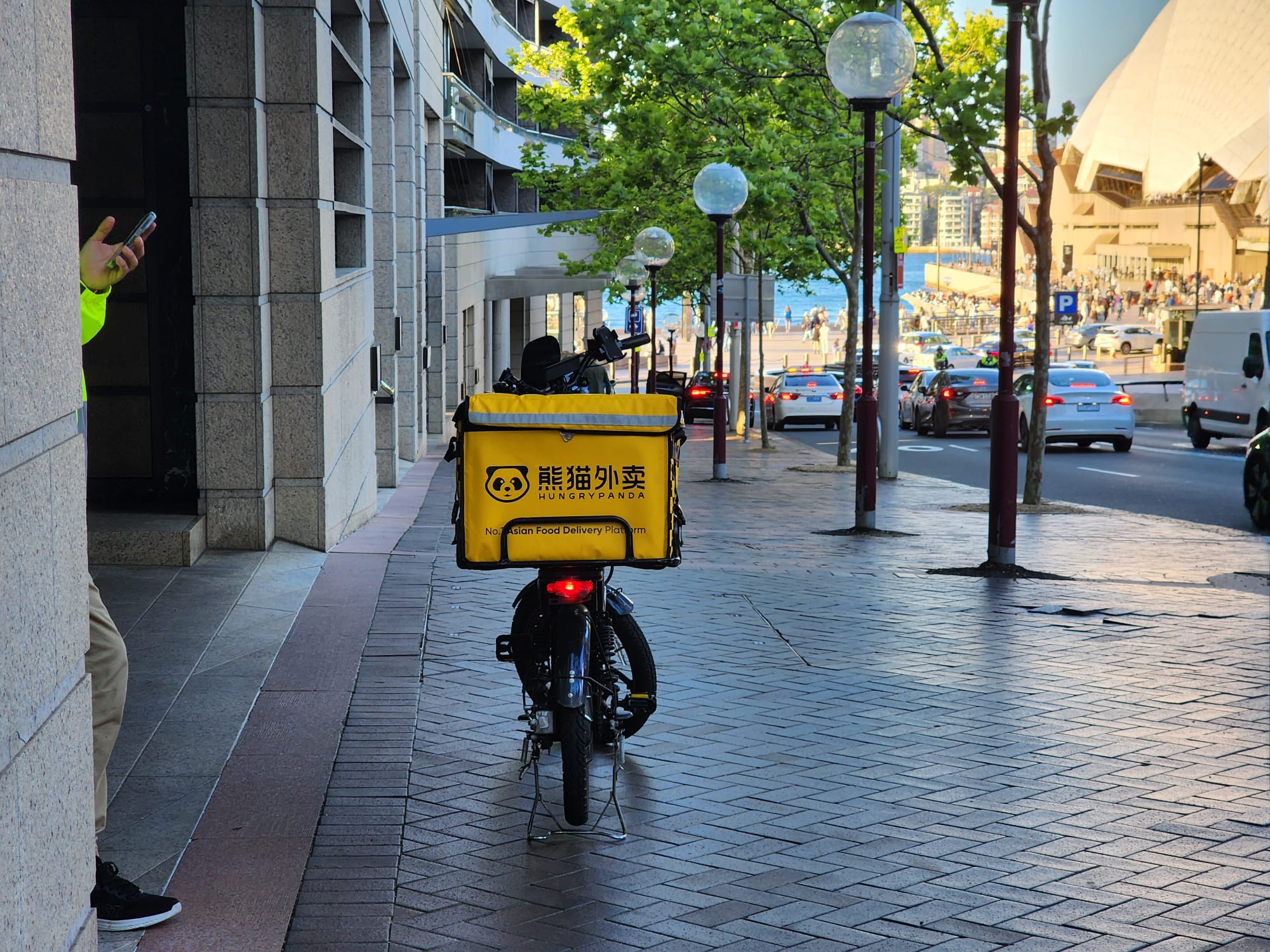

Some riders for the delivery service Hungry Panda in Sydney have abandoned their strike plan after facing pressure from police in China.
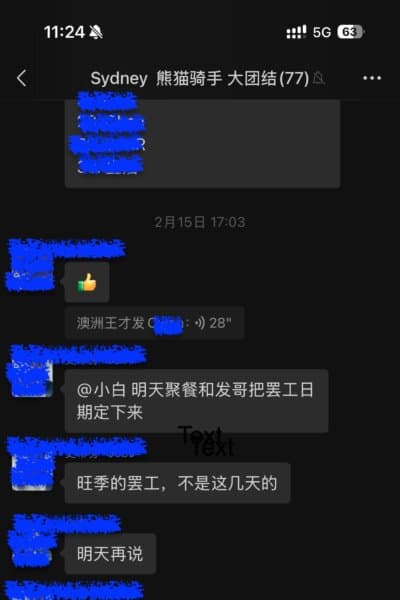
In February, multiple Sydney riders of the food delivery platform, Hungry Panda, discussed plans for protests or refusing orders in their group chat on the Chinese social media app WeChat.
There has been a long-standing dispute between the platform and some of its riders, who have complained about pay cuts and the lack of transparency in the app’s algorithm. On the eve of the Chinese New Year, dozens signed up to go offline during the business peak as a protest.
However, many Chinese riders said they soon received threats from Chinese police for organising or participating in protests. Riders said they were contacted on their Chinese mobile numbers, which they still use in Australia with international roaming.
Exchanges between Hungry Panda riders and Chinese police have been independently verified, including phone records from one rider showing incoming calls from a police station in central China’s central Henan province.
Founded in the UK in 2017, food delivery platform Hungry Panda entered the Australian and U.S. markets in 2019. It currently operates in 9 countries and over 100 cities, with around 6.5 million registered users and an annual transaction volume of approximately $1 billion.
The company operates in Sydney, Melbourne, Brisbane, and Adelaide. Many of its delivery riders are Chinese nationals on temporary visas, rather than Australian citizens or permanent residents.
Multiple Riders Exit Strike Plan
Wang, a member in the WeChat group who chose to withhold her first name due to security concerns, said that a strike the riders had planned for March 3 is no longer happening.
“Originally, [they] were planning to strike, but after all sorts of things happened, some of the riders got scared, some were privately contacted by [Hungry] Panda, and then internal conflicts also arose. Now, many of them have changed their minds,” she told The Epoch Times.
Wang, who has participated in multiple strikes against Hungry Panda, believes that it is an effective way to have a say with the company.
“You must use a strike to show them that we are not easily controlled. Only then will you have a voice,” she said. “If you don’t participate in the strike, Hungry Panda can easily ban your account and assign you as many orders as they want … We’ve dealt with Hungry Panda many times. I know how they operate and how they treat the riders.”
While the riders contacted the Transport Workers Union and successfully sought assistance, they have since changed their minds.
“Some may have been scared of the company’s retaliation; some of them had received threatening phone calls. Some riders were so frightened that they left the [WeChat] group after receiving those calls,” said Wang.
Another rider, Mr. Wang, who also received a call from police in his hometown in Xiamen City, Fujian Province, told The Epoch Times that some riders would continue to stop working.
Hungry Panda has been approached for comment.
First Time Being Pressured By China
This is the first time that Wang, who participated in strikes in 2021, 2023, and 2024, has been pressured by Chinese authorities.