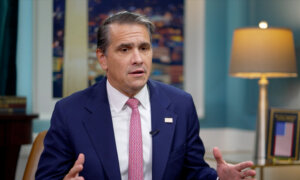
[RUSH TRANSCRIPT BELOW] A 2008 update to the landmark Trafficking Victims Protection Act (TVPA) is increasingly being used to target religious communities, says attorney John Lauro, and raising red flags for experts in constitutional law.
The definition of the term “serious harm” in the statute was altered to include psychological and other non-physical harms.
And in recent years, “that provision has been weaponized by plaintiffs’ lawyers,” Lauro says.
This could affect the many religious communities that involve members voluntarily giving their time or money to religious causes; some of whom may later become disillusioned.
“This statute … is like a dagger pointed at the soul of every voluntary religious community in the United States,” Lauro says.
An advocate for religious freedom, Lauro has worked as a criminal and civil defense attorney for decades.
Views expressed in this video are opinions of the host and the guest, and do not necessarily reflect the views of The Epoch Times.
RUSH TRANSCRIPT
Jan Jekielek:
John Lauro, such a pleasure to have you on American Thought Leaders.
John Lauro:
Great to be here.
Mr. Jekielek:
So, there’s a provision of the human trafficking statute. Alan Dershowitz is talking about it. Most recently, Eugene Volokh has written an amicus brief about it. And of course, you’re working on it, which is why we’re sitting here together right now. And basically, it targets people who are volunteering in religious communities but then perhaps have regrets sometime down the line. And so tell me what’s going on.
Mr. Lauro:
It starts with something which is very important and very positive, which is a forced labor statute that was passed by Congress and signed by the President about 25 years ago that prohibits forced labor or human trafficking, which obviously is an important public policy issue and should be and is condemned. But in the statute, Congress allowed for something called psychological coercion. If someone gives their volunteer time or gives their money and claims that they were psychologically coerced, then that could give rise to a criminal charge or big civil damages.
That provision has been weaponized by plaintiffs’ lawyers and also under the Biden administration by law enforcement and politically activist prosecutors to go after religious and spiritual minorities. It violates the First Amendment and it violates our Constitution and every principle that is important in the United States.
Mr. Jekielek:
And so I’ve been looking through a number of these cases now in quite a bit of detail. This is a scenario, or the scenario that I’m seeing in most of them is someone is involved, quite engaged, or a number of people are involved and quite engaged in work around that religious practice. And there’s a whole series, a number of them. And then later in life, decides, hey, you know, actually, I didn’t, I kind of regret having given my time to that and says, aha, you were—that was trafficking or that was forced labor. And that’s so that’s the kind of theory. Can you just explain how that works?
Mr. Lauro:
Let me give you two examples, sort of on the opposite side of the spectrum. The Maryknoll Nuns were sued by a nun.
Mr. Jekielek:
Who are the Maryknoll Nuns?
Mr. Lauro:
They’re a religious order in the Catholic Church, very well respected. They have outreach across the globe on behalf of poor and indigent people. The Maryknoll nuns are an established group within the Catholic Church. Several years ago, someone who wanted to be a Maryknoll Nun showed up and said, this is what I want to do. I believe in the spirituality of Catholicism. She works as a Maryknoll Nun, but part of that process is giving up volunteer work for the sisterhood, for the community.
A few years later, she says, it’s not my cup of tea. I don’t really think it was a good idea. Looking back now, she decided to hire a lawyer and claim that her labor was psychologically coerced. She believed in the teachings of the Catholic Church and the teachings of the Maryknoll Nuns and therefore brought a lawsuit. The Maryknoll Nuns had to spend thousands and thousands of dollars defending themselves under a forced labor statute.
To give another example on the complete opposite side of the spectrum, there’s this practice involving OneTaste, which is a spiritual, sensual, meditative practice that’s based on ancient Buddhist and Hindu Tantra. The people who were in charge of OneTaste got prosecuted criminally. They had a federal criminal lawsuit in Brooklyn, New York. I’m representing OneTaste now, the leadership there.
The theory was they brought in seven witnesses who said, at the time, I was enjoying this sensual spiritual practice. But years later, I felt that it wasn’t for me, and now I think I was brainwashed. There was no physical abuse, no physical harm. But looking back, my psychological will was overcome. These women were convicted. One got nine years in jail, one got six years in jail, believe it or not. It shows how the statute can be weaponized and used against spiritual or religious practices.
Mr. Jekielek:
Is there any situation where this makes sense?
Mr. Lauro:
Not to me.
Mr. Jekielek:
And where does this theory come from? I guess that’s the real situation.
Mr. Lauro:
It’s a good question. So it comes from a good place. We want to protect people who are abused. But when you say psychological harm or psychological coercion, I think it has to be serious harm, right? Technically, it’s not even serious. Well, it has to be serious harm, but they say psychological harm in the statute. The Supreme Court had this issue about 25 years ago, and the Supreme Court warned Congress.
In fact, it was interesting. Two Catholic judges, Justices Brennan and O'Connor, said, “If you apply psychological coercion and use it in a forced labor context, then what you’re doing is you’re opening it up for religious communities to be sued because a religious leader could be very influential, could be very persuasive, and then someone years later could say, you know what? I think that I was overly persuaded, I was psychologically coerced to give my free time and energy and money to the religious community. And now, that’s a crime.
Mr. Jekielek:
I mean, fascinating. And so you’re basically saying, is there such a thing as psychological coercion, or is there no such thing? I mean, in law is one question. In reality, how do we square this?
Mr. Lauro:
There is certainly psychological persuasion. As a free-thinking person, I can either accept, if you’re very compelling, your viewpoint or not accept it. But that’s the whole concept of free will and accountability. And if I accept your spiritual teaching, however ominous it may be to other people, that’s my decision in exercising free will, and the Constitution protects that. Now, what the Constitution does not protect is otherwise unlawful activity. So if you try to persuade me to hurt somebody else, well, that’s not protected.
But if I want to practice some kind of spiritual or religious belief, however obnoxious it may seem to you, that’s protected. And if I decide to give voluntarily of my time, my energy, my money, then that’s also protected, and it should never result in a crime or civil damages. But what’s happened is it’s been weaponized by plaintiffs’ lawyers, and it’s been weaponized by certain people in law enforcement.
Mr. Jekielek:
There’s another case that I’ve been reading about, which was the Salvation Army. And I’m just going to comment on this because a lot of people don’t even realize the Salvation Army is a Christian sect. But that sort of helping the downtrodden is part of that process. And I don’t know how the work exactly fits into it, but clearly it’s very important. They have these stores, they have lots of volunteers. Tell me a bit about that case.
Mr. Lauro:
Again, it shows how horrific the statute is in its present form. So the Salvation Army is Christian based, and it practices something called tough love, which means you have to work for your room and board. So it had, I believe it was in Chicago, a program where people who are on probation or in divorce programs would have to work at the Salvation Army. They weren’t paid. They were given room and board, but it was sort of a tough love program to get through if you’ve done something wrong. That makes sense to you and me.
Well, these participants years later said, I was coerced. My psychological will was overcome. And as a result, I’m going to sue the Salvation Army for forced labor.
Mr. Jekielek:
And in this case, was it a religious issue, or is it just the fact that they happen to work there? I mean, we’re not just talking about religious scenarios here, right? We’re talking about any sort of scenario where someone convinces someone to provide work free of charge, or they do provide work free of charge because they very much want to, or like this applies.
Mr. Lauro:
100 per cent. The Salvation Army was religious based because it was a Christian based organization. statute’s been used against families or parents in parental situations where the allegation was mom or dad or someone in that position says, I want you to do chores. And the child years later says, I was coerced and psychologically forced to do chores, and that’s now forced labor under the statute.
Mr. Jekielek:
What’s happening here? I know in this OneTaste case, it’s on appeal. There was a criminal conviction, quite significant convictions. The case is on appeal. What are you trying to accomplish here?
Mr. Lauro:
First of all, concerning OneTaste, I didn’t handle the trial. I became involved later. Now, Professor Dershowitz is involved. Professor Eugene Volokh is involved. And what they’re saying, and I agree with them, is that the prosecution violates the First Amendment because the government’s theory was not physical harm, not any kind of physical abuse, but that this spiritual and sensual practice was so persuasive that it overcame the will of the individuals who testified at trial.
Mr. Jekielek:
I’ve looked through this quite extensive amicus brief. Could you give me just a simple, brief explanation of this amicus brief by Professor Eugene Volokh?
Mr. Lauro:
Professor Volokh is a wonderful scholar, a constitutional scholar. He looked at the OneTaste case and said, I may not agree with this sensual spiritual practice as something I would be interested in, but I’m going to defend the right of individuals to freely engage and give voluntarily of their time and energy in a spiritual community, without any physical abuse, without any kind of restraint, everybody was free to leave. So, all of the witnesses in the case said, while I was participating, I enjoyed it; I was free to leave. But eventually, it became something I wasn’t interested in. And then years later, looking back, oh, I think I was psychologically coerced.
The brilliance of what Professor Volokh says is that’s what our Constitution protects. That’s exactly the kind of religious, spiritual, communal practice that our Constitution envisions. It has the protection of government, not the hatred of government. And he wrote this wonderful brief, which was submitted to the court in support of the OneTaste folks, Nicole Daedone and Rachel Cherwitz, and said they should be released instead of spending years in an abyss in a jail. They should be free. And the argument was based on the core First Amendment principle that in the United States, you’re entitled to follow and practice your religious belief and associate with those who share those values.
Mr. Jekielek:
What is it that can be done in a situation like this? Because at the moment, this psychological coercion does exist as part of that statute.
Mr. Lauro:
It’s a brilliant brief by Professor Volokh, and it really lays out the constitutional violations. We’re hoping that we can persuade, not psychologically coerce, but persuade the Department of Justice to reverse course and dismiss the charges. It was brought under the Biden administration by very, very woke and aggressive prosecutors that wanted to use this theory as an example of how women’s free will could be overcome by persuasive authority or persuasiveness, even in the absence of any physical abuse by persuasive authority.
Mr. Jekielek:
And why this case?
Mr. Lauro:
It shows how the statute can be used against religious minorities and spiritual means.
Mr. Jekielek:
So you think this would, it was, you believe it might have been picked for this purpose?
Mr. Lauro:
I think it was picked because it had a certain degree of sensuality and physicalness, sexuality involved. And there were cases that were in the legal system that may have facially resembled it, but it was totally different because it was very similar to what was practiced years ago in Tantra Hindu tradition, and it was used in an inappropriate way. The statute was used to go after a religious, spiritual minority.
Mr. Jekielek:
So, okay, this is important, right? Because we do have, within this statute, sex trafficking, for example, is a criminal offense. And you’re saying that the approach to this is something completely different.
Mr. Lauro:
Totally separate. Trafficking was not involved in that case at all, and no one is suggesting that there should be any limitation on sex trafficking statutes or criminal prosecutions. But what should not be used is a situation where the statute is used in the case of any kind of spiritual or religious practice. In fact, there should be a special carve-out, that if someone truly believes in good faith that they are practicing a spiritual or religious pathway, forced labor should not be involved in that situation at all. And if you decide to give your free time and labor under those circumstances, then that should not be a violation of federal law.
Mr. Jekielek:
So, okay, if I understand you correctly, you’re basically advocating for some sort of an amendment to the statute that would make it so someone at the time is, based on their belief, willingly enacting that belief through a type of volunteerism that would be exempted from the statute.
Mr. Lauro:
100 per cent. It has to be. In fact, there was a book recently, recently written, that accuses Christianity of being a forced labor cult. That the teachings of Jesus were so persuasive that Jesus’ followers were engaged in an effort to obtain voluntary labor inappropriately in a cult-like manner, fashion, and psychologically coerced and overcame the free will of Christians. Think about how outrageous that is, but the forced labor statute could be used in that circumstance.
Mr. Jekielek:
You know, so, as I’ve been reading these different cases and just kind of starting to understand the statute better, it almost feels like an attack on volunteerism itself. I mean, it’s weird because that’s a centerpiece of what makes America tick, in fact, right? Civil society has been the engine of America since the beginning, I think. And is this the sense you get at all?
Mr. Lauro:
100 per cent. It’s the bedrock of what makes America different in terms of people from all different backgrounds coming together and often volunteering their time and energy in a spiritual community or as part of a religious practice. I also represent followers of Falun Gong and Shen Yun who are being sued now. In an example of this statute, plaintiff’s lawyers are saying that individuals who participated in Shen Yun performances, attended school, received room and board, received stipends, and had their labor forced because of the spiritual teachings of Falun Gong.
So, we are all now involved in a very significant lawsuit that was filed in New York using this statute. I feel it is being used inappropriately, but with the same sort of theory. It is being used against spiritual practices, as it was being used against the Maryknoll Nuns and other religious activities as well.
But what you’re saying is, let’s take a spiritual community where people are volunteering their time and energy, they share values, they share a spiritual or religious viewpoint, and then years later, maybe they change, or maybe their spiritual path takes them in a different direction. And they say, wait a minute, I was psychologically coerced. I now want to sue because I was coerced in some way or even brainwashed, and I don’t believe in the practice anymore. But I gave all this time and energy, and I’m going to get money for that.
And what’s ironic is that oppressive regimes around the world often characterize religious minorities as cult-like or inducing forced labor or suggesting that there’s something criminally wrong with volunteering your time, following a charismatic spiritual leader, or following certain religious principles. And that’s based on the belief among those oppressive regimes that you should follow just one religious practice, and that’s their practice. And that’s an anathema to the United States and our principles of law and Constitution.
Mr. Jekielek:
You know, it’s fascinating. And I hadn’t, I obviously am very aware of what you’re talking about. I just hadn’t really thought about it in that particular way because in that case, it’s very obvious that, you know, Chinese communism functions as a replacement for all the other faiths. And it sort of demands, in a way, tolerates it at low levels as long as it doesn’t get too popular, or too many people are committed to it because it would be impossible to stamp it out entirely. But then when something becomes influential, they just try to destroy it using any means.
Mr. Lauro:
I’m going to go one step further because I believe there’s a trend in the United States right now among some, particularly on the far Left, that look at wokeism as sort of a religious substitute. And if you don’t believe in the state religion of wokeism, then we’re going to come after you. In fact, in the Biden administration, there were statements made to the effect that we’re going to take a hard look under the forced labor statutes at religious organizations. And when you look at the record of that administration, clearly they targeted religions.
In fact, the OneTaste case came out of the Biden administration, where these prosecutors went after a spiritual practice on the forced labor theory. So all of that’s coming into fruition, and I think it’s ideological. What I’m really concerned about most of all is what the future is going to bring. And if this statute’s allowed to stand, it gives a weapon into the hands of those who hate independent, non-state religious practices, and that should never be.
Mr. Jekielek:
Going back to the Shen Yun case, there was part of one of the cases, it was the New York Department of Labor. And so that has already been settled. It took them a year-and-a-half, I think. They looked at the labor practices, and they found no evidence of any sort of coercion or even underpayment or anything like that. Does that impact this case, this New York Labor Department finding?
Mr. Lauro:
Let’s look at it this way: all states and the federal government allow students to attend school on scholarship, and they play volleyball or football for free. They don’t get paid for it. They get compensated in other ways. They get a scholarship, room and board. They get training. They get community values. And it’s not against the law. It’s not against the labor law. It’s permitted in New York State and everywhere around the country.
Think about if, under those circumstances, every single athlete or dancer or participant in voluntary activities in a school setting could come back later and say, you owe me money, because I volunteered my time and energy. I was psychologically coerced in some way, I was mistreated, and I want back pay. The relationship was not one where you were separating the benefits to the student in terms of room and board, training, education, shared values, and community experience. You can’t put a monetary value on that.
But under this statute, it allows plaintiff’s lawyers to sue and seek, in effect, damages, multiple, multiple times of damages, what it would be in terms of any kind of employment case. So even if the York State Department of Employment, or whatever bureaucracy says it’s okay, you still have this statute which is like a dagger pointed at the soul of every voluntary religious community in the United States.
Mr. Jekielek:
Just if I may comment, this particular case strikes me as bizarre because we’re talking about a situation where, yes, there are students learning how to do classical Chinese dance at an elite level, and some of them become good enough to then perform on the world stages at the elite level. They go on practicum. They get to participate in this incredible thing, visit, you know, and be on all the world stages and so forth. So it’s like, it feels like a kind of an honor. It’s like, you know, it’s very hard for them to actually get that. So the idea that that would, and that’s really, that’s the work that’s being sued for, I think. So it just strikes me as bizarre that this…
Mr. Lauro:
Look at Notre Dame football. You get a scholarship to go to Notre Dame, and maybe you also look at it as part of your spiritual pathway. You get to go to Notre Dame and be part of a Catholic community, and you look at football in that. In that sense, you also get to demonstrate to the NFL [National Football League] that maybe I'll be an NFL player, and at the same time, I get a wonderful education. Could that player years later say, you know what? I want to be paid as a professional, because I was psychologically coerced based on my Catholicism or based on my religious beliefs.
Mr. Jekielek:
You know, when I was asking you about the finding of the New York Labor Department, I was thinking more that their finding is actually helpful to your side of the case because it says there was no issue. But of course, it’s some kind of different jurisdiction. Like, I don’t understand how this works exactly.
Mr. Lauro:
It certainly is persuasive and helpful, but it’s not determinative because that’s just state law, and this is a separate federal law, and that’s why we need protections regarding this federal law.
Mr. Jekielek:
I understand that you’re interested in this specific carve-out for religious beliefs that people are enacting in good faith, and then the law is kind of weaponized in a way by people who have regrets subsequently or by their lawyers and so forth. But I want to explore just this idea that the more I talk about it with folks, the more I learn about it, it just feels like something that goes much further than faith. Of course, there can be very persuasive people, but just because someone is super persuasive doesn’t mean that you’re not accountable for your actions, like, just conceptually, right?
I kind of feel like our society is heading in a direction where we’re absolving people of responsibility for their actions for spurious reasons. And I understand people can be incredibly persuasive. That’s reality. Those people have an advantage in life, I suppose, if they can be particularly persuasive. But how could that, how could that actually make it so that we’re not accountable for what we did because of that persuasion?
Mr. Lauro:
It’s a negation of free will because each person can make a decision, either on their own or if they’re a child in the family context, of pursuing a spiritual, religious belief or a pathway, assuming it’s not illegal in some way. And then years later, if they decide that’s not their pathway, they still need to be accountable for the free will that was exercised at the time that they decided to follow that. Now, I may have regrets about a religious practice or spiritual practice that I entered into years ago. But I own up to it. I’m not going to blame somebody else for it. I take responsibility.
Mr. Jekielek:
Well, or just for something that you chose to volunteer for, for some other reason that’s self-gratification. I don’t know, go ahead.
Mr. Lauro:
I'll give you another example. So there’s Steven Hassan, a writer who talks about brainwashing, and he’s deep into the concept of forced labor. In fact, he was someone that advocates that the forced labor statute should be used in this way. Well, he characterizes supporters of President Trump as being in a cult, and that they’ve been brainwashed, and that they give up their time and energy in support of President Trump.
And if you ask him, he would say, I believe that you could use the forced labor statute under that circumstance, because if you take him literally, what he’s saying is that political supporters have been brainwashed, they give up their time and energy, and then they’re criminally victimized under this forced labor statute. That’s how ludicrous the statute is right now.
Mr. Jekielek:
You would argue that this is obviously being done selectively because there are all sorts of political leaders out there who get people to volunteer all sorts of massive amounts of time. For supporting their campaigns.
Mr. Lauro:
That’s the danger of the statute. It leaves too much discretion in the hands of government and in the hands of plaintiffs’ lawyers to bring these lawsuits.
Mr. Jekielek:
So let’s talk a little bit about your background because you were one of these rare lawyers that defended President Trump back in the day. Tell me a little bit about how you came to be in that scenario.
Mr. Lauro:
It was the best thing I’ve done professionally, but I started my career as a federal prosecutor years ago in New York City. Then I had a small boutique defense firm. And about three years ago, I got a call and was asked to meet with President Trump. At the time, no big law firm in the country would take on his case. This was between the 2020 election and the 2024 election.
And a group of us came together, including the current Attorney General, Todd Blanche, exercising tremendous courage because we were facing insurmountable odds against a weaponized government that wanted to do in not just President Trump, but an entire political movement. And we stood firm. Will Scharf, John Sauer, Chris Kise, Todd Blanche, Emil Bove, a good core group of us, defended the president, and we won. And the president won, and the country won, because we beat back the concept of a weaponized criminal justice system.
Mr. Jekielek:
What made you decide to do this? Presumably, you had to think about it quite a bit. Presumably, there were people that said to you, if you do this, it’s the end of your career. I would guess there were a few of those, but tell me about that.
Mr. Lauro:
There were numerous people that not only said that to me but acted that way and shunned me and criticized me in social media, refused to talk to me because I represented President Trump and took on the weaponization in the Biden administration. So sadly, particularly among former federal prosecutors who, instead of obeying the rule of law, looked at my participation in that defense as somehow being unethical or inappropriate, but I felt in my core President Trump deserved a defense and a vigorous defense because what was happening to him was outrageous. It could happen to any American and it had to be stopped.
And thankfully, it was stopped by the American people who saw through what Jack Smith and other prosecutors, I'll call them persecutors, were doing to a political movement. It was outrageous. It was the best thing I’ve ever done. I would do it again in a heartbeat. It was the right thing to do, and it’s not very often that a lawyer gets that opportunity. I’m very grateful to President Trump for having that chance to represent him.
Mr. Jekielek:
How did you find yourself working on this particular type of First Amendment case?
Mr. Lauro:
They actually came to me after my representation of President Trump, but I saw the similarities in terms of how the legal system was being weaponized. In the one case, in President Trump, in connection with a political movement, and now with this forced labor statute in connection with religious minorities. The principles are the same. The power of government should never be used in a way that abuses constitutional rights.
Mr. Jekielek:
You know, I saw a little bit of Alan Dershowitz, who’s been on this show a number of times before, thoughts around this. He actually, I’m going to quote from him, he says, “America’s first president promised that the new nation would give to bigotry no sanction, to persecution no assistance. It was more than a gesture of tolerance. It was a radical pledge that this country would never criminalize belief.” Fascinating.
Mr. Lauro:
I couldn’t have said it better, but that basic principle is under attack right now. And there’s a clear and present danger that we’re going to lose those rights.
Mr. Jekielek:
So, what do you think is the path to rectifying the issue? What is the best path that you see to rectifying this issue?
Mr. Lauro:
First of all, knowledge, and I’m grateful for you giving me this forum. Second, activism. We’ve been able to get a number of religious leaders interested now in this issue. It doesn’t sound like something that leadership would be involved in, the forced labor statute. But once religious leaders realize it could be used against religious communal practices, they’re very, very active. And they’re concerned about it.
And then finally, there has to be political movement. We are truly blessed by the Trump administration’s protection of religious rights. And I fear that one day we may not have the blessing of a very, very protective administration. If that protection is gone, then a Justice Department or plaintiff’s lawyers can use this statute as a weapon against religious minorities. And that’s my concern.
Mr. Jekielek:
John, thank you so much for coming on the show and kind of elucidating this whole case and this provision and this statute. Is there anything else that you'd like to share with me as we finish up?
Mr. Lauro:
I think there is, and it’s something that really affects me personally, which is taking for granted our constitutional protections and our rights, which I’ve been a lawyer for almost 40 years and never had to think about these things until the last four or five years. But it’s very, very ominous that our rights can be taken away at a moment’s notice, and we have to be vigilant at all times.
Mr. Jekielek:
Well, John Lauro, it’s such a pleasure to have had you on.
Mr. Lauro:
Pleasure to be here, Jan. Thank you.
This interview was partially edited for clarity and brevity.