
[RUSH TRANSCRIPT BELOW] During World War II, America learned a hard lesson about the strategic importance of the small island nations scattered across the Pacific.
Among them is Palau, a nation of 18,000 people in what’s known as the second island chain. It’s home to the bloodiest battlefield of the Pacific theater, on the island of Peleliu.
Today, as the Chinese regime prepares for a possible invasion of Taiwan, Palau finds itself on the front lines again. It’s one of only 12 countries that diplomatically recognize Taiwan, and one of only three with a Compact of Free Association with the United States—an agreement that gives the U.S. exclusive military access to Palauan waters in exchange for providing defense, postal service, economic assistance, and other benefits to Palauans.
Palau’s strategic position has made it a target. The Chinese Communist Party (CCP) has ramped up gray-zone tactics and information warfare across the region to pull small Pacific nations away from Taiwan and the United States.
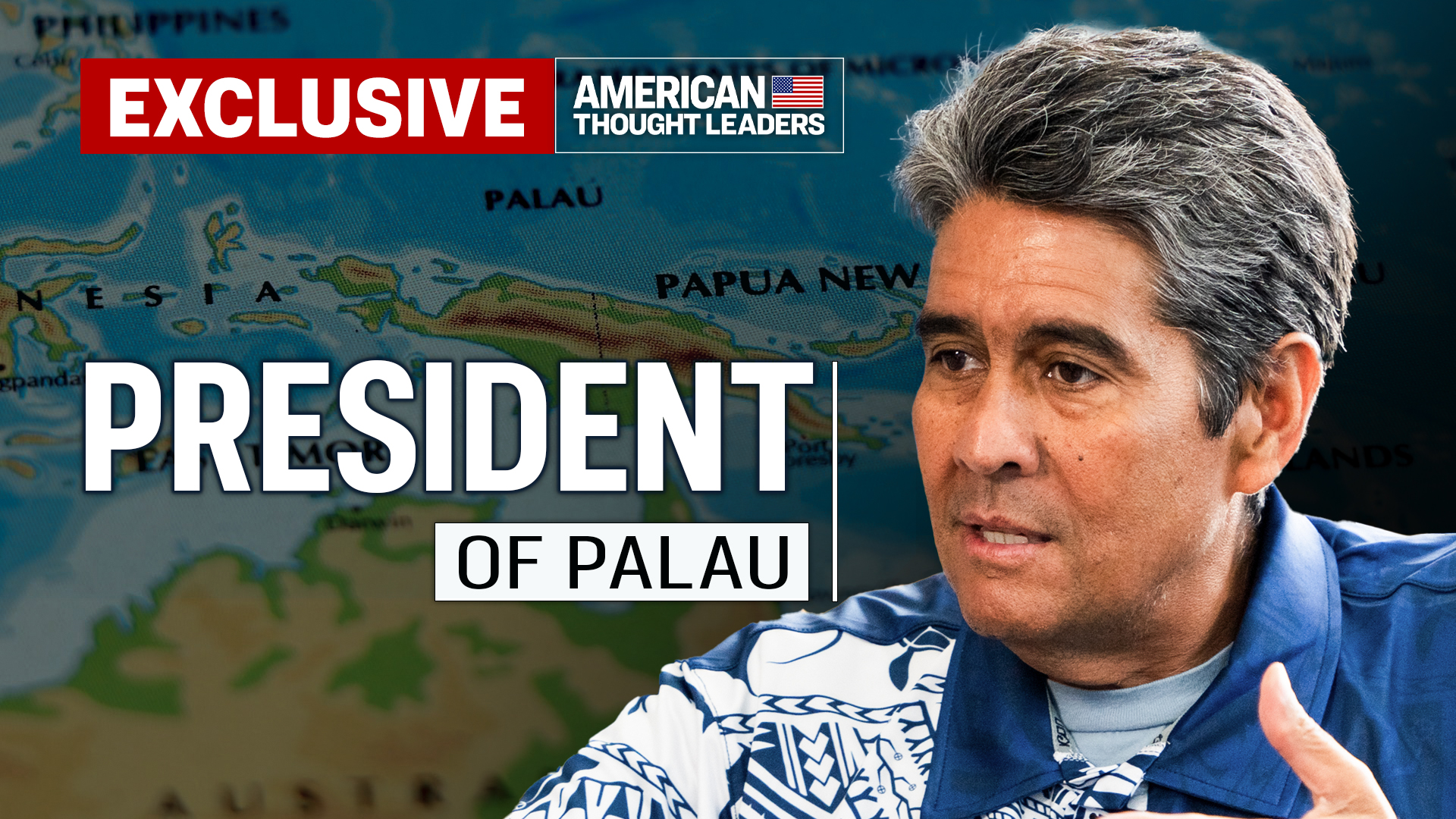
In this episode, I’m sitting down with Palau’s President Surangel Whipps Jr. Half-American and half-Palauan and born in Baltimore, Whipps decided to give up his American citizenship to serve as president of his father’s homeland and chart a new course for its development.
In this episode, Whipps explains how Palau is defending its sovereignty against foreign encroachment and shares his vision for the country’s future.
We cover how the CCP has threatened Palau, how the Compact of Free Association shapes U.S. regional defense strategy, why the U.S. military is building radar sites on the island, and how Western private sector investment can help secure a free Indo-Pacific.
Views expressed in this video are opinions of the host and the guest, and do not necessarily reflect the views of The Epoch Times.
RUSH TRANSCRIPT
Jan Jekielek:
President Surangel Whipps Jr., it’s such a pleasure to have you on American Thought Leaders.
President Surangel Whipps Jr.:
The pleasure is all ours, and welcome to Palau.
Mr. Jekielek:
I’ve had an absolutely incredible experience here over the past week or so. One of the things I’ve learned is that you were born in Baltimore, but you actually gave up your American citizenship so you could serve here. I want to get a sense from you; what does Palau, what does this place mean to you?
President Surangel Whipps Jr.:
To be clear, you can only be Palauan if your mother or your father is Palauan. If you run for public office, you can only be Palauan. I was born in Baltimore. My parents met there. My mother’s from Frederick, Maryland. My father convinced her after they finished college to move back to the Pacific. They actually first went to Pohnpei for a year, and then we moved back to Palau. I was only four years old, and we’ve been here since, except for going to university.
So, when the time came where I had to give up my U.S. citizenship, or basically the ability to become a U.S. citizen, I talked to my mother about it. The reality is, we’ve lived here basically all our lives. My mother said, this is our home. So even though it felt at one point like I was giving up, having to give up half of me, right? She understood that this is our home, and this is what we’ve made it. So I feel blessed to be a Palauan, to live in this—we call it a pristine paradise.
One of the things that my father always believed in was that he went to school, but he wanted to come back to help this country develop. He had a very rough time growing up. His father passed away when he was only one. Then both his stepparents died—adopted parents, who he calls parents—by the time he was seven. He kept moving from family to family. He even told the story that when he went to get on a ship to go to Guam, there was nobody to see him off, so he went to the other side of the vessel. But he still felt this burning desire to come back.
It wasn’t easy for me growing up here. For my mother, of course, coming from Maryland, it was quite a culture shock. But, you know, some of the things that maybe she enjoyed there helped us start our family business, which got us into groceries and everything from making sure that you have cheese or lettuce or certain kinds of things on the shelf. It helped influence the way we ran our business.
So I have to say that mix of culture, mix of opportunities, allowed us to grow up in a very challenging place at the beginning, but really a land of opportunity. That mindset is really what helped me. Going to university, that was my goal. I wanted to get an education, come back as soon as I could, help our family business, but eventually give back opportunities that my father saw.
My father always said, we’ve been able to be successful here in Palau. We should try to ensure that every child here that grows up knows that there is potential in Palau, and the opportunity is really up to you to carve out. But government should not be impeding; it should be helping support that land of opportunity. And that’s why our slogan is, Palauan First, but really it’s about building the Palauan dream. They want to live the American dream. We want kids to understand that the Palauan dream is better.
Mr. Jekielek:
Well, and I understand that’s actually a challenge here because, and we'll talk about the Compacts of Free Association [COFA], Palauans have an unusual ability to travel to the United States, to live there, to work, to serve in the military, which they do in disproportionate amounts for the population, all of that. But some of them maybe don’t want to come back as quickly, but you did. I want to understand at a deeper level where that comes from, even though there’s this lure of huge opportunity, say in America and elsewhere.
President Surangel Whipps Jr.:
You know, there’s something about being part of nation-building, being part of something that you can make a big difference in. When I was in grad school at UCLA, my classmates at the time—I was getting my MBA—so a lot of them were going to New York for interviews. They were, you know, Silicon Valley. In 1992, that’s where most of the jobs were. And then they asked me, why are you not interviewing?
I said, no, I came here to go to school, but my plan was to go back home, help our family business, and then eventually serve the public. I think my father said it best. He says, don’t you want to be a big fish in a small pond rather than just a fish in a big pond? That’s really the opportunity you have. If you come back home, you can make a difference in your community. And that’s what we want to help our young people understand.
The problem is, you’re right, when they see you’re making $5 an hour, you get off a plane in California, you’re working at McDonald’s and making $20 an hour. But that $20 an hour in California, and you’re paying $2,500 a month for rent for a two-bedroom house. You have to put things in perspective, or so much for insurance. People think that the opportunity is great, but you have to put everything in perspective.
One of the things we’ve been working hard on here is trying to raise wages, trying to create opportunities so that our kids can see that there is a future. Because unfortunately, two-thirds of our population has moved to the United States over the last 50 years, partly because of the military. And so, one of the things that I’ve been working hard on is trying to get the U.S. to understand the importance of giving veterans benefits to those who have served to bring them back.
My father served in the U.S. Army. Veterans can really contribute to nation-building. And just having that confidence to come back home and being able to avail oneself of those services is key. We’re getting there. It was in this last compact. I think the Veterans Administration is finally seeing the light.
But it’s also a security issue. If you think about security, these are the people that you want to bring back to the islands because they have the values, they have the understanding of what it means to fight for freedom and democracy. That’s the kind of people you want here.
Mr. Jekielek:
Palau is in these Compacts of Free Association with two other countries across the Pacific. It’s a very unique treaty, a deep, deep relationship, I think unique in the world. And so the American presence is significant in different ways, and I guess I want you to help me understand how that manifests here.
President Surangel Whipps Jr.:
It’s intertwined with everything from the people-to-people relations that begin with the Peace Corps, for example. I know there are so many Peace Corps volunteers that have had a huge impact in Palau. From our Minister of Education, who came in the 70s, was a teacher, went and lived in Guam and Saipan, married a Palauan, came back to retire, and helped us reform our education system.
We have my favorite story about a Peace Corps volunteer that married a Palauan that ended up being a librarian here, went and got his PhD in computer science, and then created an online Palauan dictionary where you can just go in and type any word and translate it to Palauan or Palauan to English and vice versa. So the American influence runs deep.
Then there is High Chief Rakhlai, who’s now 94-years-old, who was a retired Marine, or High Chief Ibadul, who had passed away, who was also in the army, and my father, who was also in the army. You have that influence, and then you have just what the U.S. has done over the years to help us develop.
When we were going up to the PIF leaders’ meeting up north, we rode on the compact road, and they said it’s a beautiful road. I said, yes, that was built by the United States under the Compact, and it was a compact—we call it the Compact Road. It’s actually been up for 20 years, but you know, it makes a difference when you have the right specs, good engineering. It was built like the interstate system in the U.S. One of the specs was to carry M1 tanks, for example.
But there’s a lot of rhetoric, and people are concerned because, of course, people have the memories of World War II. As you know, Peleliu was the scene of one of the bloodiest battles. I think the U.S. had the worst casualty rate of any war or battle. For Palauans, it makes us want to live in peace and harmony and not experience that again. But the reality is, if you think that way, that’s good. However, because of our location, we’re always going to be the center of interest, geopolitical interest.
What’s important is you have to find the right partners to work with, that you share the same values: freedom, democracy, rule of law. And Palau made that decision with a compact. It was to give our security and denial rights to the United States. And, you know, a lot of people say, that’s just for the protection of the United States. But I think we also need to understand that it also is for our own protection.
When I first met with the U.S. military, we had what we call Joint Committee Meetings [JCM], twice a year with the Defense Department. The first thing they showed me was a map of the Pacific; they showed all the FAS [freely associated states], and they said, Palau is protected just like it’s part of the homeland. And I think that’s an important message for people to understand that the protection of Palau is just like the United States treats it—just like Guam or CNMI [Commonwealth of the Northern Mariana Islands] or California. That’s the sphere that we’re in.
In order for us to be a good partner with the United States to ensure the security of the United States, Palau has radar sites. People say that we’ve become a bullseye. That’s, I think, an important thing that we need to remember. The United States wants to improve our ports, or they want to improve our airports. That is a good thing because if the United States is ready and capable to defend, we’re protected.
That’s something that we need to help people understand because a lot of times they don’t understand that. If you want prosperity and you want growth, you need peace. And the bottom line is, I believe in the theory that President Reagan said, if you want peace, it comes through strength.
President Trump says the same thing. That’s an important message for people to understand. This false security—that you think that if we’re just out here in the Pacific, nobody’s going to be interested in us, and we can just live and be happy—to me, is a false sense of security. We need to understand that in the world that we live in, there’s always going to be competition. And that’s why it’s so important that we choose our friends and choose our friends carefully, and then work with them to ensure that they are strong and able and that we can continue to maintain the peace and prosperity that we have.
Mr. Jekielek:
It’s very interesting. You describe Palau as a bullseye. And as we’re speaking, we'll put up a little map of the area so people can see exactly where Palau is located in the Second Island chain and why it’s of such strategic importance to the United States, but not just to the United States potentially, right? This was the seat of where the Japanese government set up and was the South Seas headquarters for Japan.
President Surangel Whipps Jr.:
That’s right.
Mr. Jekielek:
And of course, there are other powers that are also very interested, which is why I’m going to talk—I’m going to read back something that you told me when we first met in front of the one-stop shop earlier, because I thought it was very pointed. You said you’re talking about an interaction you had with the Chinese envoy. And you said, if you want someone to love you, usually you come with chocolates and nice cards. But these guys, you start with one sweet word, and if you don’t behave, they slap you. And they say that’s love, but that’s not partnership. And you’re talking about the importance of partners. So flesh that out for me a little bit there.
President Surangel Whipps Jr.:
With a partnership, it’s just like marriage or just like when you’re courting somebody. You try to understand each other. If you’re wooing somebody, you definitely want them to understand what your good qualities are, that affection, but that’s not what we’ve experienced. Every time I have meetings with the Chinese, what they’ve done is they first tell me how wonderful they are, and then they turn around and say, if you don’t behave, we'll beat you up.
I don’t know how that translates into trying to woo somebody, but usually that’s not the way you woo somebody. That’s usually how you end up in prison for beating your wife or other things. So this is what I see as being a challenge. They’ve told us, we can build all the hotels you want, bring you a million tourists, but then if you don’t switch, then we'll cut off the tourists. This has been the narrative.
Mr. Jekielek:
And just, if I may, when you’re talking about switching, you’re talking about this diplomatic recognition from Taiwan to the mainland.
President Surangel Whipps Jr.:
They keep on saying, what we’re doing is illegal. You have to stop doing illegal activities. There is the One China principle. Well, obviously, Palau recognizes Taiwan, so the One China principle doesn’t apply in Palau. It only applies in countries that recognize China. It doesn’t apply in Palau, but they continue to tell us that what you’re doing is illegal. Well, we believe that every country that has a right to self-determine should be allowed that right, just like us as a small country. We’re able to say we’re part of the UN; we have a voice, even though we’re small.
I was talking to a Chinese diplomat, and we were talking about our extended continental shelf, for example. And I was saying, there seems to be a misunderstanding at your government’s level about our claim on the continental shelf. Maybe you can help us with it. Finally, they just got upset at me and they said, you’re a small country. You shouldn’t have so much ocean.
I thought that’s an interesting way of putting it. They also said, you’re a small country. We’re a big country. Okay. I said, but we’re still countries. But that’s just the way they think. In this global world that we live in, mutual respect, the rule of law, and the rules that we operate under are so important.
Mr. Jekielek:
I'll put it this way: not everybody in the region, when it comes to these countries, or not everybody in the world seems to be willing to challenge communist China the way that you do. You have, at least, simply about sovereignty, which is what you’re talking about here, I believe. And I’m trying to understand, I see this more broadly among Palauan people as I’ve been here this week and speaking with them. And I want to get a sense of where that comes from because there seems to be a deficit of courage in the world.
President Surangel Whipps Jr.:
If I go back to when I was young, there was a big debate in Palau: self-determination. There were people that said we should be a Commonwealth or we should be a U.S. territory. And then there was overwhelming support for independence. In fact, at the time, yankees go home were signs going around because there was this desire.
For 3,500 years, Palau was self-governing. Then the Spanish showed up. Actually, the British and the Spanish showed up, but the Spanish said, Palau is part of Spain. So we are the western Caroline Islands. We didn’t have a choice, but then they sent the missionaries here, and we were part of Spain. Then they needed money, so they sold us to the Germans. We didn’t have a choice on that either. Then World War I ended, and the League of Nations said, you’re part of Japan now.
Then came the United States after World War II. Finally, the United States said, you’re only a trust territory, so we'll help you on your route to become independent. For doing that, for being a truly responsible nation and giving us that right, giving us the freedom of choice.
Maybe that also comes from our spiritual growth. God gave us the power of choice. He doesn’t force us to love Him. That’s so important. You do things because you love Him, not because He’s forcing you to love Him. Maybe that’s the difference between the Western world and sometimes China, because maybe they don’t understand God’s love. That’s what we need to work on: helping them understand God’s love. Because if you understand God’s love, then you understand how we should treat each other.
Mr. Jekielek:
Thank you for offering that bit of history. I mean, each of these powers that have been here, of course, have had a profound impact in each of those time periods. I understand that 25 per cent of Palauans have some kind of Japanese ancestry, even during that 40-year period, right? So these are not small influences.
President Surangel Whipps Jr.:
I always tell the Japanese, we were the number one per capita consumer of Kikkoman soy sauce in the world at one point. And with every country that’s been here, we’ve been good partners. It hasn’t been a bad relationship. It’s just that we didn’t have our opportunity to decide for ourselves. That freedom of choice is so important.
Mr. Jekielek:
So that’s very interesting. So you credit the United States with basically choosing a different path, even though they could have been more heavy-handed.
President Surangel Whipps Jr.:
Yes, I’m sure they could have said, you are to be a territory because of your location. But that is not what they said; they said you have the choice. So, as you know, Micronesia was Saipan. CNMI was part of Micronesia, Marshall Islands, FSM, [Federated States of Micronesia] and Palau. We were all part of the trust territory. CNMI chose to be a Commonwealth. Of course, the rest of us chose to be the freely associated states.
Mr. Jekielek:
I was going to say nexus earlier, but you said bullseye. It seems like it’s still a bullseye, the role you’re playing, because of the strategic interest in this region. There are regular Palauans living their lives, doing their thing here, but then there’s this large geopolitical, I don’t know if game is the word, but afoot. How do you deal with that?
President Surangel Whipps Jr.:
Most importantly, it is that we have to be firm and we have to be clear on the partnerships that we want and how we want those partnerships to be. And that’s at least what we’ve been trying to make clear. There’s no problem with Chinese tourists coming to Palau. There’s no problem with buying products from China. The whole world runs on products from China and tourists from China. What we say is if you want to partner, you partner understanding our rules, and we work together. It should be about shared prosperity, shared benefits.
That’s what I tell our friends from the United States. I tell our friends from Japan, Taiwan, and Australia. I said, you know, the other thing that I see is Palau has a lot of potential, and it’s being unlocked in the private sector. But guess by whom? The biggest investors in the private sector are Chinese companies. And they’re the ones right now, I think, reaping the most when it comes to the private sector.
But when it comes to infrastructure development, building up our education and health systems, guess who contributes to that? It’s the United States, it’s Japan, it’s Taiwan, it’s Australia. So I believe that we should all share in the prosperity that Palau has to offer, and especially our friends and partners that have been so loyal and have helped us get as far as we’ve gotten.
Mr. Jekielek:
To your point here, there’s a hotel up north that is not being built, but I understand there’s a long lease that’s been given for the land for it to be built, a very large hotel, over 100 rooms, directly across the road. The radar site that’s being built.
President Surangel Whipps Jr.:
This has been a challenge, but I think it’s once again you see our friends from China see the potential, but we also see that maybe strategically they hold on to some of these prime properties to hold back development in Palau, because they’ve acquired a lot of leases and they’re inactive. But as the Chinese ambassador told me, just say, give me the go signal and you'll have a million tourists a year.
That’s something that Palau does not welcome—a million tourists a year. That would destroy the beautiful, pristine environment that we have. That goes back to wanting partners that understand the value that we have, share the same values that we have, and want to develop in the right way.
Mr. Jekielek:
One of the things that comes with the Compacts of Free Association is a guarantee of defense. There are conversations where there’s different understandings of what that actually means among perhaps even yourself or the Americans and so forth. But one of the areas that, for example, America is facing, and I get the sense that Palau is facing it increasingly as well from these conversations, is the influx of drugs. And in America, it’s fentanyl. Here, I understand it’s methamphetamine that’s coming in and actually affecting the young population, which is not huge in the first place. So, you know, tell me a little more about what’s happening and what you would like to see happen.
President Surangel Whipps Jr.:
This meth crisis or cocaine crisis is not only happening in Palau; it’s happening all across the Pacific. It was one of the main things that we talked about during the Pacific Islands Forum Leaders Meeting that just finished. We see that sometimes it seems like other governments may be looking a different way and letting it infiltrate our countries.
We know most of it comes on flights that come from Macau and Hong Kong. It’s something that I brought up with the Chinese government. I said, we need your help to stop it so it doesn’t get on the planes. They said, yes, we want to help you with that. But the reality is, no, they haven’t helped us much in that area.
They’ve made one arrest in Macau of people getting on the plane. But what we do see is that it’s overrunning our systems. So, not only do we see an influx of them coming in, then when we arrest them, they fill up our jails, so then we have not enough space to take care of all these prisoners. Now they’re more than 15 per cent of our prisoners and growing. Maybe that’s an idea because they know that if they overwhelm our jails, then our judges will say, it’s inhumane to keep them, so start releasing them.This becomes a problem. So, it’s so important.
This morning was the Pacific Policing Security Arrangement that we have among the Pacific Island countries. We help each other in real time. The first real deployment was at the mini-games last year, and this was the first PIF deployment. There were over 100 officers here.
It’s made up of police officers from all across the Pacific. It was great to have them working together here in Palau for the leaders, but it’s about building relationships so that a buddy can call the other buddy and say, we have this person here and maybe they’re causing these problems. This is what partnership is all about.
We’ve been working with U.S. federal agencies trying to get information to ensure that our borders are secure. To be honest, it hasn’t been coming as fast as it needs to happen. So we’ve been talking to the military, intelligence agencies, the FBI [Federal Bureau of Investigation], DEA [Drug Enforcement Administration], and we keep on talking, but sometimes boots on the ground is just not happening as fast as it needs to happen.
Recently, I signed the TCN [third country national] agreement with the United States, which promised more assistance. We’re now about eight months into that. It hasn’t quite happened yet, but it was an important issue that I have brought up with the United States continuously. And whether it’s Homeland Security assistance, DEA assistance, or FBI assistance, just attorneys to help us prosecute so that these people know the full extent of the law and that we’re going to come down on them.
Presence is deterrence, strength, peace through strength; this is the same concept. And so, as a security issue, weakening Palau by the influence of drugs is a problem. And it’s something that I think, under the compact, the United States should be taking an active role. When we do have our JCM meetings twice a year, it’s one of the things that’s at the top of the list.
Mr. Jekielek:
Just to be super clear, what you’re hoping for, if I understand it correctly, is some more operational boots on the ground. Is that right?
President Surangel Whipps Jr.:
I'll give you an example. Back in the late 80s, and everybody knows this in Palau, there was a DEA agent that came to Palau, was disguised, worked with everybody here; he was a mechanic, and in the end, he rounded up 13 Palauans. They put them on C-130s and took them off to federal prison. That helped. And there was trafficking going through here in the late 80s of heroin and other things. So that’s what everybody expects.
But we still have not reached that level. We’re getting there through what they’re trying to help. But that’s what we want to see. We know we’re a small community. People are related. Sometimes it’s hard to be able to go out and do what needs to be done. So that’s why we’ve been asking for help.
Mr. Jekielek:
President Whipps, this has been an absolutely wonderful interview. Do you have anything else at this point that you'd like to tell me as we finish up?
President Surangel Whipps Jr.:
Most importantly, when I was in Washington a few years ago, I said, the United States, you fly across the Pacific and you’re in Asia doing business. Don’t forget that there are all these dots all across the Pacific that have opportunities not only for security, but for economic development, that you can partner with us and really unlock that potential. We’re three-and-a-half hours from Hong Kong, three hours and 40 minutes from Taipei, two hours from Manila, and five hours from Singapore. We want to encourage private sector development here, whether it’s maybe AI centers or IT that’s protected by the United States but so close to Asia.
What other business opportunities are here? We’re grateful for the United States for providing that security. As a U.S. taxpayer, what I want to encourage U.S. businesses to do is look at us as a place where you can expand your business in Asia, but in a secure place that’s protected by the United States. I try to look for those win-wins. There’s a lot of potential, and I really want to unlock that and encourage U.S. businesses to look at Palau.
Mr. Jekielek:
And just to your point, Deputy Secretary Landau mentioned that the U.S. is a Pacific nation, and a lot of Americans, I think, tend to forget that as well. And frankly, you know, I wasn’t clear on how much of a Pacific nation it is until the last few years as I’ve been looking into this region.
President Surangel Whipps Jr.:
Absolutely. If you look at it, if you stretch from California all across the Pacific to Palau, it’s a pretty big stretch of strong partnerships that the United States has that covers the whole from California to Palau. We’re all the way at the end. That’s the partnership that we have, and we need to make it stronger. I’m looking forward to more private sector investment, but also the opportunity that I was sharing with Secretary Landau.
When the port is complete, because they’re dredging it and they’re going to expand it, it’s good for the military, because now the military ships can come in, not only for security, but also for ship visits. But it also creates an opportunity for cruise lines. It’s full of cruise ships.
But now you can do Palau, Yap, Guam, Saipan, pop over to Davao or Cebu and just make a loop. These are opportunities that are there. That’s the benefit of having the military because then it opens up those new opportunities. It’s also about hotel development. We need to see a Ritz-Carlton. We want to see a St. Regis.
When Secretary Landau was here, I was talking to him about the Development Finance Corporation [DFC]. For a long time, Palau wasn’t eligible. Now, we’re eligible. But that’s so important because it de-risks U.S. businesses so they can know that they can come here and invest in a condo or a hotel or a cruise line or do something that can provide economic opportunity for Palau, but also for them. And it’s secure. I think that’s what we need to also.
Mr. Jekielek:
Mr. President, just as a final thought, I understand that a big part of the economy here is tourism, and for the typical American that might be watching this show, what will people find when they come to Palau?
President Surangel Whipps Jr.:
I like to describe Palau as a kind of a representation of the entire Pacific within a 60-mile radius. If you go up north, we have the atolls that are just like the Marshall Islands, just like Babeldaob, which is volcanic, and just like Hawaii. Then, if you go down south, we have the limestone rock islands, which are like Raja Ampat. I’m not sure where else they are in the Pacific, maybe the Philippines has some of them.
Then we have islands like Guam and Nauru. So you can see the whole Pacific in a very small space. That’s above ground, but we also have lush tropical forest. We’ve just discovered that we have these amazing terraces that were built. They were built 3,500 years ago, some of the first settlements in the Pacific, and cover 21 square miles of our big island. So we have an amazing culture.
Then, of course, what everybody knows Palau for is the underwater beauty. We have 500 species of coral, 1,300 species of fish, and stingless jellyfish. I just went out on Friday with the leaders and was able to see them again after four years of them being gone because of extreme heat. So we call it pristine paradise, and we truly believe it.
One of the things that we do is that when every visitor comes and visits Palau, we make them sign a pledge that all they leave, when they leave, are footprints in the sand that wash away. Respect what we have, what we’ve taken care of, enjoy it, and let’s continue to share it with the world.
Mr. Jekielek:
President Surangel Whipps, it’s such a pleasure to have had you on.
President Surangel Whipps Jr.:
Thank you so much.
This interview was partially edited for clarity and brevity.