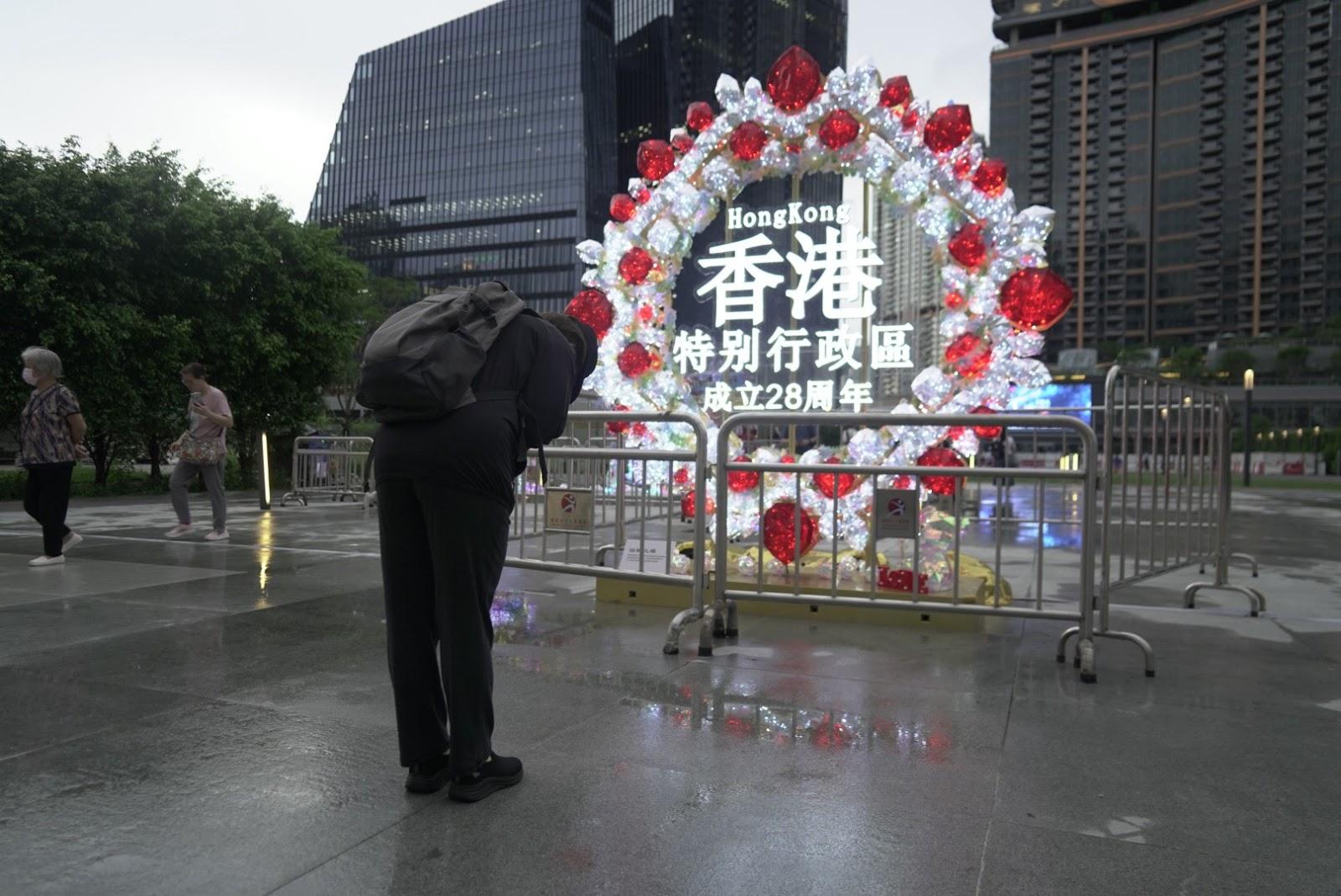
“Hong Kong died 28 years ago,” said one Hong Kong citizen while bowing to a floral wreath-like illuminated plaque on July 1 decorated with the words “28 years since the establishment of the Hong Kong Special Administrative Region.”
The day marked the anniversary of Hong Kong’s handover from British to Chinese rule in 1997. Once drawing hundreds of thousands of participants, the city’s traditional July 1 pro-democracy march has been impossible to hold since the implementation of the Chinese Communist Party’s (CCP) National Security Law (NSL).
This year’s spotlight instead fell on a light installation set up by pro-Beijing groups at Kai Tak Station Square. Though officially themed as a celebration of 28 years under Chinese sovereignty, the display has sparked heated discussion among locals, with many saying its arrangements resemble a funeral hall. Some visitors have even performed ritual bows before the floral plaque, as if attending a memorial service, to mourn what they see as the loss of Hong Kong’s former glory.
One woman, Lee, who requested that only her first name be used, was seen bowing before the floral installation. She told The Epoch Times that the light display felt “very fitting for the occasion,” saying the floral arrangement resembled funeral wreaths, while the illuminated structures behind looked like paper offerings for the dead. In addition, she pointed to a dragon head installation, describing it as symbolizing a beheaded dragon, “like a specimen put on display.”
Acclaimed media personality Tsang Chi-ho wrote in a column for the Chinese edition of The Epoch Times that the public’s three bows to the Special Administrative Region’s (SAR) floral plaque can be construed as an act of “performance art.”
“This should be the first government propaganda that the public feels very personal and highly recognized,” he said.
Locals Describe Hong Kong’s Economy as ‘Utterly Perilous’
An Epoch Times reporter attempted to reach out to people on the street about their views on the 28 years of sovereignty transfer and the three years since Chief Executive Lee Ka-chiu took office.Kwong, who requested only his first name be used, from the engineering sector, described the current situation in Hong Kong as “utterly perilous” and revealed that he is still owed some fees after undertaking several minor state projects for public housing estates. There are also workers in other projects who do not have enough work, and some master artisans are owed wages, he said.
“I didn’t feel good in all things. There is just sweat [hard work], but no pay. Even complaining is of no use. What is the point of working?” he said.
Kwong also criticized authorities for bringing in foreign workers, which caused a drop in the wages of local counterparts. For example, a local plasterer earns HK $1,800 a day (less than US $230), while foreign workers only ask for $1,200 (US $152).
In response to not being able to stage a rally on July 1, Kwong asked, “Which country in the world doesn’t allow a march in the street? Even mainland Chinese people will go to the streets to voice their grievances if they are dissatisfied.”
He lamented that he did not dare to speak publicly because he did not know which words would be illegal.
Elderly Men Protest Against National Security Law
There was a large number of police patrolling the streets in Victoria Park and Causeway Bay, where the July 1 march was held in the past. But that did not deter a small number of protesters who still took to the streets.Ng, an 80-year-old man who only gave his first name, displayed a cardboard sign in Causeway Bay with slogans including demands for the repeal of the NSL and Article 23 of the Basic Law (the Maintenance of National Security Ordinance), the abolition of the National Security Commission, the National Security Department, and the release of political prisoners.
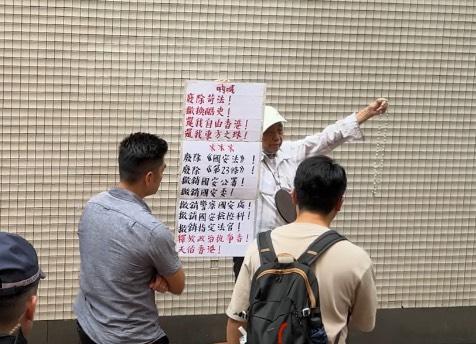
A man holds a sign in Causeway Bay demanding the repeal of the national security law, in Hong Kong, on July 1, 2025. (Ruilue Wu/The Epoch Times)
Ng was immediately surrounded by many police officers. A female police officer used a loudspeaker to warn him of a possible violation of incitement under the Maintenance of National Security Ordinance. Ng then put aside the sign at the request of plainclothes police and was “escorted” to the transit station by a large contingent of police officers.
Wong, 101, said he came to Causeway Bay to “stroll” but was asked to leave by police officers. He sat on the thresholds to rest after leaving the place. He told The Epoch Times that the CCP once said that Hong Kong people were “masters of their own rights,” but “grandpa,” meaning the Beijing regime, does not treat them as human beings, “without freedom and democracy, [we’re treated] more like animals.”
Traditional Parade Site Becomes Panda Exhibition
The July 1 march was once an important annual event for the Hong Kong democracy movement. Victoria Park in Causeway Bay was the starting point of the march. Several of the most attended demonstrations include July 1, 2003, when 500,000 people took to the streets to protest the Hong Kong authority’s intended forced implementation of Article 23, which led to the suspension of the legislation until 2024.In 2019, 550,000 people participated in the July 1 march during the Anti-Extradition Movement, a protest against Hong Kong authorities’ intended amendment to extradite Hongkongers to mainland China.
After the implementation of the NSL in 2020, the police no longer approved the July 1 march. However, on July 1, 2020, the day after the implementation of the NSL, tens of thousands of citizens spontaneously marched along the past July 1 route to protest the NSL. They were forcibly cleared by the police and more than 370 people were arrested.
On July 1, 2021, Hong Kong officials banned the July 1 march again, which did not stop a large number of people from taking to the streets to protest. Many police officers were stationed in Causeway Bay, the starting point of the previous marches, to intercept them. That evening, across the road from the Sogo department store in Causeway Bay, 50-year-old Leung Kin-fai killed himself with a knife after stabbing a police officer. He expressed in his will his last words about his dissatisfaction with the NSL and police brutality.
On July 1 this year, in Victoria Park, where hundreds of thousands of people used to gather to attend the annual rally, only an exhibition organized by several pro-communist organizations showing hundreds of panda installations remained.
Free Expression Criminalized
Amnesty International released its latest report on June 29, saying that of the 78 closed NSA cases, at least 66 (84.6 percent) involved legitimate expressions of speech that should not be convicted under international norms, and there was no evidence of violence or incitement involved.Sarah Brooks, director of China affairs at Amnesty International, said that in the past five years, the NSL has transformed Hong Kong from a city that allows multiple voices and public debate to a city full of repression and self-censorship.