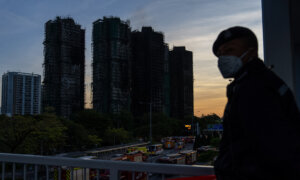
During a parliamentary session on Nov. 7, Japanese Prime Minister Sanae Takaichi responded to budget committee lawmakers’ questions about Japanese military posture in the event of a China-Taiwan conflict with the expected rhetoric past leaders had used.
Then she was pressed on whether such a conflict would constitute a “survival threatening situation”—a trigger term for military action under a defense statute enacted in 2015 by her mentor, the late Prime Minister Shinzo Abe.
Takaichi responded that it would depend on the specifics of the situation, but if naval fighting ensued, it could constitute such a situation.
The island of Taiwan lies about 100 miles off the coast of China. Japan is a nation of several islands, its westernmost territory only 68 miles from Taiwan—half the distance between San Diego and Los Angeles. Japan also hosts 50,000 U.S. troops and several advanced aircraft.
The Taiwan Strait—a narrow body of water between China and Taiwan—also sees trillions in trade pass through, and a conflict between China and Taiwan is widely expected to result in severe disruption to international commerce.
Chinese communist regime leader Xi Jinping has made “reunification” of Taiwan a primary goal, and has repeatedly refused to rule out the use of force to capture the island.
Takaichi’s remarks were documented in local media such as Asahi Shimbun, one of Japan’s major newspapers, and prompted what international officials viewed as a disturbing response from a Chinese official, which set off a series of escalatory actions, including a recent clash at the United Nations.
Nov. 8: The Deleted X Post
“The filthy head that recklessly sticks itself in must be cut off without a moment’s hesitation,” Xue Jian, the Chinese consul-general in Osaka, wrote on X on Nov. 8,
according to Asahi Shimbun. The post was no longer viewable as of Nov. 9.
In a separate post on X, he said considering an attack on Taiwan a threat to Tokyo is “a path of death” that some “stupid politicians in Japan would choose.”
The Chinese diplomat didn’t mention the Japanese prime minister by name, but he made clear the subject of his comments by quoting a report by Asahi Shimbun about Takaichi’s recent comments, according to a screenshot of the post shared by George Glass, the U.S. ambassador to Japan.
Beijing hasn’t apologized or retracted the remarks, instead sidestepping the issue by stating the deleted post was made in a personal capacity.
Japan Protests
Japanese Chief Cabinet Secretary Minoru Kihara told reporters on Nov. 10 that the Japanese government had lodged a strong protest with Beijing over Xue’s “extremely inappropriate” remarks.
The Japanese Foreign Ministry and the Japanese Embassy in China requested an immediate retraction of Xue’s statement and an explanation for the post.
Nov. 10: Takaichi Defends Remarks
Takaichi
said on Nov. 10 that her remarks were assuming a “worst case” scenario and presented no deviation in Japan’s stance.
“It is in line with conventional government views,” she told Parliament, adding that she would not retract her statements but would avoid making similar remarks in future sessions.
Japanese Foreign Minister Toshimitsu Motegi later reiterated this position during a Nov. 16 press briefing.
“It is not at all against international law,” he said. “Therefore, naturally, we don’t need to retract the previous remarks.”
Nov. 11: Japan Lawmakers Back Expulsion of Chinese Official
Japanese
lawmakers with the ruling Liberal Democratic Party (LDP)
adopted a resolution on Nov. 11 that would declare Xue persona non grata, which would expel him from the country, unless Beijing remedied the situation.
The resolution stated that Xue’s remarks were an “insult” to the entire nation of Japan and severely damaged Japan–China relations.
Nov. 11: Chinese State Media Doubles Down
Chinese media
doubled down on attacks on Takaichi in the meantime, with state broadcaster CCTV accusing the Japanese prime minister of “crossing the line” in a Nov. 11 editorial.
One social media account affiliated with CCTV said in a separate commentary posted on Weibo and several other popular Chinese social media platforms that if the prime minister continues with such remarks, she “might have to pay the price.”
Nov. 12: China Dials Up Rhetoric
In a Nov. 12 statement, a spokesperson for China’s embassy in Japan likened Takaichi’s reference to “survival-threatening situations” to Japan’s invasion of northeast China’s Manchuria during World War II.
A Chinese foreign ministry spokesperson that same day said it was the “80th anniversary of Taiwan’s recovery (as a lost territory)” and highlighted “Japanese aggression” in war with China. The spokesperson warned Japan to “exercise caution” and stop sending the “wrong signals” to Taiwan.
On Nov. 13. a Chinese foreign ministry spokesperson flipped the script at a press briefing and said that despite Beijing’s “démarches and protests,” Japan refused to retract “blatantly provocative remarks about Taiwan.”
He said that the regime “will never tolerate it” and that unless Japan retracted these remarks, “Japan must bear all the consequences.”
The spokesperson suggested Japan was “attempting to subvert the post-war international order,” and maintained Beijing’s narrative that Taiwan is China’s territory, even though it has never been ruled by the regime.
On Nov. 14, the regime’s defense ministry warned that if Tokyo attempts to use forces to intervene in Taiwan issues, it would face a “crushing defeat” and “pay a heavy price.”
In recent years, Beijing has ramped up military activity in the Indo-Pacific, especially around Taiwan, drawing international condemnation for disrupting stability in the region and prompting U.S. allies to increase joint military exercises.
Nov. 13: China Summons Japanese Ambassador
The Chinese foreign ministry summoned Japanese Ambassador to China Kenji Kanasugi on Nov. 13 over Takaichi’s remarks and demanded a retraction.
Chinese Vice Foreign Minister Sun Weidong told local media that Taiwan was a red line issue of the regime’s and if anyone sought to interfere in its “reunification” mission, “China will inevitably strike back.”
Nov. 14: Japan Summons Chinese Ambassador
The Japanese foreign ministry
summoned Wu Jianghao, Ambassador of China to Japan, on Nov. 14 and again lodged a strong protest over “highly inappropriate remarks” made by Xue.
According to the short readout, the officials made their respective positions clear, but did not signal any action.
Beijing Cancels Flights to Japan
Chinese authorities
warned citizens not to travel to Japan, with state media Global Times reporting that all flights between the two countries had been canceled because of low passenger volume.
Beijing has done similarly in the past and leveraged tourism as economic pressure against other countries.
Nov. 15: Chinese Coast Guard Patrols Near Japan
The Chinese Coast Guard
deployed four vessels
near the Senkaku Islands on Nov. 15.
The uninhabited islands are administered by Japan but Beijing claims them as its own territory.
The Chinese Coast Guard issued a statement that it was exercising its rights to enforcement patrols in the waters.
Nov. 16: Beijing Warns Against Studying in Japan
On Nov. 16, Chinese authorities warned students to “plan studies in Japan with caution” and made references to “social unrest.” Japanese universities pushed back against the claims in local media.
Nov. 17: Japan Continues Engagement
During a Nov. 17 press briefing, Japanese Chief Cabinet Secretary Minoru Kihara
criticized the advisories against traveling to Japan as not constructive to bilateral relations.
Such notices are “not compatible with the broad direction of promoting a strategic, mutually beneficial relationship confirmed by the leaders, and building a constructive and stable relationship,” Kihara said.
Kihara told reporters that daily communication between Japan and Chinese officials was continuing but did not signal progress.
Senior Japanese foreign ministry official Masaaki Kanai had traveled to Beijing the same day. Kihara declined to comment on what was discussed.
Nov. 18: China Bans Japanese Seafood
On Nov. 18, Japanese media reported that Beijing was ramping up economic pressure by imposing a
ban on Japanese marine products.
Later at a briefing, a Chinese spokesperson attributed it to an administrative issue, but added that there was “no market” for Japanese products even if imports were permitted, because of Takaichi’s remarks.
Nov. 20: US Backs Japan
U.S. Ambassador Glass has reaffirmed Washington’s support for Tokyo and said the seafood ban was “unwarranted.”
“Coercion is a hard habit to break for Beijing,” Glass said on X on Nov. 20. “But just as the United States stood by Japan during China’s last unwarranted ban on Japanese seafood, we will be there for our ally again this time.”
On Nov. 20, the U.S. State Department also expressed support for Japan.
“The U.S.-Japan Alliance remains the cornerstone of peace and security in the Indo-Pacific,” State Department spokesperson Tommy Pigott stated on X. “We firmly oppose any unilateral attempts to change the status quo, including through force or coercion, in the Taiwan Strait, East China Sea, or South China Sea.”
Nov. 21: Takaichi Stands Her Ground
Asked whether she would retract her statement amid escalating actions from the Chinese regime, Takaichi maintained her position.
“The government’s position is consistent,” she told reporters on Nov. 21. “I myself have repeated this answer.”
Nov. 21: CCP Accuses Japan of Violating International Law
China’s permanent representative to the United Nations, Ambassador Fu Cong, circulated a letter addressed to U.N. Secretary-General António Guterres, alleging Japan had committed a “grave violation of international law” with Takaichi’s remarks.
Nov. 22-23: No Dialogue at G20
Takaichi and Chinese Premier Li Qiang both attended the G20 summit Nov. 22 and Nov. 23, but notably did not speak to each other.
Takaichi later told reporters that the door was not closed on dialogue with Beijing.
Nov. 24: Japan Rebuts Chinese Letter at U.N.
Japan’s Ambassador to the United Nations Kazuyuki Yamazaki
responded with a letter to Guterres that the Chinese ambassador’s letter was “inconsistent with the facts and unsubstantiated.”
“China’s assertion that Japan would exercise the right of self-defense even in the absence of an armed attack is erroneous,” he wrote.
He added that Beijing was recently “stifling” bilateral communications, listing some of the recent escalatory actions and contrasting them with Japan’s attempts at engagement.
Trump Speaks With Xi, Takaichi
On Nov. 24, President Donald Trump
spoke with Xi by phone as a follow-up to the two leaders’ bilateral meeting in South Korea on Oct. 30. Readouts from both nations highlighted that Taiwan was a priority issue for the Chinese regime.
The next day, Trump called Takaichi, who said the conversation reiterated strong U.S. support for Japan.
“President Trump mentioned that he and I are extremely good friends, and that I should call him anytime,” Takaichi told reporters.
She said they spoke about Trump’s recent call with Xi and the state of U.S.–China relations.
Nov. 26: Beijing Demands Explanation
Beijing demanded an explanation from Japan on its position toward Taiwan on Nov. 26, a spokesperson said, taking a different tack than demanding a retraction.
Takaichi had to defend her remarks again on Nov. 26, as she had her first debate with lawmakers from the Japanese parliament’s lower house.
Opposition lawmakers criticized her for souring relations with China, but Takaichi said dialogue remained constructive and open with Beijing, adding that any Japanese defensive action would depend on the specifics of the situation.
Nov. 27: Japan Refutes WSJ Report
The Wall Street Journal (WSJ), citing anonymous sources,
reported on Nov. 27 that Trump had advised the Japanese prime minister not to provoke Beijing on the question of Taiwan’s sovereignty during the call. The report described Trump’s advice as subtle, saying that he did not pressure Takaichi to withdraw her comment. A Reuters
report made a similar claim, citing two unnamed Japanese government sources.
Minoru Kihara, the Japanese government’s top spokesperson, said during a press briefing on Nov. 27 that this was not the case.
“In the article you mentioned, there is a description that President Trump advised not to provoke the Chinese government on the issue of Taiwan’s sovereignty, but I would like to make it clear that there is no such fact,” Kihara told reporters when asked about the WSJ report.
Dorothy Li and Reuters contributed to this report.