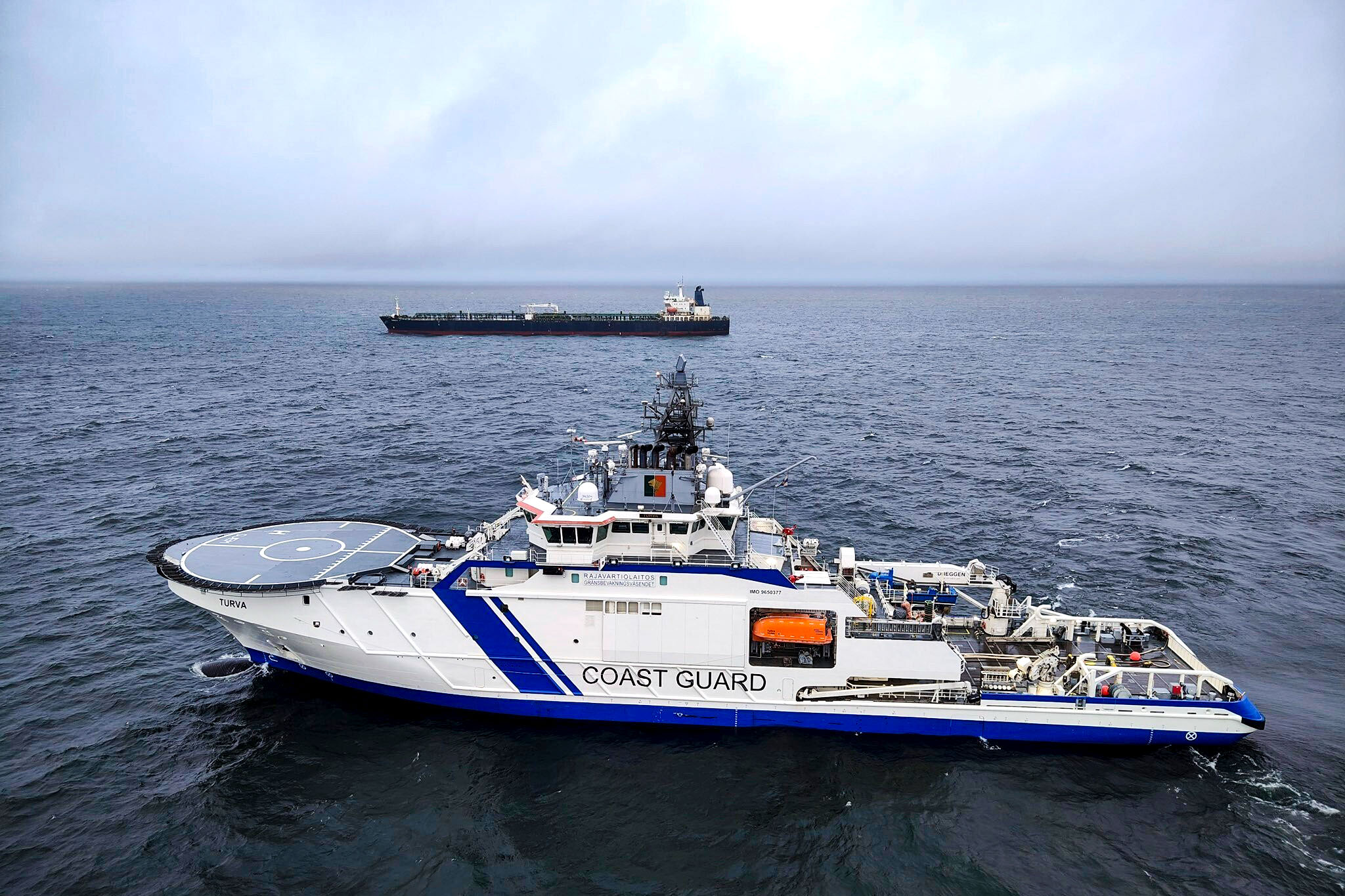

Finnish authorities on Wednesday took control of a vessel they believe may have been responsible for damaging an undersea telecommunications cable running between Finland and Estonia. The suspect vessel may have dragged its anchor across the undersea cable.
Telecommunications company Elisa initially detected a fault in one of its undersea cables running across the Gulf of Finland from the Finnish capital Helsinki to the Estonian capital Tallinn early on Dec. 31. According to a press statement shared by the Finnish national police service, the cable damage site was located within Estonia’s exclusive economic zone.
After learning of the cable fault, Finland’s Border Guard identified a suspicious vessel operating in the area. The Finnish border security service dispatched its patrol vessel Turva and a helicopter to locate the suspect vessel, and subsequently stopped the vessel in the waters of Finland’s exclusive economic zone.
The responding border guard authorities found that the suspect vessel had its anchor chain lowered into the sea, according to the press statement. Those responding authorities subsequently instructed the vessel to raise its anchor and move to a designated anchorage on the Finnish side of the waterway.
Finland’s border security service has since transferred responsibility for investigating the incident to the Helsinki Police Department.
“At this stage, the police are investigating the incident as aggravated criminal damage, attempted aggravated criminal damage, and aggravated interference with telecommunications,” the Finnish national police service said.
Finland’s National Prosecutor’s Office has also issued a prosecution order in connection with the cable damage incident.
In their initial press statement, the Finnish authorities did not immediately identify the suspect vessel by name, nor did they specify details of the vessel’s registration and the nationality of its operator.
The cable damage incident bears similarities to another incident almost exactly one year ago.
Finnish authorities detained the Russian-linked and Cook Islands-flagged crude oil tanker Eagle S on Dec. 26, 2024, after being alerted to a fault in an undersea power supply cable running between Finland and Estonia.
Upon boarding the Eagle S, responding authorities said they found that the vessel had its anchor lowered. Authorities instructed the vessel’s crew to retract the anchor chain, but found that no anchor was attached.
Publicly available vessel data indicated the Eagle S departed St. Petersburg, Russia, the day before the cable damage incident.
In August, Finland’s national prosecutor’s office charged the captain and first and second officers of the Eagle S in connection with the 2024 cable damage incident.
By October, a Finnish court dismissed the case, concluding that prosecutors failed to show sufficient evidence that the Eagle S had dragged its anchor intentionally.
Damage to undersea cables has been a growing challenge in recent years. Undersea cables running between Lithuania and Sweden, and between Finland and Germany, were damaged in a pair of incidents in November 2024.
In response to undersea cable damage incidents impacting its Baltic Sea member states, in January, NATO launched an expanded maritime patrol effort in the region.