
Fewer Australian students are studying Asian languages despite the country being in close proximity and having strong trade ties with Asia, a House Standing Committee on Education has been told.
A hearing for the inquiry into building Asia capability through the education system was held on Oct. 29, and Labor MP Tim Watts, the chair of the committee, noted some statistics about the decline in Asian languages studied in Australian schools.
“To take one example: In 2010, the number of Year 12 students enrolled in Bahasa Indonesia studies nationwide was over 1,160 students. It dropped to just 524 students in 2023,” he told the committee.
“In Victoria, the number of high schools teaching Bahasa Indonesia declined by 65 percent between 2005 and 2024—from 116 schools to 44 schools. In Queensland, stakeholders have told us that Bahasa Indonesia is functionally extinct.”
Overall uptake of languages has also declined, with 11.3 percent of senior students studying a foreign language in 2010 compared to 7.6 percent in 2023.
According to Shane Samuelson, the assistant secretary at Department of Education, Skills, and Employment (DESE), in the Australian curriculum, six out of the 14 languages are Asian languages: Chinese-Mandarin, Hindi, Indonesian, Japanese, Korean, and Vietnamese.
The top three languages studied at the moment are Japanese, Mandarin, and French.
The chair, in conclusion of the inquiry, admitted the existing problem.
“As it stands at the moment, there’s not a federal government strategy to build Asia capability at a whole-of-nation level or at different stages along this development pathway,” said Watts.
Reasons Behind the Decline
The chair listed some reasons behind the phenomenon, one being poor learning experience in earlier years.
“The moment it becomes optional [in senior secondary school], students generally tend to take the choice to drop out of language learning in those final two years of school,” said Watts.
Samuelson added that since languages are often perceived as difficult, students may choose an easier subject to ensure they achieve a higher Australian Tertiary Admission Rank (ATAR) for university.
The lack of enough qualified language teachers is another factor.
“Data from the Australian teacher workforce data set teacher survey shows that in 2023, 32 percent of secondary school teachers who are teaching languages other than English were teaching out of field, which means that when they did their initial teacher education training, they didn’t even do one course of that language in university,” said Watts.
Samuelson explained that graduates going into the teaching workforce find it very confronting.
“They didn’t necessarily have all of the equipment in their kit, so to speak, to actually perform well in the teaching workforce,” she said.
The weak pathway to connect what is taught at primary, secondary schools, and universities also contributes to the problem.
“It feels like a squandered resource if we’re funding language learning at primary school and there’s no pathway to continue it. My kids went to a bilingual Vietnamese-English primary school that now teaches Italian because there are no teachers left that can speak Vietnamese. There was no high school where they could continue Vietnamese,” said Watts.
“Does that make sense for a use of Commonwealth money? It seems like wasted resources.”
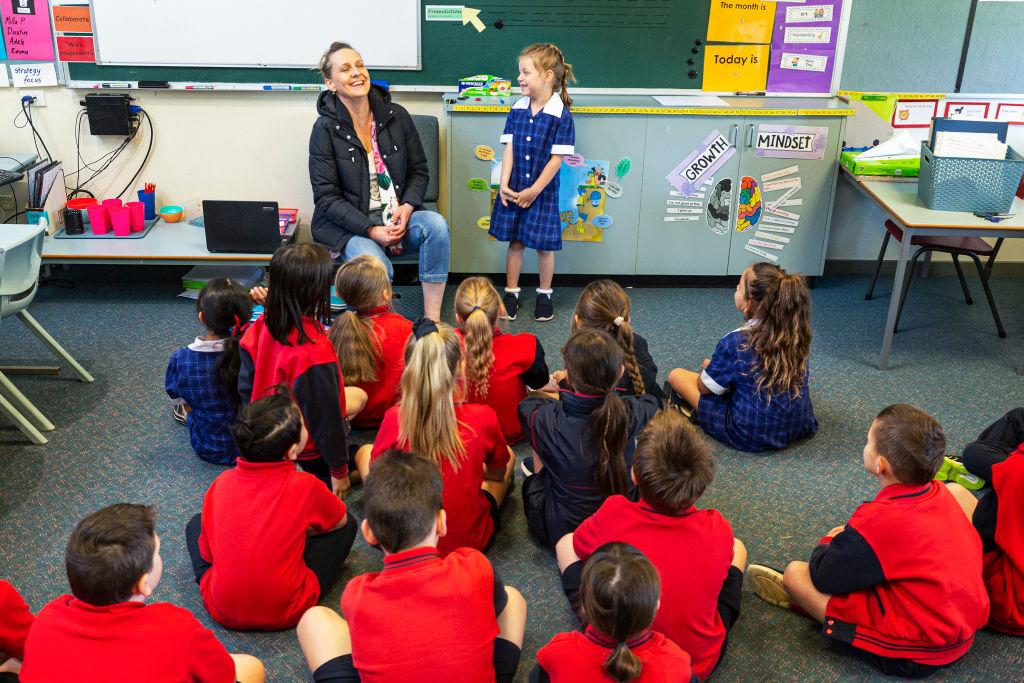
Grade one students enjoy returning to the classroom at Lysterfield Primary School on October 12, 2020 in Melbourne, Australia. (Photo by Daniel Pockett/Getty Images)
Chinese Material Selection Questioned
The significance of Mandarin Chinese was specifically noted at the inquiry.
“Australia has distinctive interests in relations with China which require a sovereign China knowledge capability, balancing security, politics, economics, and relationship-building,” said Watts.
“However, there are serious questions around our ability to generate core capability for stakeholders: direct knowledge of China, informed by world-class understanding of how China operates, and engaged with Australia’s national interests.”
Alina Lin, the deputy principal of the Minghui School in Sydney, a Chinese language school, suggested that lawmakers use resources from Taiwan for teaching and teacher training.
She noted that apps and resources from China, ruled by the Chinese Communist Party (CCP) may contain content aligned with the communist regimes’ ideologies.
“Taiwan’s Chinese language education is relatively better because Taiwan is a democracy,” she told The Epoch Times.
“We should adopt the educational principles of democracies, avoiding those from authoritarian countries. After all, teachers in authoritarian regimes are trained with the mindset of that regime, which often leans toward authoritarian thinking.
“In a communist country, it’s not just about teaching the language itself; it’s about the ideology behind it,” she said.