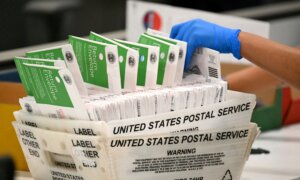
A federal judge has denied the U.S. Department of Justice’s emergency request to force California to sequester about 20,000 mail ballots tied to voters the Justice Department flagged as likely noncitizens.
The ruling late on Oct. 28 by Judge David O. Carter of the U.S. District Court for the Central District of California allowed the ballots to be counted in the Nov. 3 midterm congressional elections.
Earlier this month, the Department of Justice (DOJ) asked Carter to sequester mail ballots for the Nov. 3 elections from more than 20,000 individuals that it suspects are noncitizens. It stated that California had failed to meet a deadline to complete a review of the suspected noncitizens, some of whom the department said had mailed in ballots.
Instead of waiting for a ruling on the merits, the DOJ filed an emergency application last week with the U.S. Court of Appeals for the Ninth Circuit, asking it to block California from counting the ballots. On Oct. 26, a three-judge panel of that court ruled 2–1 that it lacked jurisdiction to rule on the matter because Carter had not yet issued his ruling in the case.
At a hearing on Oct. 27, Carter said he was concerned that the DOJ’s request to temporarily sequester ballots until voters’ citizenship can be verified might disenfranchise and confuse legitimate voters, saying that it represented a “monumental change” to election procedures to implement while voting was already underway.
In the new ruling, Carter turned down the DOJ’s request for a temporary restraining order, describing it as unprecedented federal overreach close to an election.
“This case is about the right of every American citizen to vote in a free and fair election,” he said.
“Never before in American history has the federal government, on the eve of an election, sought to coerce a state and local government to abandon their own Constitutional elections procedures and bend to the will of the Executive Branch.”
The “last-minute” request goes against long-standing constitutional principles that give states control over elections, he said, and if it were granted, “either party could create chaos for their own political purposes to disrupt the election process.”
Carter said that granting the request could cause more than 20,000 registered Californians to lose the right to vote.
In denying the federal government’s request for a temporary restraining order while the litigation plays out, Carter said the DOJ failed to show that it would likely succeed on the merits.
He also held that, for purposes of emergency relief, the DOJ had not shown that it was harmed in a way the law recognizes. In other words, he held that California is not injuring the federal government by declining to help it enforce a federal ban on noncitizen voting, so the DOJ had not justified emergency relief at this stage.
During the Oct. 27 hearing, DOJ attorney Bill Essayli said the federal government’s request was aimed at ensuring electoral integrity.
Carter replied, saying that the “traditional remedy” for voter fraud was a criminal indictment. Unlawfully cast ballots, he said, can be removed in the weeks following Election Day, before the results are officially certified.
“You’ve got a remedy, for goodness sake,” the judge said. “Go out and indict.”
California’s attorney, Anne Bellows, said the state already has strong safeguards to prevent noncitizens from voting.
Bellows argued that the DOJ’s claims relied on “mysterious database methods” and that complying with the department’s demands runs the risk of disenfranchising eligible voters.
“The Supreme Court has reiterated time and again that, as an election is close at hand, federal courts should not interfere to change the rules under which that election is held,” she said. “This applies with even more force when the election is ongoing.”
The DOJ on Oct. 16 told California election officials that they could be criminally liable if they count ballots that the department has stated were cast by noncitizens.
Carter told the DOJ attorneys during the hearing, “This court believes that it would be wise that any threats to state and county election employees cease immediately.”
President Donald Trump has said on multiple occasions that states are not doing enough to prevent noncitizens from voting.
California Attorney General Rob Bonta said the new ruling prevents the Trump administration from interfering in elections in the state.
“No administration can disenfranchise thousands of individuals or disrupt an ongoing election based on highly unreliable claims of noncitizenship,” he said in a statement.
“Today’s ruling is yet another important victory for the rule of law and the right to vote.”
The DOJ did not respond to a request for comment on the new ruling.