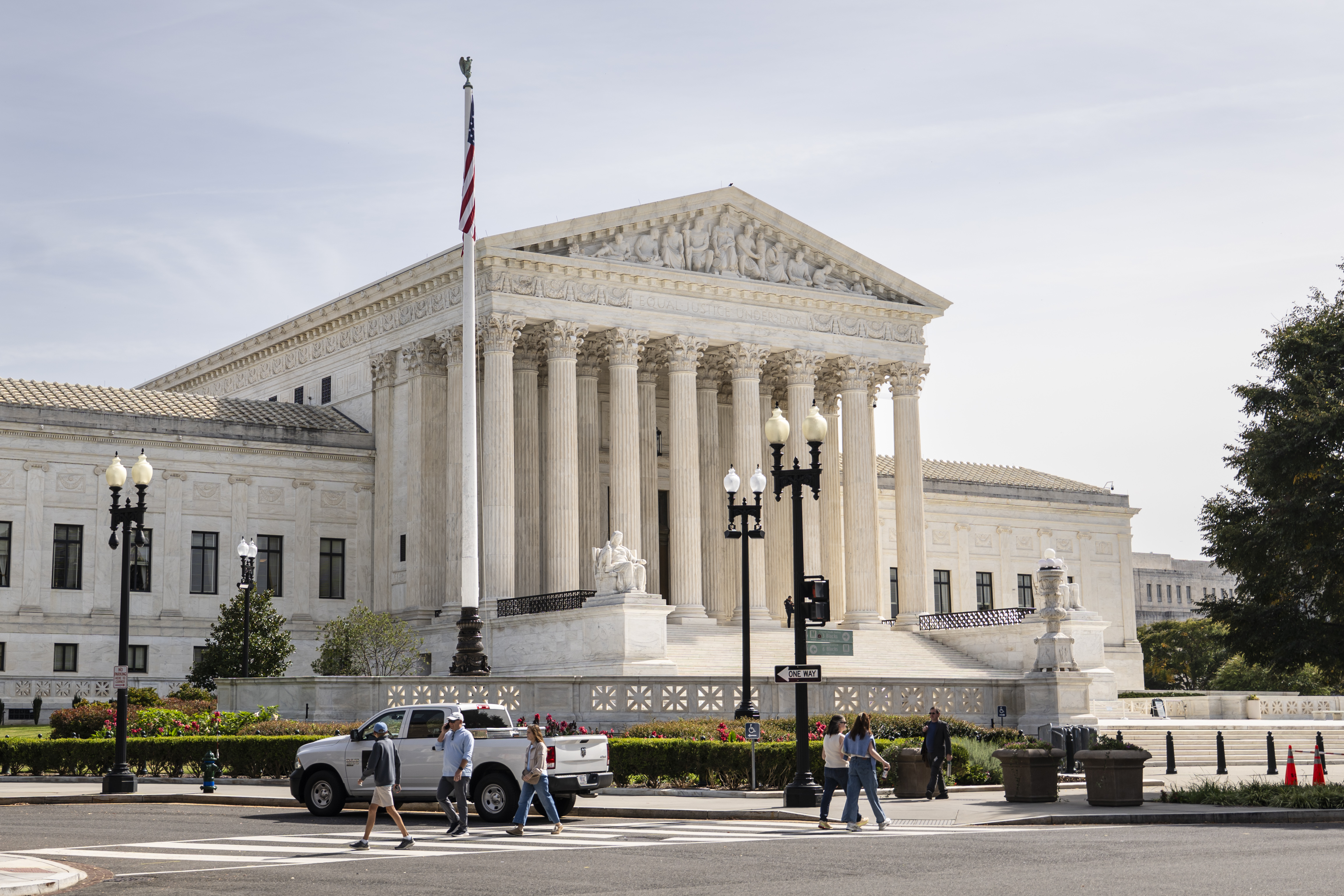

The Supreme Court has scheduled an oral argument for early in the new year in Apple’s bid to avoid being found in civil contempt in its legal battle with Epic Games after it was found to have violated a lower court’s order.
The Nov. 2 announcement in Apple Inc. v. Epic Games Inc. scheduled the hearing for Jan. 11, 2027.
The case is the latest chapter in a years-long fight between Apple and Epic Games—maker of the “Fortnite” video game—over Apple’s control of payments inside apps on its devices.
The high court is not expected to reopen the core findings from the original lawsuit.
Instead, the justices will decide the narrower question about when a company can be held in contempt for failing to fully comply with a court order.
The case goes back to 2020 when Epic sued Apple to reduce its control over transactions in applications based on the company’s iOS operating system and its restrictions affecting how apps are distributed to consumers.
Epic’s lawsuit was partly dismissed in September 2021 by U.S. District Judge Yvonne Gonzalez Rogers, who ruled Epic failed to present sufficient evidence that Apple possessed unlawful monopoly power in a specific market that she described as “digital mobile gaming transactions.”
Rogers also held that year that Apple’s rules regarding its App Store ran afoul of California competition laws, and issued an injunction requiring the company to let developers embed links in their apps, allowing users to use non-Apple payment methods.
Apple permitted the links but introduced new conditions, including a 27 percent commission on developers for purchases completed on payment systems outside the App Store within a week of clicking a link.
Epic argued Apple’s commission violated the injunction, and on April 30, 2025, Rogers found Apple in civil contempt.
The judge said Apple was in “willful violation” of her 2021 injunction aimed at curbing the company’s allegedly anticompetitive practices.
Apple “willfully” failed to comply with the injunction “with the express intent to create new anticompetitive barriers which would, by design and in effect, maintain a valued revenue stream; a revenue stream previously found to be anticompetitive,” she said.
“That it thought this Court would tolerate such insubordination was a gross miscalculation. ... For this Court, there is no second bite at the apple,” Rogers said.
In December 2025, the U.S. Court of Appeals for the Ninth Circuit affirmed the contempt finding but said Apple could present new arguments at the trial court level about what commission it should be permitted to charge for digital goods purchased in apps that are distributed through the App Store but paid for with third-party payment systems.
Apple, which denies wrongdoing and says it is obeying court orders, asked the Supreme Court in its petition on May 21 to take up the case.
The company said the injunction should not apply to millions of developers because Epic is the sole plaintiff and the litigation is not a class action. Apple also said it should not be held in contempt for supposedly violating the “spirit” of an injunction that it argues did not specifically forbid the conduct in question.
The Supreme Court agreed on June 30 to hear the case but declined to review whether the injunction should apply only to Epic. The justices limited their review to the narrower question of when a company may be held in contempt for violating the “spirit” of a court order.
Epic filed a brief urging the Supreme Court not to accept Apple’s case.
After it was found in contempt, Apple responded with “evasion and defiance,” and “imposed a new commission on steered transactions set so high that Apple knew—and intended—that it would make steering financially infeasible,” the brief said.
A steered transaction is a purchase of digital services that a user has to make outside of Apple’s in-app payment, or IAP system, typically through an external website link provided in the app.
The brief said the district court found that Apple “outright lied” about how it calculated its commission, “falsely claiming that it had relied on an objective outside study ... when in fact the study was ‘a sham’ that Apple ‘entirely manufactured’ for litigation.”
The Ninth Circuit held, the brief said, that the “prohibitive effect” of Apple’s commission—which guaranteed that “‘no rational developer would’ engage in steering—violated the text of the Injunction.”
The brief said the Supreme Court should reject Apple’s petition because that company violated the court order by levying a large fee on outside purchases and mischaracterizing the lower court decisions.
The court is expected to rule on the case by June or July of 2027.