
Tariffs are again a central issue in the U.S. economy, days after the recent Supreme Court decision overruled President Donald Trump’s policy.
Legal and political battles surrounding tariffs continue as the United States is poised to stop collecting the import taxes ruled illegal.
Trump invoked the International Emergency Economic Powers Act (IEEPA) to impose tariffs last year, citing a need to address international transactions unfair to the United States.
The Supreme Court ruled on Feb. 20 that the IEEPA doesn’t allow the president to impose tariffs. As of Feb. 24, duties established under the IEEPA are no longer in effect.
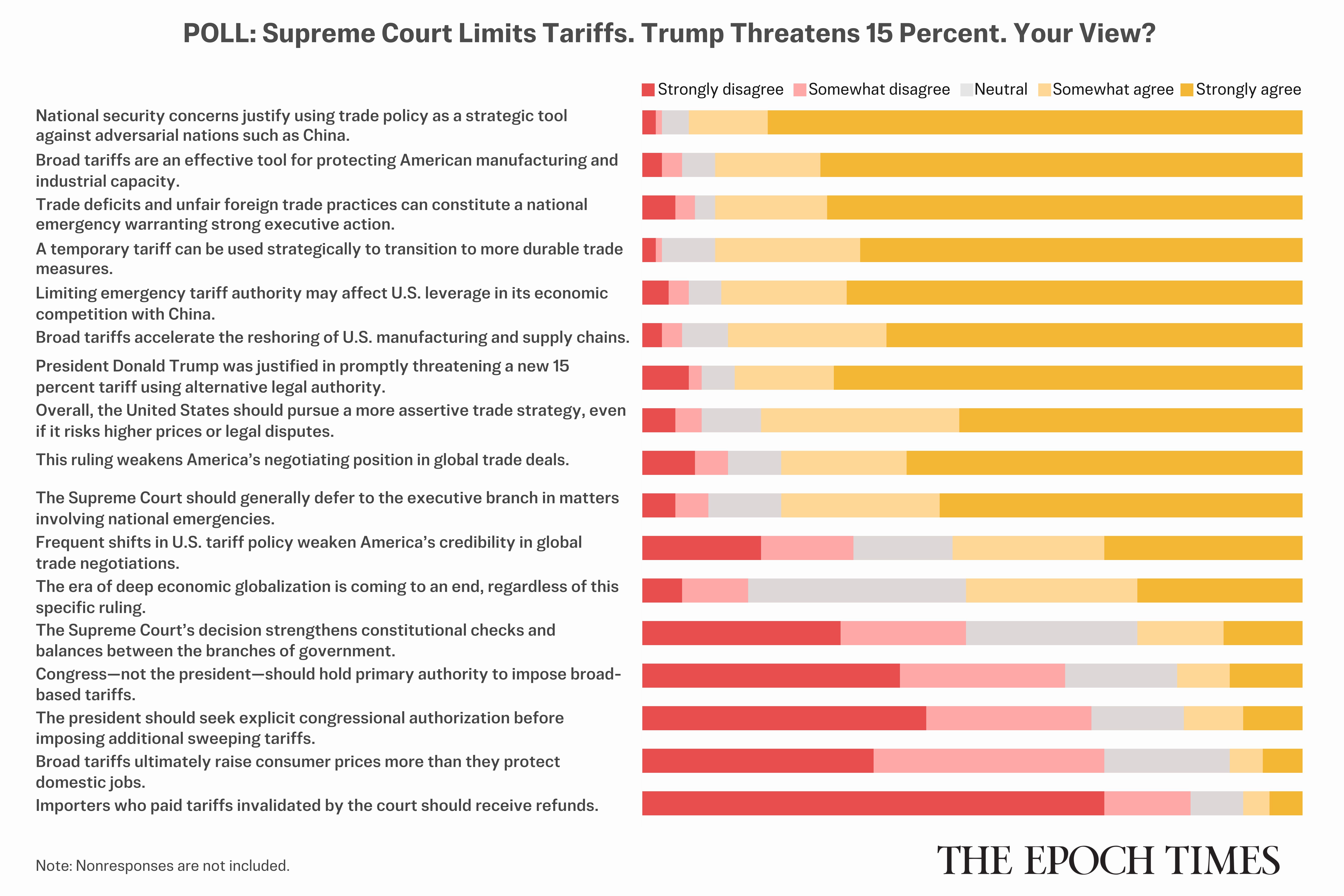
We found that most readers believe that tariffs are a significantly useful tool for protecting American interests.
Protecting America
More than nine in 10 respondents (93 percent) believe that national security concerns justify using trade policy as a strategic tool against adversarial nations such as China.
Additionally, 89 percent believe that broad tariffs are an effective tool for protecting American manufacturing and industrial capacity.
As to the use of emergency authority to implement tariffs, 88 percent of those polled believe that limiting the authority could affect the U.S.’s leverage in its economic competition with China.
Presidential Authority
Presidential authority has been a major issue of contention due to Trump championing the tariffs as part of his economic plan.
Of those polled, 86 percent agree that Trump was justified in promptly threatening a new 15 percent tariff using an alternative legal basis.
Additionally, 89 percent believe that the trade deficits and unfair foreign trade practices can constitute a national emergency, warranting strong executive action on the part of the president.
A majority of readers surveyed—64 percent—said they do not believe Congress should hold primary authority to impose broad-based tariffs.
Similarly, 68 percent opposed requiring the president to obtain explicit congressional approval before enacting additional tariffs.
Supreme Court’s Decision
The Supreme Court made headlines after handing down its decision that ultimately paused many of the tariffs put in place by Trump.
A large majority of respondents (79 percent) believe that the ruling weakens America’s negotiating position in global trade deals.
The same percentage believes that the Supreme Court should generally defer to the executive branch in matters involving national emergencies.
Just under half of those polled (49 percent) disagree that the Supreme Court’s decision strengthens constitutional checks and balances between the branches of government, and another 26 percent are neutral or have mixed feelings on the topic.
However, 83 percent of respondents disagree with the idea that importers who paid tariffs invalidated by the Supreme Court should receive refunds.
Economic Impact
In addition to the appropriate division of federal authority, the primary issue at stake within the topic of tariffs is their economic impact.
Fully 89 percent of those polled believe a temporary tariff can be used strategically to transition to more durable trade measures, and 87 percent agree that broad tariffs accelerate the reshoring of U.S. manufacturing and supply chains.
Overall, 82 percent agree that the United States should pursue a more assertive trade strategy, even if it risks higher prices or legal disputes.
Meanwhile, 70 percent of those polled disagree with the assertion that broad tariffs ultimately raise consumer prices more than they protect domestic jobs.
On the question of a major shift in global trade, a slight majority, 51 percent, believe that the era of deep economic globalization is coming to an end, regardless of the recent decision on tariffs.
When asked how presidential authority to impose tariffs during national emergencies should be defined going forward, readers were largely in favor of executive authority on the issue. A number were against the Supreme Court exerting power over tariffs.
One reader responded that the ability to impose tariffs “levels the trading requirements for both countries negotiating. The problem is today, we no longer control our production of so many things, we are disadvantaged versus where we were 50 years ago.”
While another said, “How about this … the [Supreme Court] has no business in controlling a sitting [president] negotiating for the U.S. citizens being crushed by global tariffs!”
One reader captured the sentiment of many, saying, “There should be no scenario where the U.S. pays more tariffs than the country with whom they have a trade agreement.”
The Epoch Times conducted this reader survey on Feb. 25–26, 2026, by email and social media, generating 2,045 responses.