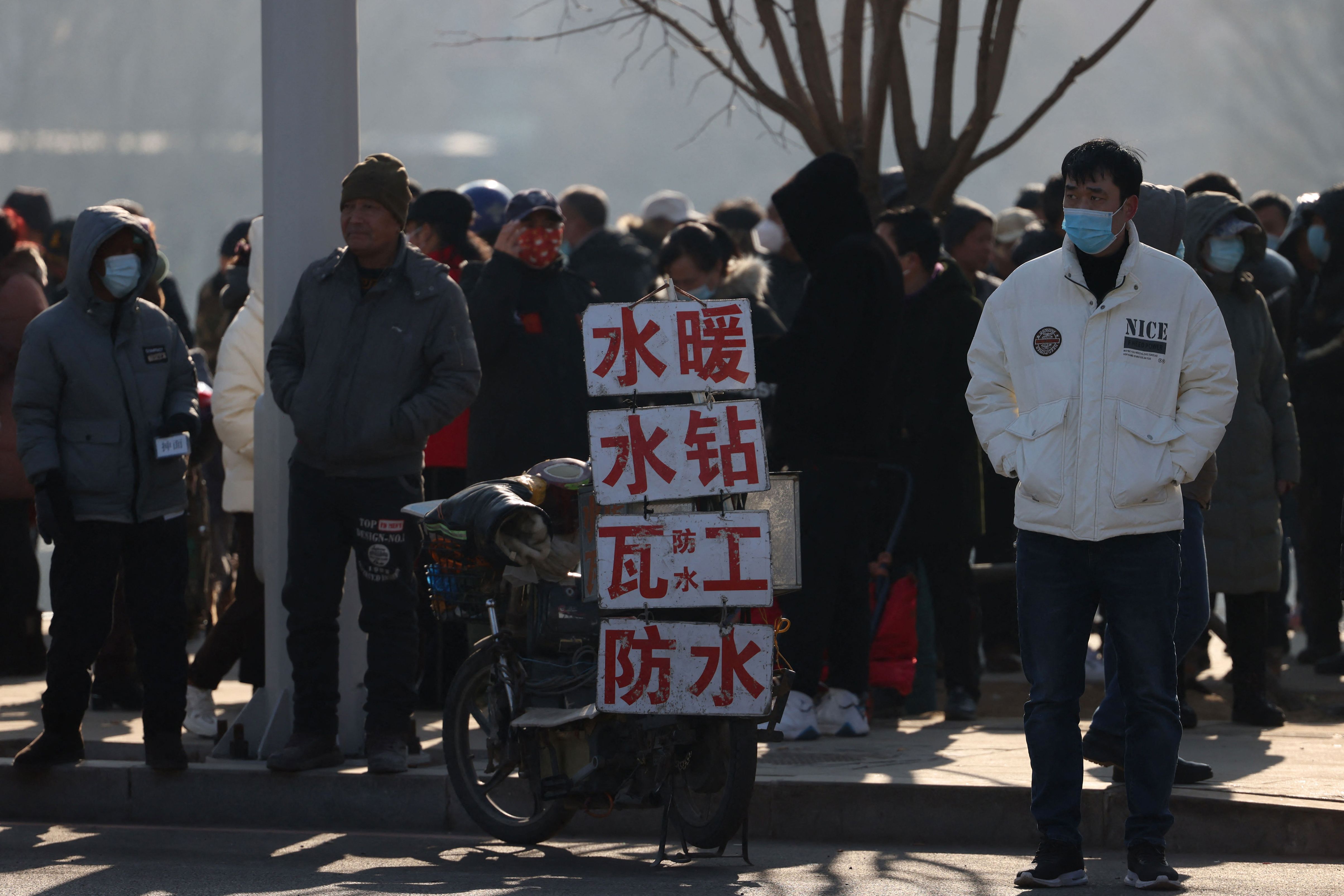

China’s struggling economy is leaving many rural migrant workers unable to find jobs after the Lunar New Year holiday, prompting a new wave of workers returning to their hometowns, while others remain in major cities despite unemployment.
Interviews with workers and videos circulating on Chinese social media suggest that many people who traveled to large cities along China’s eastern coast in search of employment have failed to secure stable work weeks after the holiday.
The Epoch Times spoke to several individuals in China who requested anonymity or that their surnames be published only due to fears of reprisal.
Some have already begun returning home. Others, finding even less opportunity in their hometowns, are remaining in cities and are getting by however they can.
Jobseekers Can’t Find Work
The surge in return trips has been noticeable at railway stations across the country.
A young male worker from China’s Shanxi Province told The Epoch Times on March 10 that many people at train stations were heading home after failing to find work.
After the Lantern Festival—the traditional end of the Lunar New Year holiday—he traveled to Wuhan, a major city in central China, to look for a job but struggled to find suitable employment.
“The wages are all around 3,000 yuan [about $437] a month, and even those jobs are hard to get,” he said. “I’ve already traveled around the country, but I couldn’t find work.
“In Beijing, most job openings are for security guards. Tianjin isn’t worth going to since even locals there are leaving to find work elsewhere.”
Videos circulating on Chinese social media appear to show similar situations in other major cities.
In one video shared on March 8, a blogger said many rural migrant workers in Guangzhou, China’s third-largest city, had begun returning home because they could no longer find work there.
Another clip showed large numbers of migrant workers leaving Shanghai by train after failing to secure jobs. The man filming the video joked bitterly that they were “the first group returning home for the 2027 Lunar New Year.”
In some areas, factories have been slow to resume operations after the holiday, further limiting job opportunities.
In the industrial province of Zhejiang, many shoe factories have not reopened, leaving migrant workers without work and forcing some to return home.
A male worker from southwestern Guizhou Province told The Epoch Times that he traveled to Yiwu, a major manufacturing hub in Zhejiang, to find work after the Lantern Festival. However, the conditions he encountered discouraged him.
“The jobs there require 12 hours a day and pay only 15 yuan [about $2.18] per hour, which is way too low,” he said. “I went to textile factories making socks, and many of them had almost no workers. At night, there are even fewer people.
“Traveling that far just to earn 3,000 to 4,000 yuan [about $437 to $583] a month isn’t worth it.”
The job search itself has also become costly. The man said he spent more than 2,000 yuan [about $291] on high-speed rail tickets to reach Yiwu, while hotel stays cost more than 200 yuan [about $29] per day.
Back in his rural hometown, he said typical wages are similar, while the cost of living isn’t much lower than in the big cities.
“I feel this year is more difficult than last year,” he said.
Despite the lack of jobs, some migrant workers say they prefer to remain in large cities rather than return home, where opportunities may be even scarcer.
A young female migrant worker in Shenzhen, a major tech hub bordering Hong Kong, told The Epoch Times that she arrived in the city with two friends. They spend their days looking for jobs and their nights collecting recyclable bottles to earn a small amount of cash.
“We’ve been here half a month and still can’t find jobs,” she said. “At night, we go out to collect bottles— even that is hard.”
During the day, they look for temporary work, such as restaurant service jobs or short-term labor.
“Wherever there’s temporary work, we go,” she said. “We’ll keep trying.”
Struggling Small Businesses
The economic slowdown is affecting not only workers but also small businesses that rely on them.
A female entrepreneur from the Guangxi region drove to Wenzhou on March 4, hoping to open a breakfast shop catering to migrant workers in the city. Nevertheless, she abandoned the plan less than a week later.
“There were too few people, and rents were expensive,” she told The Epoch Times. “Factories aren’t operating much, and it’s hard to find jobs there.”
With fewer workers in the city and little business activity, she decided to return home.
“It’s exhausting, and you still don’t make money,” she said.
Homeless and Jobless in Shanghai
In Shanghai, some unemployed migrant workers are staying in the city despite having no stable housing.
A local surnamed Wang told The Epoch Times that some people survive by collecting recyclables and sleeping outdoors.
“They can’t earn money if they go back home, so they stay here,” he said. “They pick up scrap to survive.”
However, he said city authorities regularly remove homeless migrant workers from public areas and sometimes send them back to their hometowns.
“They sleep under bridges or outside with blankets, but police often come at night to catch them,” Wang said.
He said unemployment is also rising among residents in Shanghai.
According to Wang, some companies and factories have closed or laid off workers, leaving many commercial areas quieter than before.
“Many businesses in Shanghai have shut down,” he said.
He added that his son recently lost his job after the owner of the five-star hotel where he worked disappeared without paying wages following the Lunar New Year.
“Many young people can’t find jobs now and are staying at home relying on their parents,” Wang said.
Ning Haizhong and Gu Xiaohua contributed to this report.