
In early May, the head of an American chipmaker told investors that his company was running short of a material most people have never heard of. A week later, he was on a plane to China alongside President Donald Trump, hoping to pry loose the export licenses his factories needed.
The company was Coherent, the executive was CEO Jim Anderson, and the material was indium phosphide, a compound that turns electricity directly into laser light.
Anderson went in part to press China over the delays it had placed on shipments of the material, according to Reuters, citing three people familiar with the matter. Without indium phosphide, the warehouse-sized computer facilities behind America’s push into artificial intelligence cannot move data between chips fast enough to keep up. China refines about 70 percent of the world’s indium, the metal at the heart of the compound, according to the U.S. Geological Survey.
That bottleneck is one half of a broader squeeze on America’s AI build-out. On the material front, China has restricted exports of indium phosphide and other critical minerals, raising prices and stretching timelines.
On the information front, OpenAI and several lawmakers say operatives in China have tried to turn the American public against data centers.
Experts studying both fronts told The Epoch Times that the effort has done little so far—but it reveals how the Chinese Communist Party (CCP) competes when it is behind.
The Material Behind the Machines
Stephen Xia, a former People’s Liberation Army engineer who has been following the development of AI technology, said the AI contest cannot be separated from the materials that underpin it.
“AI competition is an integrated contest across algorithms, data, talent, and computing power, and it is tied to supply chains for chips, electricity, data centers, and critical minerals,” he told The Epoch Times. If the CCP chokes off rare minerals, he said, it would “at the very least slow the pace at which the United States expands its high-end chips and data centers.”
Indium phosphide is one of those materials. Data centers are buildings packed with servers, and as the AI systems running on them grow, the chips inside need to exchange information faster than copper wiring can carry it.
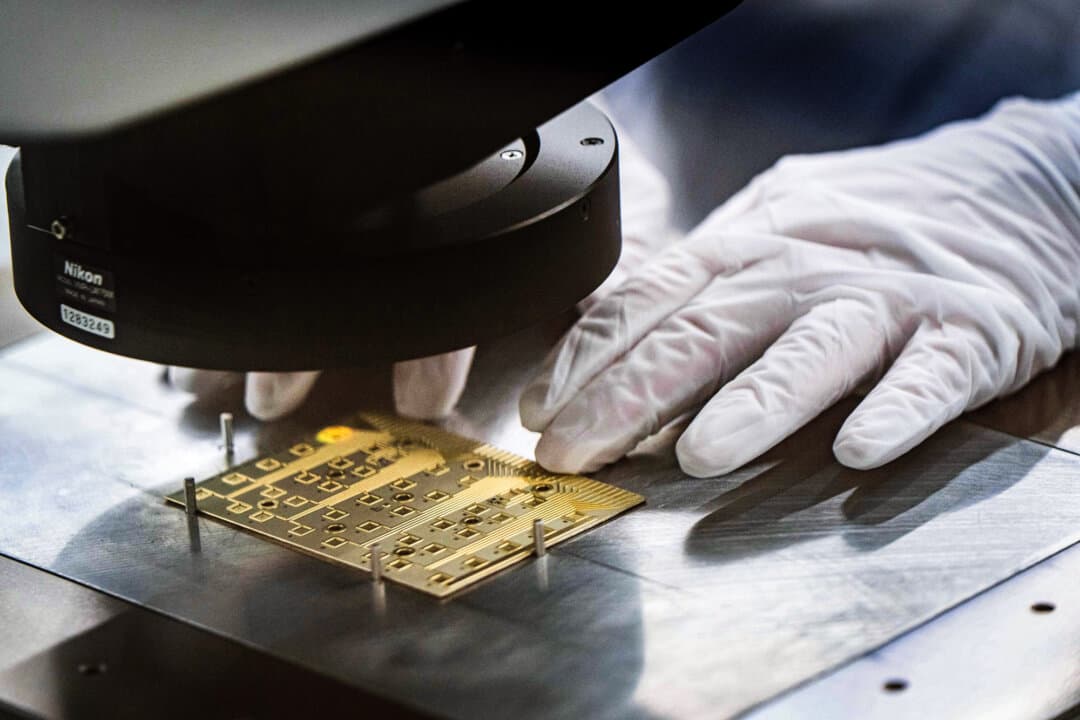
A worker conducts testing in a Coherent manufacturing facility where lasers are developed for transmitting data among chips, which could decrease power use by artificial intelligence systems, in Sherman, Texas, on June 16, 2026. Data centers are switching to light, transitioning from copper to fiber optics as artificial intelligence systems grow. (Jeffrey McWhorter/AP Photo)
So the industry is shifting to light, sending data as laser pulses through fiber-optic cable, and indium phosphide is the standard material for the tiny lasers that feed it.
China began restricting its export in February 2025, and prices have moved sharply since: A six-inch wafer now costs about $5,000, up by roughly 250 percent, industry sources told Reuters in June.
One major supplier, Lumentum, is sold out through 2028. The world’s second-largest maker of the wafers, AXT, produces most of them inside China, where its export permits have been delayed.
Mark Smith, a 45-year veteran of the mining industry who formerly ran the rare-earths producer Molycorp and is now the CEO of the company behind a planned critical minerals mine in Nebraska, NioCorp Developments, said China’s grip on indium is real but not absolute.
“It’s not 100 percent,” he told The Epoch Times. “If we take a look at all the bits and pieces that make up the supply chain, it’s probably greater than 70 percent.” A few other producers exist, he said, but “it’s nowhere near enough to take care of what’s going to be the demand for these AI chips.”
Even so, he said, indium is a milder case than some rare-earth elements that are “basically 100 percent controlled by China.”
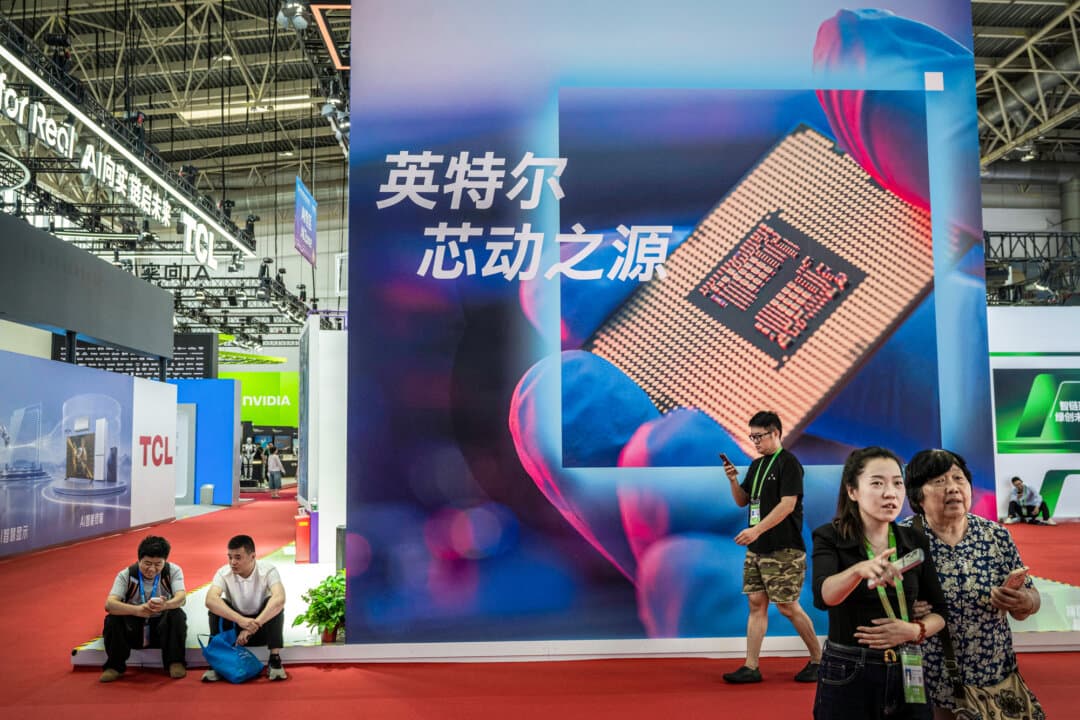
People near a billboard showing a semiconductor chip, at the Chinese International Supply Chain Expo in Beijing on June 26, 2026. China is investing heavily in artificial intelligence and robotics, pouring billions of dollars into what the government sees as the country’s next economic engine. As part of the AI race, it is turning to second front tactics such as funding protests against data centers in the United States, analysts say. (Kevin Frayer/Getty Images)
Both Smith and Xia cautioned against overstating what the CCP’s restriction on these critical minerals can do.
“[The controls] only affect the speed and cost of data-center expansion,“ Xia said. ”They cannot exert a decisive impact on the U.S. AI industry.”
The reason, he said, is that the United States holds the higher-value ground in the competition—the advanced chips and the software—while the CCP leans more heavily on American technology, from high-end graphics chips to the software used to design semiconductors.
In an all-out fight, Xia said, the CCP “would suffer the greater losses,” which is why, in his view, “even if the CCP had the means to cut off raw-material supplies, it would not dare to act unilaterally.”
Smith also described the standoff from China’s side. When Beijing restricts a material, importers panic—but China also needs to sell.
“China needs the technology the United States has for these AI chips, and yet the United States needs the indium to make those AI chips,” he said.
“We both kind of need each other—just in different ways, but for the same application.” He said he expects that mutual need to force a degree of cooperation, at least until the United States can build its own supply, which for a mine such as his takes about three years.
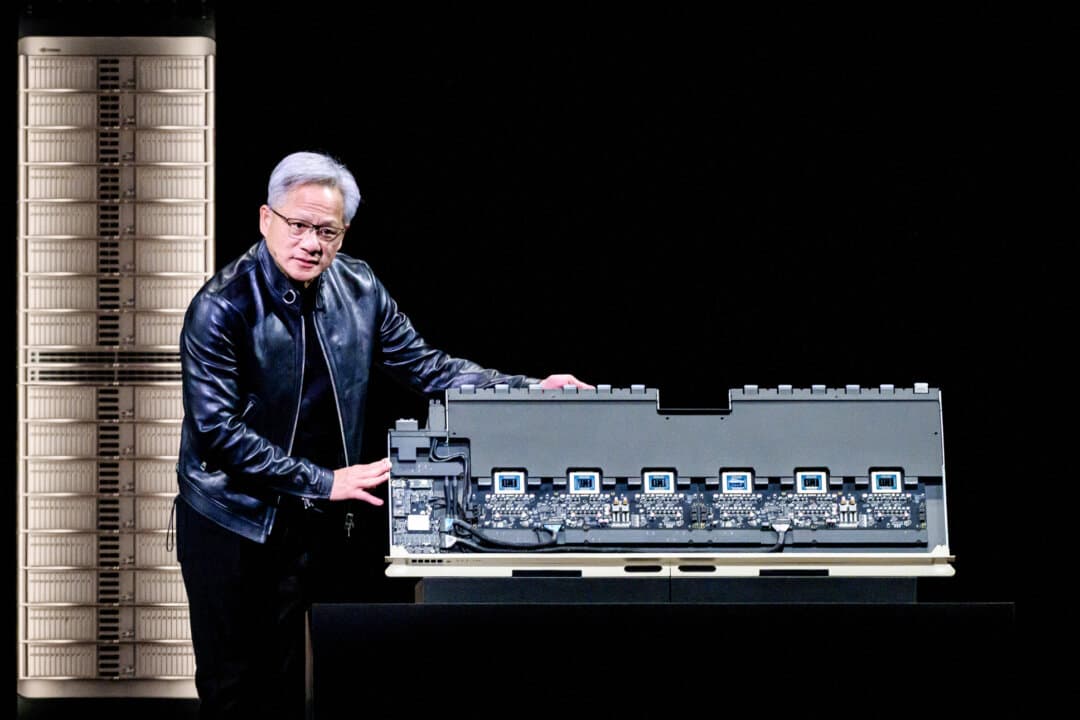
Nvidia CEO Jensen Huang introduces Vera Rubin, a next-generation artificial intelligence data center platform, and Rubin Ultra, a next-generation AI graphics processing unit architecture, during the company's annual graphics processing unit developers conference in San Jose, Calif., on March 16, 2026. As America continues its AI buildout, China has restricted exports of critical minerals, raising prices and stretching timelines. (Josh Edelson/AFP/via Getty Images)
For now, China’s leverage has held. When Washington and Beijing reached a trade truce in November 2025, China agreed to ease its controls on gallium, germanium, and antimony—but not on indium phosphide, which remained restricted into June 2026.
And where exports have resumed, Smith said, China still blocks anything tied to defense. NioCorp learned this firsthand. After it announced a Pentagon-funded partnership with Lockheed Martin in October to develop a scandium alloy for fighter aircraft, the company found that it could no longer buy scandium from China, and an attempted workaround through another firm was denied.
“So it’s real,” Smith said.
The Campaign to Turn the Public
The clearest evidence of the CCP’s efforts on the second front came from OpenAI, which uncovered a China-based influence operation because the people behind it were using its chatbot to write their material.
In a June report, the company said it banned two clusters of accounts it traced to China. One, which it named the “Data Center Bandwagon,” produced comments and comic strips claiming that data centers were driving up families’ electricity bills; a second targeted U.S. tariffs.
OpenAI said the operators used ChatGPT through tools that hid their location, wrote their instructions in simplified Chinese, and most likely worked for a private China-based firm serving provincial government clients. It also said the direct Chinese effort reached almost no one.
That account rang familiar to Ethan Tu, founder of Taiwan AI Labs, a Taipei-based nonprofit that uses AI to expose coordinated influence operations and has documented Beijing’s campaigns targeting Taiwan’s elections.
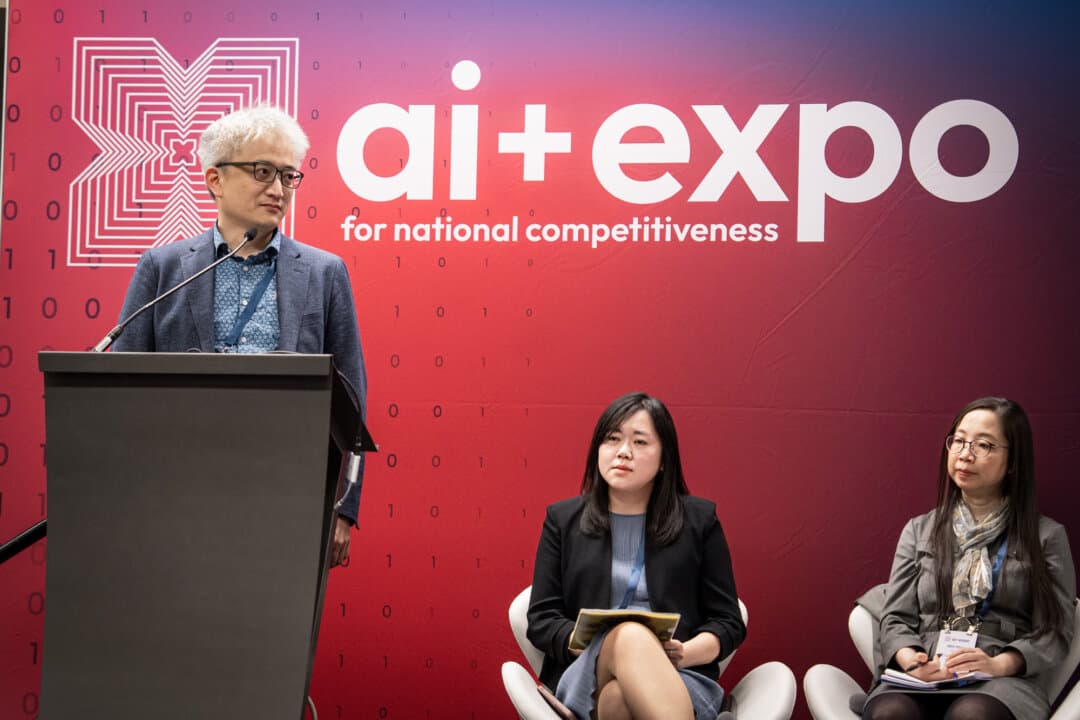
Ethan Tu, founder of Taiwan AI Labs, speaks during the AI+Expo Special Competitive Studies Project in Washington on June 3, 2025. The Taipei-based nonprofit uses artificial intelligence to expose coordinated influence operations and has documented Beijing's campaigns targeting Taiwan's elections. (Madalina Vasiliu/The Epoch Times)
Tu, a former principal development manager in Microsoft’s AI and research group who worked on its Cortana assistant, told The Epoch Times that OpenAI’s findings matched his own team’s research.
The energy sector, he said, is a recurring target of Chinese and Russian influence work “from Taiwan to the United States to Europe,” and U.S. data centers are the latest version of that.
He pointed to one detail OpenAI disclosed: The operators’ written instructions told the chatbot to feature Trump but never to mention Chinese leader Xi Jinping.
“They’re forbidden from mentioning their own boss,” Tu said, “but Trump is fair game to attack.” Because the disclosure came from the maker of the tool, which can see where accounts are based and their actions, he said it “carries a great deal of credibility.”
Darren Linvill, a Clemson University professor who coleads the school’s Media Forensics Hub and has spent years studying foreign influence campaigns, said he trusted OpenAI’s attribution and described the CCP as “very aggressive” in its attempts to shape opinion abroad.
Beijing pours resources into controlling how the world sees China, he told The Epoch Times, and works hardest to bury narratives that make it look bad, including by harassing Chinese diaspora communities.
On the use of AI to run fake accounts, Linvill said China was “still experimenting.” For now, he said: “They aren’t very good yet. But they are getting better.”
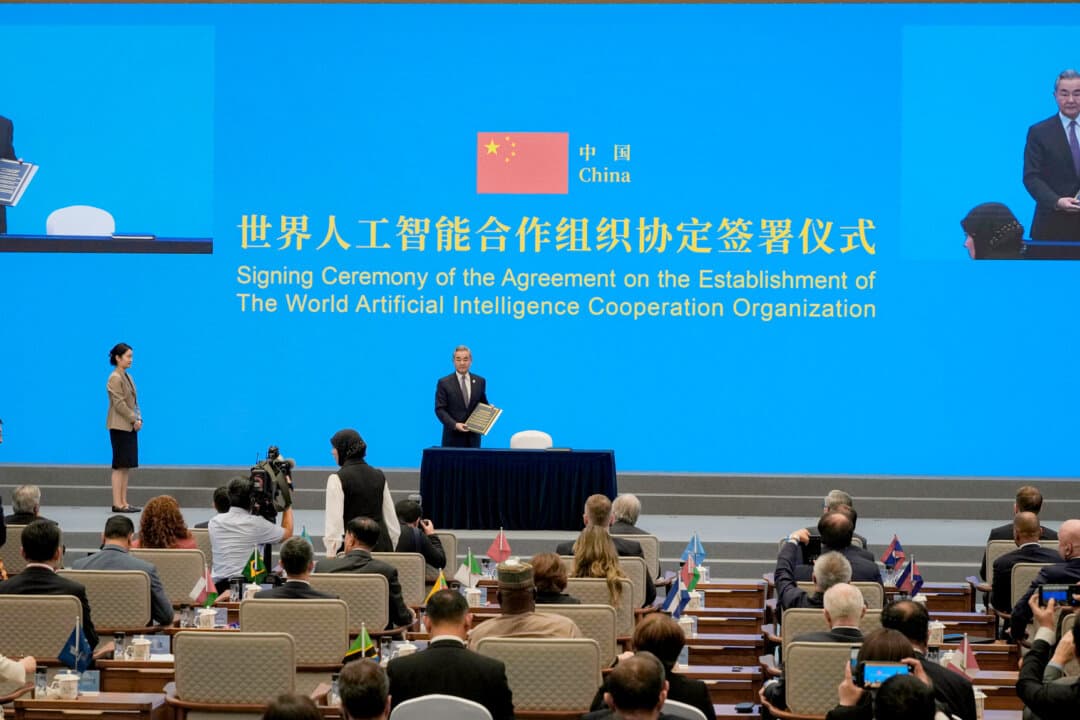
Chinese Foreign Minister Wang Yi and representatives of 29 countries at the signing of the agreement on the establishment of the World Artificial Intelligence Cooperation Organization ahead of the World AI Conference in Shanghai on July 16, 2026. The real divide in the AI competition is moral, says a former People's Liberation Army engineer. (Ng Han Guan-Pool/Getty Images)
Washington Sounds the Alarm
Officials in Washington have made broader claims. Interior Secretary Doug Burgum told an audience at a policy discussion hosted by Breitbart News in May that state efforts to ban AI data centers are “not organic and local,” and that “some of this is foreign-source dark money coming in.”
Rep. Brett Guthrie (R-Ky.) has asked the FBI and the President’s Council of Advisors on Science and Technology to examine foreign influence campaigns about the build-out, and Rep. Jason Smith (R-Mo.), who chairs the House Ways and Means Committee, said his investigators had traced Chinese money to U.S. nonprofits organizing the protests and pressed the Treasury Department to revoke their tax-exempt status.
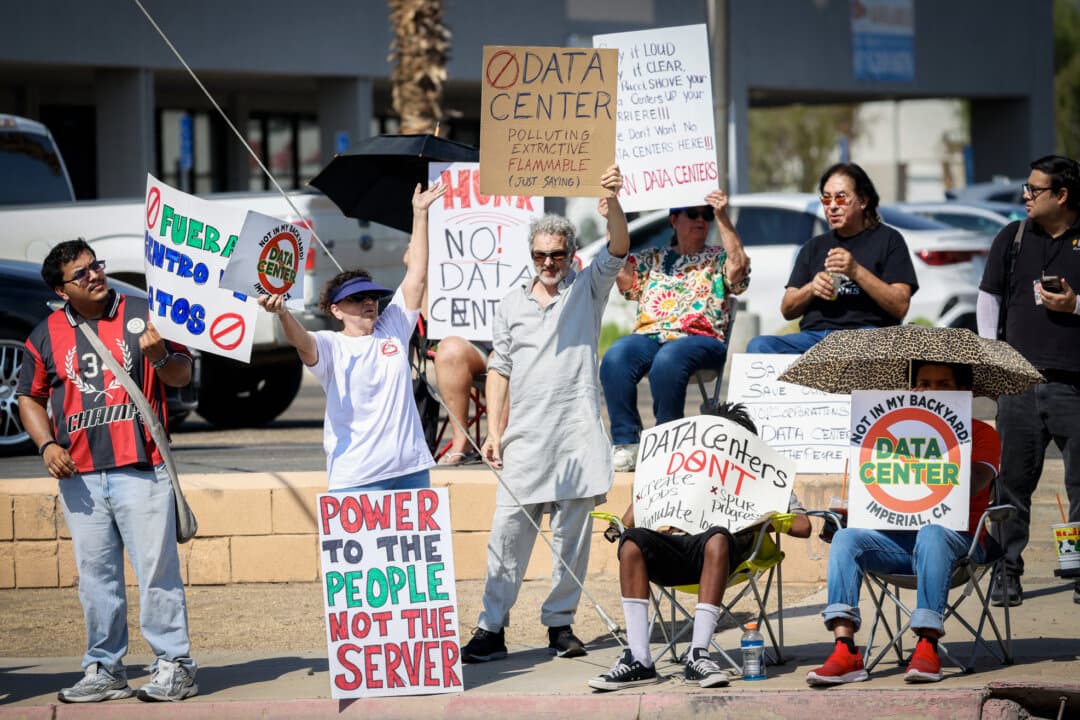
Demonstrators wave signs during a nationwide protest against artificial intelligence data center expansion, in Imperial, Calif., on July 18, 2026. (Sandy Huffaker/AFP via Getty Images)
The experts who study these campaigns warn against mistaking foreign manipulation for the source of the backlash.
Taipei-based Tu put it most plainly: The manipulation is real, and so is the grievance it feeds on. The claim the bots push—that data centers compete with households for power and can raise electricity bills—is “actually true,” he said, and opposition to data centers “genuinely exists,” in Taiwan as much as the United States.
But there is a danger that once people become aware of manipulation campaigns targeting public opinion, they dismiss any and all grievances as manufactured, Tu warned.
“When people object and you label all of it cognitive warfare, I think that oversimplifies the issue,” he said.
The influence operators’ real skill, he said, is blowing issues out of proportion—taking “a scattered case here and there” of genuine resentment and engineering it “into what looks like a full-blown social phenomenon.”
Linvill said the data center fight was plainly homegrown.
“This debate real Americans are already very interested in having,” he said. “[China] may be trying to amplify the conversation, but I’m not sure why they need to bother.”
Stoking divisive issues inside a rival’s population, he noted, is “influence 101.” And opposition to America’s data center build-out is no fringe phenomenon: Research group Data Center Watch has counted blocks or delays from local opposition to at least 75 data center projects, worth some $130 billion, in the first quarter of 2026—mostly over concerns about electricity prices, water use, and noise.

An Amazon Web Services data center near single-family homes in Stone Ridge, Va., on July 17, 2024. A research group counted blocks or delays from local opposition to at least 75 data center projects in the first quarter of 2026—mostly over concerns about electricity prices, water use, and noise pollution. (Nathan Howard/Getty Images)
Linvill said China’s homegrown Data Center Bandwagon campaign “had no meaningful effect whatsoever” and that this was typical of China, which he said was better at suppressing unwelcome stories than amplifying them.
Xia similarly said Beijing’s direct sway over American opinion was “very limited” and unlikely to “fundamentally alter the strategic direction” of the U.S. build-out.
It was the first time that China has tried to directly influence public opinion. In 2022, the cybersecurity firm Mandiant uncovered a Chinese operation that posed as worried local residents to stir opposition to American and Australian rare-earth projects, warning of radioactive contamination and calling for protests. That effort, too, gained little traction.
For Tu, the issue at hand is rarely the real target. Most of the influence operations his team tracks support no single party or position; their aim, he said, is to push democratic argument toward the extremes until “there’s no room left for a neutral, objective third party,” and to wear down public trust in institutions—courts, the press, elected leaders.
The end state, he said, is a creeping belief that “democracy is really just chaos, no better than China.”
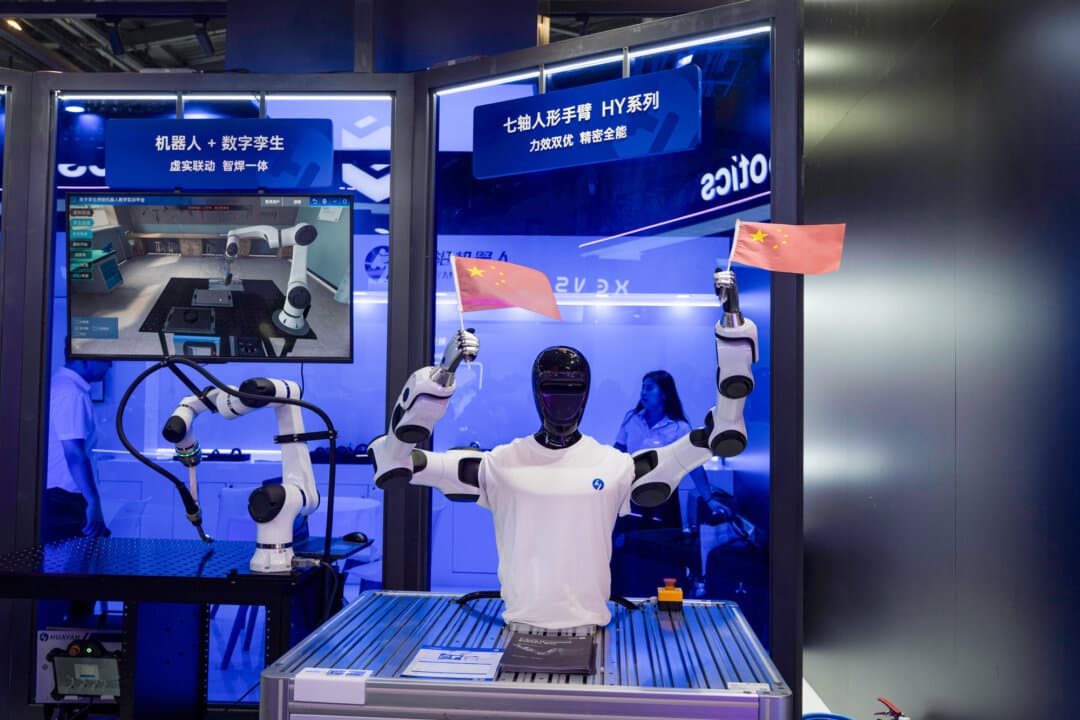
A humanoid robot from Chinese firm Huayan Robotics waves Chinese national flags during the World AI Conference in Shanghai on July 18, 2026. (Ng Han Guan/AP Photo)
The Deeper Contest
For Xia, the more important competition is the one underneath the supply chains. In AI generally, he said, the CCP still trails the United States, and in military AI, the gap is wider—but the threat is pushing the U.S. military to move faster.
The real divide, he said, is moral.
American military AI is built around what is called a “human-in-the-loop,” meaning that a person must approve any decision by an autonomous weapon to take a life.
The CCP, Xia said, “has no moral bottom line in its AI applications” and gives no clear account of what human control, if any, oversees its autonomous weapons—one reason the United States has pushed for international rules on such systems.
The two militaries, he said, could end up developing AI in entirely different directions.
But the CCP’s path, Xia said, may not be sustainable. Military AI freed of moral limits, he said, “would first bring lethal risk to its own developers, so this path is unlikely to prove workable.”
Gu Xiaohua contributed to this report.