China recorded 1.697 million marriage registrations in the first quarter this year, the lowest figure for any opening quarter since modern records began in 2013, according to data released on May 9 by the Chinese Ministry of Civil Affairs.
The number fell 6.24 percent, down from 1.81 million in the same period last year. A decade ago, in the first quarter of 2016, 3.45 million couples registered their marriages. The first quarter, which includes the Chinese New Year and traditional peak wedding season, has historically been the strongest registration period of the year.
A Decade of Declining Marriages
China’s marriage numbers have been falling for most of the past 13 years, according to data compiled by the National Bureau of Statistics of China. Registrations peaked at 13.47 million couples in 2013, then declined almost without interruption, reaching 6.83 million in 2022. They bounced back to 7.68 million in 2023 before dropping sharply to 6.106 million in 2024—a 20.5 percent decline in a single year. Full-year 2025 reported a modest uptick to 6.76 million.
Yi Fuxian, a demographer at the University of Wisconsin-Madison and author of “Big Country with an Empty Nest,” writing in Project Syndicate in January 2026, attributed these fluctuations to temporary effects rather than any durable reversal.
The 2025 uptick reflected two specific, time-limited factors. The first was a May 2025 policy change in which Beijing eliminated the longstanding requirement that couples register their marriage in the city where their household registration—known as the hukou—was held. Under the old system, millions of migrant workers living and working far from their hometowns faced significant logistical hurdles to marriage registration.
The second factor was a traditional belief among many Chinese that a so-called double-spring year on the lunar calendar is auspicious for weddings, leading to a cultural surge in wedding ceremonies in 2025.
Li Jiangping, a Beijing high school physics teacher and social affairs commentator, wrote on the Chinese web portal 163.com on May 11 that, with both tailwinds now exhausted, first-quarter 2026 data indicate that “young people have become completely desensitized to these policy incentives.” Drawing on the historical pattern—in which first-quarter figures typically account for 28 percent to 30 percent of annual totals—Li projected that full-year 2026 registrations would fall between 5.3 million and 5.9 million couples.
Little Mi, a Chinese commentator on demographic affairs, said on May 11 in a YouTube program that full-year 2026 registrations would likely be below 6 million.
According to calculations based on data from the National Bureau of Statistics, the number of people ages 20 to 39 fell from about 435 million in 2013 to about 371 million in 2023—a decline of 64 million over a decade.
Why Young People Are Not Tying the Knot
The financial barriers to marriage in China have become severe enough that a growing body of survey data shows that reluctance runs deeper than economics alone.
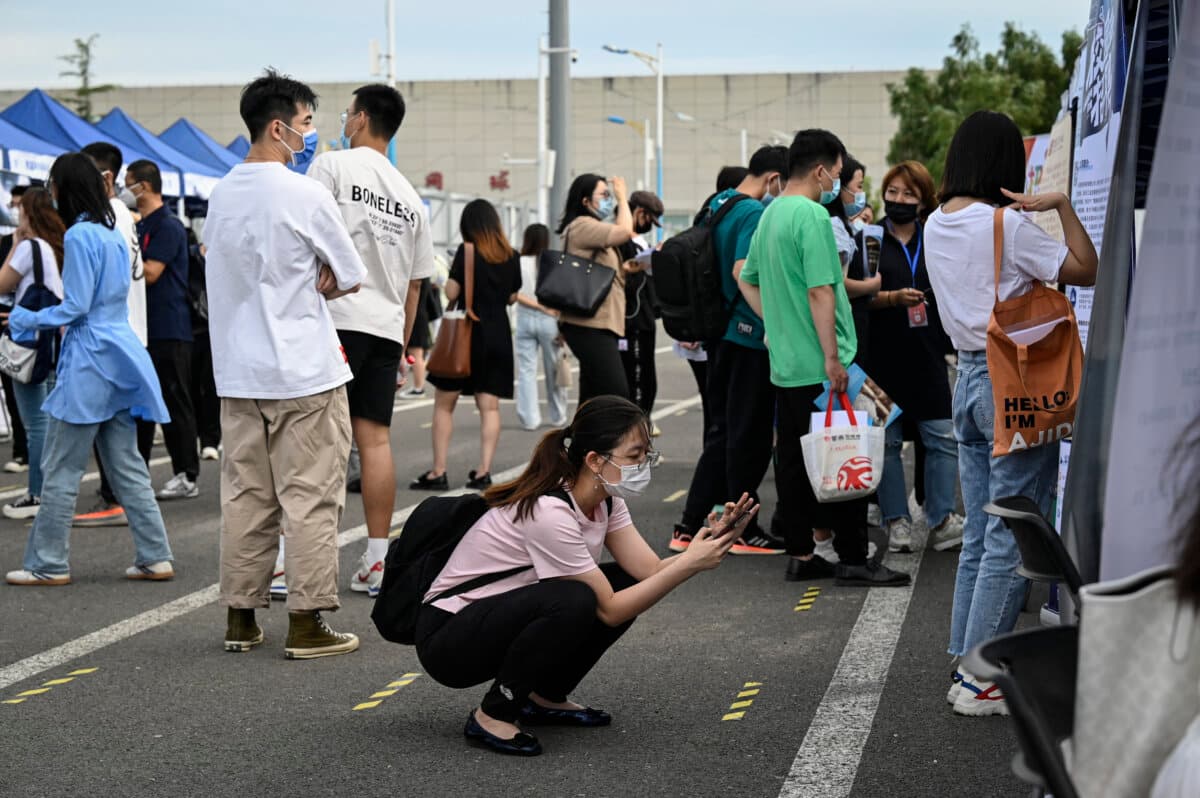
A job fair in Beijing on Aug. 26, 2022. China's slowing economy has left millions of young people fiercely competing for an ever-slimmer raft of jobs and facing an increasingly uncertain future. (Jade Gao/AFP via Getty Images)
An April 2025 survey by the Institute of Psychology at the Chinese Academy of Sciences, based on responses from nearly 56,000 college students and 7,300 adults across all 31 provinces, found that 51.8 percent of college students considered marriage unimportant and 59.4 percent considered having children unimportant. The gender gap was stark: Female students were 37.6 percentage points more likely than male students to consider marriage unimportant and 34.7 percentage points more likely to consider having children unimportant.
Chen Zhiyan, a professor at the Institute of Psychology and the lead author of the survey report, said the shift reflects both economic anxiety and a breakdown of the social compact that once made marriage feel self-evidently worthwhile.
“Adults—especially college students—face enormous economic pressure,” Chen wrote. “Considering the costs of marriage, such as buying a home and holding a wedding, as well as the high cost of raising children, they feel fear and worry about marriage and childbirth.”
The survey found that female students’ reluctance is driven in part by an assessment of the historical cost of marriage for women in China’s labor market. Workplace discrimination against married women in China—including documented hiring preferences for single women and demotions or dismissals following pregnancy—has made marriage a calculated career risk for educated women. The survey data reflect that calculation: Among college women, 85.3 percent said they would accept marrying without having children.
The financial barriers reinforce the attitudinal ones. Figures widely circulated on Chinese social media in May estimated the national average wedding cost at about 330,000 yuan (nearly $50,000)—roughly seven years of savings for an average wage earner. In major cities—such as Beijing, Shanghai, Guangzhou, and Shenzhen—the figure approaches 680,000 yuan (about $100,133).
On top of that is the traditional “caili,” or bride price—a separate payment from the groom’s family to the bride’s family. A 2023 survey by the Organization for Research on Central Asia found that the national average caili had reached 69,000 yuan (about $10,000), with wealthier provinces like Zhejiang reporting averages exceeding 183,000 yuan (about $25,000).
Cao Duoyu, a widely followed economic analyst and top-rated contributor on Zhihu, a China-based question-and-answer social media site and news aggregator, framed the breakdown in systemic terms on May 11: “Once the majority of participants conclude that entering the arrangement is a net loss, the rational choice is simply not to participate. Once everyone stops yielding, the mechanism seizes up entirely.”
Numbers Include ‘Make-Up’ Registrations
A detail buried in China’s official marriage statistics further complicates the picture. In recent years, local governments have actively promoted “make-up registrations”—encouraging elderly couples who married decades ago without formal documentation to file for retroactive certificates, often rewarding them with eggs and complimentary wedding photographs. These retroactive filings are included in national totals without age or category breakdowns.
The scale is measurable at the provincial level. In Jiangsu, state media reported that 57,558 of 412,286 marriage registrations in 2022—roughly 14 percent—were make-up filings. China National Radio’s Jiangsu bureau reported that the figure rose to 62,400 of 453,852 registrations in 2023, again about 14 percent.
Marriage registration figures are tracked by local officials as a performance metric, creating a structural incentive to maximize totals. The Ministry of Civil Affairs has not published a national subtotal that separates make-up registrations from new marriages.
Falling Marriages and Births
The marriage collapse feeds directly into China’s birth numbers. The National Bureau of Statistics reported 7.92 million births in 2025—down 17 percent from 9.54 million in 2024 and less than half the total from a decade earlier. The birth rate fell to 5.63 per 1,000 people, the lowest since the founding of communist China in 1949.
Beijing has responded with a package of measures that reads as a study in policy contradictions.
Effective Jan. 1, 2026, child care providers, marriage-related services, and elder-care institutions were granted value-added tax exemptions under a revised value-added tax (VAT) law—while the same legislation simultaneously removed a 30-year exemption for contraceptives, subjecting condoms and contraceptive drugs to a 13 percent VAT for the first time since 1993, when China was enforcing its one-child policy and actively promoting birth control.
Additional measures included a 3,600 yuan (about $530) annual child care subsidy per child under 3 and the hukou-free marriage registration reform. First-quarter 2026 data suggest neither has moved the needle.
A Henan-based writer who publishes social affairs analysis on 163.com under the name Lao Ti said on May 12 that official responses have targeted the wrong pressure points. Affordable housing, universal subsidized child care, and enforceable workplace protections for women who marry and have children would reduce barriers, he said.
“Only when housing prices no longer suffocate, when raising children no longer overwhelms, and when the workplace no longer causes anxiety would more people be willing to marry,” he wrote.