News Analysis
China’s housing market had another very weak month in October, with price declines even steeper than in September.
New home prices saw their sharpest monthly drop across 70 major cities, while investment in real estate development fell sharply over the first 10 months of the year. At the same time, another big-name property developer has been pushed into court-led restructuring.
Former Chinese Finance Minister Lou Jiwei has recently said publicly that the property downturn will likely persist and that shifting China’s real estate sector to a more stable model will take at least another five years.
Taken together, analysts say, the latest data and policy signals point to a long, grinding correction that is weighing on economic growth, local government finances, and consumer confidence.
‘Painful Cleanup’
“This isn’t a normal cyclical dip,” said U.S.-based economist Davy J. Wong. “It is a slow, painful cleanup of balance sheets after more than two decades of debt-driven expansion in housing and land.”
Prices are still falling in most places, developers’ cash flows remain weak, and the policy fixes so far have not restored trust, Wong recently told The Epoch Times.
For the broader economy, he said, that means weaker consumer spending, ongoing deflationary pressure, and tighter budgets for local governments that used to rely heavily on land sales.
Policymakers can soften the blow, Wong added, but the evidence so far suggests they cannot quickly reverse the downturn.
What the Latest Data Show
October’s official numbers show new home prices fell by another 0.5 percent month over month and 2.2 percent from a year earlier—both worse than expected for what is normally a strong autumn selling season. September’s 0.4 percent drop was already one of the weakest readings of the year.
Second-hand home prices also dropped. Xu Tianchen, a senior economist at the Economist Intelligence Unit (EIU), warned that the month-on-month decline in second-hand home prices is approaching a “critical threshold,” suggesting that if the fall continues, Beijing may feel forced to intervene more aggressively.
On the investment side, property development spending for January through October fell by 14.7 percent compared to the same period last year, a larger contraction than in earlier months.
China’s real-estate “prosperity index”—a composite indicator the Chinese regime uses to track the health of the sector—slipped to 92.43 in October. Historically, readings closer to at least 100 indicate a relatively healthier market.
Sun Guoxiang, an international affairs professor at Taiwan’s Nanhua University, told The Epoch Times that the current index level reflects continued stress and contraction in real estate activity.
A Broken Funding Model and a Slow Policy Shift
Lou Jiwei, who served as China’s finance minister from 2013 to 2016, used the Caixin Summit—a high-level annual business conference in Beijing—on Nov. 14 to publicly criticize the structure of the housing system.
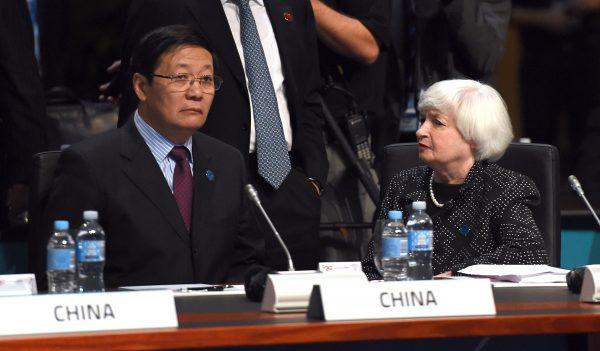
Chinese Finance Minister Lou Jiwei talks with U.S. Federal Reserve Chair Janet Yellen at the G20 Finance Ministers and Central Bank Governors Meeting in Cairns, Australia, on Sept. 20, 2014. (William West/AFP/Getty Images)
He singled out China’s pre-sale system, in which developers sell homes before construction even starts, as a key source of risk.
In theory, pre-sales are meant to help finance construction. But in China, Lou noted, many developers took buyers’ money for one project and used it to plug holes in others, rather than setting it aside for the project those buyers paid for. That practice amplified risk, he said. When sales slowed and funding conditions tightened, many projects were left short of cash and could not be delivered.
Lou called for a gradual move away from the current pre-sale model toward selling finished units and speeding up delivery of homes already presold. He also warned that the property slump is suppressing consumer spending and strengthening deflationary forces in the economy.
He estimated that reorganizing the sector and shifting to a more sustainable model would take at least five years.
Developers’ Distress Persists
In 2020, regulators drew the “three red lines” to cap developers’ leverage by limiting the ratio of their debt to cash, equity, and assets. That policy shift helped trigger the default and liquidation of Evergrande—once China’s largest property developer—and a broader property slump.
The credit stress that erupted in 2021 is now in its fourth year and still spreading through the property sector.
China Fortune Land Development (CFLD), a former 100-billion-yuan ($14 billion) property giant, announced on Nov. 16 that it is entering a court-supervised restructuring process.
The move comes after years of stalled debt talks and mounting pressure that began with the company’s default in early 2021 and later rippled through the wider developer market.
The court’s acceptance marks an important step toward sorting out CFLD’s multibillion-yuan debt crisis. But what finally pushed it into this court-ordered restructuring was not a large bond coming due; it was an unpaid construction bill of approximately 4.17 million yuan ($586,000).
Sun said this small but serious default shows how thin many companies’ cash buffers have become.
Wong noted that CFLD’s earlier offshore restructurings in 2023 focused on large financial debts owed to banks and bondholders, but many smaller operating debts to contractors and suppliers remain unpaid. Those smaller bills are now pushing companies such as CFLD back into trouble, even as sales remain weak.
The broader cleanup is moving slowly. According to data collected by China Index Academy, a Beijing-based Chinese real estate research institute, 77 developers defaulted on their debts between 2020 and August 2025. About 60 troubled companies have reported some progress on debt restructuring, but approximately 20 have had restructuring plans approved.
Wong said the backlog of defaulted companies and unfinished restructurings is huge for courts, creditors, and administrators to work through, and it is one reason many building projects remain frozen.
Evergrande continues to symbolize the collapse in the property sector, Sun added. In January 2024, Hong Kong’s High Court ordered the company’s liquidation after it failed to present a viable restructuring plan for its offshore debt; the group now carries more than $300 billion in liabilities.

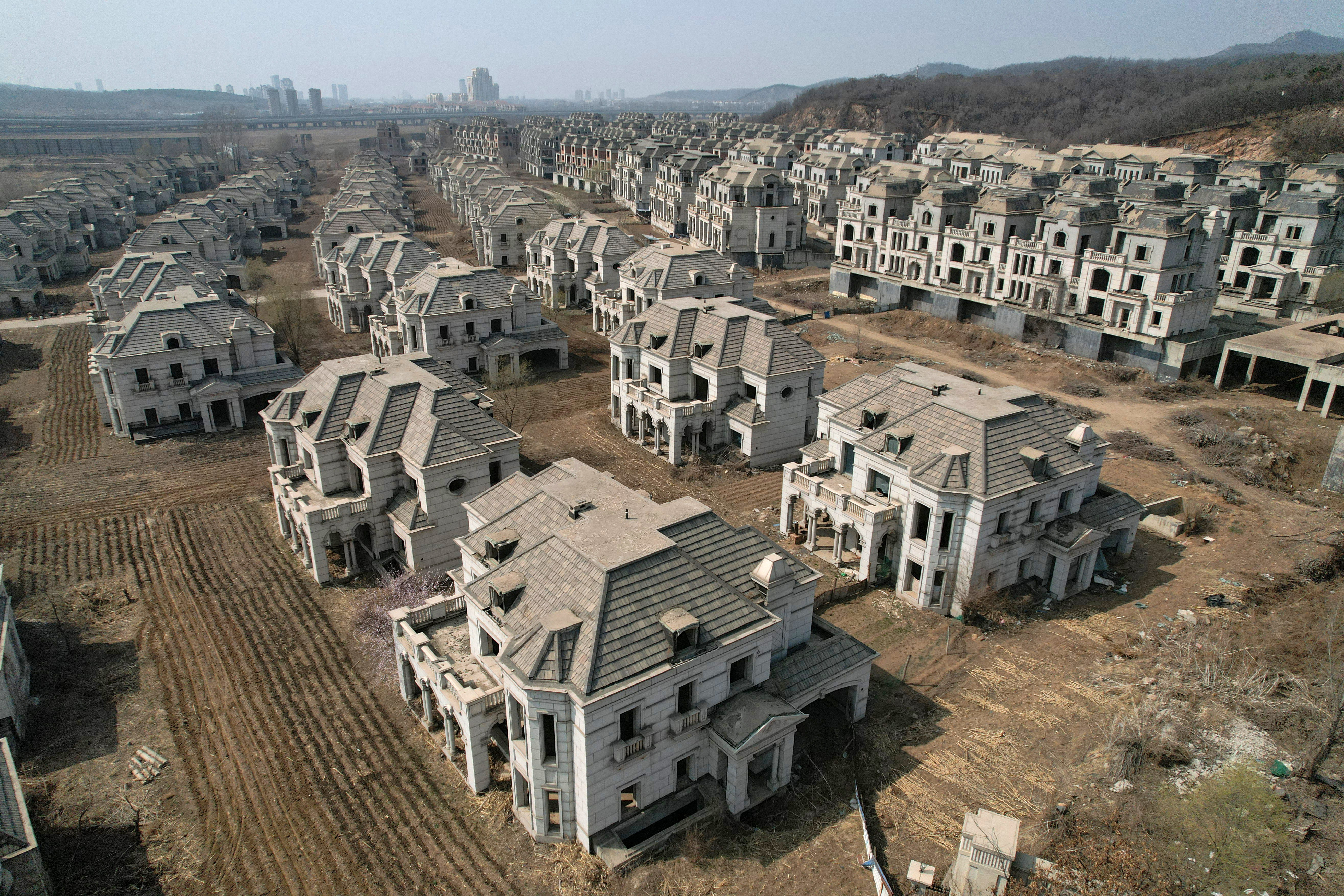
An aerial view shows an Evergrande housing complex left unfinished amid a liquidity crisis, in Wuhan, China, on Oct. 18, 2021. (Getty Images)
The Evergrande case shows how little value is left once sales dry up and land prices fall, and how difficult it is to protect the millions of homebuyers and suppliers caught in the collapse, Sun said.
Local Governments Under Financial Strain
Housing is deeply tied to the rest of China’s economy. Research by Harvard economist Kenneth Rogoff and International Monetary Fund economist Yang Yuanchen
estimates that real estate and its supply chain—such as construction materials, home furnishings, and property-related services—together account for roughly a quarter to a third of China’s GDP.
When prices fall and construction slows, the damage spreads to steel, cement, home appliances, real-estate brokers, and many service jobs.
Because Chinese households keep a large share of their wealth in housing, falling prices also weaken their balance sheets. That makes families more cautious about spending, Wong said, and contributes to the weak consumption numbers that have worried Beijing in recent years.
Local governments are especially exposed. In 2021, at the height of the housing boom, land-related income—including land-use rights sales and land- and property-related taxes—made up nearly 38 percent of their total fiscal revenue, according to research by the Peterson Institute for International Economics.
With land-sale revenue now sharply lower, particularly in less-affluent cities, local budgets are under growing strain. Meanwhile, central authorities face rising demands to fund the completion of stalled projects, support local government financing vehicles (LGFVs), and shore up growth.
LGFVs are shell companies that China’s provinces and cities use to borrow money off the books, often by selling bonds to local residents.
These entities let officials raise cash for infrastructure and development projects without the debt appearing in official budgets, creating a parallel financing system that has grown rapidly—and opaquely—over the past decade.
Now, LGFVs are struggling to refinance an estimated 78 trillion yuan ($10 trillion) in liabilities—more than half the size of China’s economy—according to research by global financial services group BBVA.
Wong said that the fiscal squeeze limits how much authorities can do to rescue the housing market without creating new financial risks elsewhere in the system.
Why the Downturn Is Lasting
Wong and Sun point to three main forces driving the property market’s decline.
First, recent demographics and migration patterns indicate that there are fewer new homebuyers in many smaller cities, where oversupply is most severe and many units sit empty. China’s working-age population is shrinking, and younger people are moving to top-tier cities, leaving weaker demand in lower-tier markets.
Second, the pre-sale system has severely undermined trust. Buyers saw their deposits being used to cover unrelated developer debts, and projects either stalled or became “rotten-tail buildings”—unfinished or abandoned housing developments. As a result, many households now hesitate to make down payments on homes that are not yet built.
Third, the policy response so far from Beijing—including lower mortgage rates, reduced down-payment requirements, and targeted support measures—has helped at the margins but has not convinced people that home prices will hold their value over time.
Former Chinese Finance Minister Lou’s call to gradually phase out pre-sales and focus on delivering completed homes is, in part, an attempt to rebuild that trust. But as Wong noted, it also implies a slower, more capital-heavy business model that will take time to put in place.
Cheng Wen, Yi Ru, and Reuters contributed to this report.