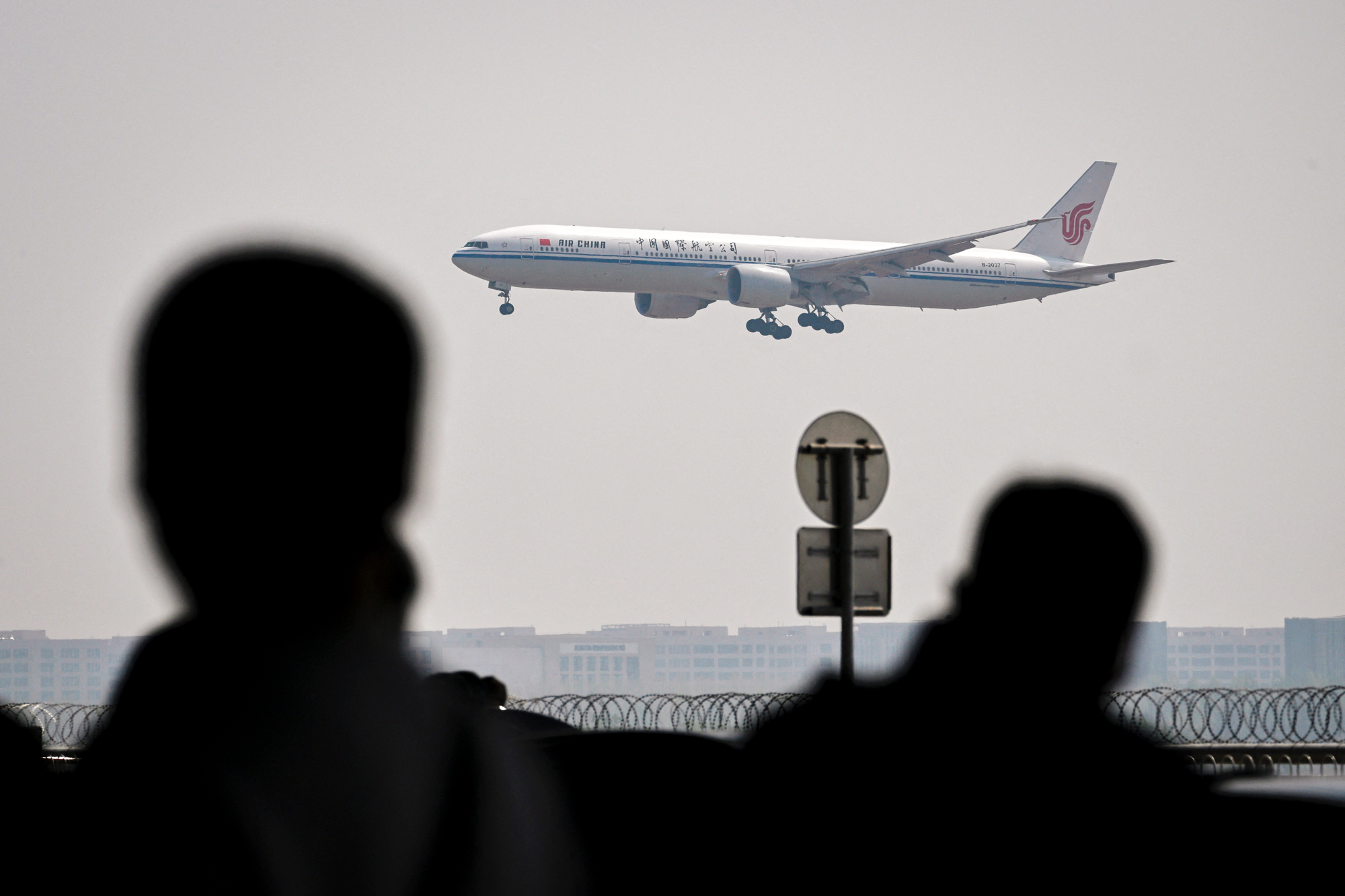

Lu Tingge handed his boarding pass to a border officer at the airport in Kunming, China, expecting to board a flight to Thailand on Sept. 17.
Minutes later, the human rights lawyer from Hebei Province was sitting in a side room while two officers filmed him on a body camera.
He was told that he could not leave China.
When Lu asked why, an officer returned with a sheet of paper: A December 2019 exit ban issued by Hebei police, citing Lu for “picking quarrels and provoking trouble.” This is a catch-all charge often used against Beijing’s critics and legal advocates, a group Lu belonged to after handling sensitive legal cases.
Pressed for further details, one officer said only that it was “an internal system matter.”
It was the third time Lu had come up against the ban when trying to leave the country.
The latest incident occurred two days after China’s new State Council rules on exit and entry officially took effect, on Sept. 15.
Arbitrary exit bans have long existed, but analysts expect cases like Lu’s to become more frequent and more arbitrary under the new rules.
The regulations require travelers to provide “true and lawful” reasons for leaving, allow officers to bar anyone deemed to have made a false statement, and allow commerce officials to halt travelers whose export control violations “may” endanger industrial or technological security.
Analysts say the vague wording gives immigration officers broad authority to stop travelers at the gate and withhold explanations under the banner of national security.
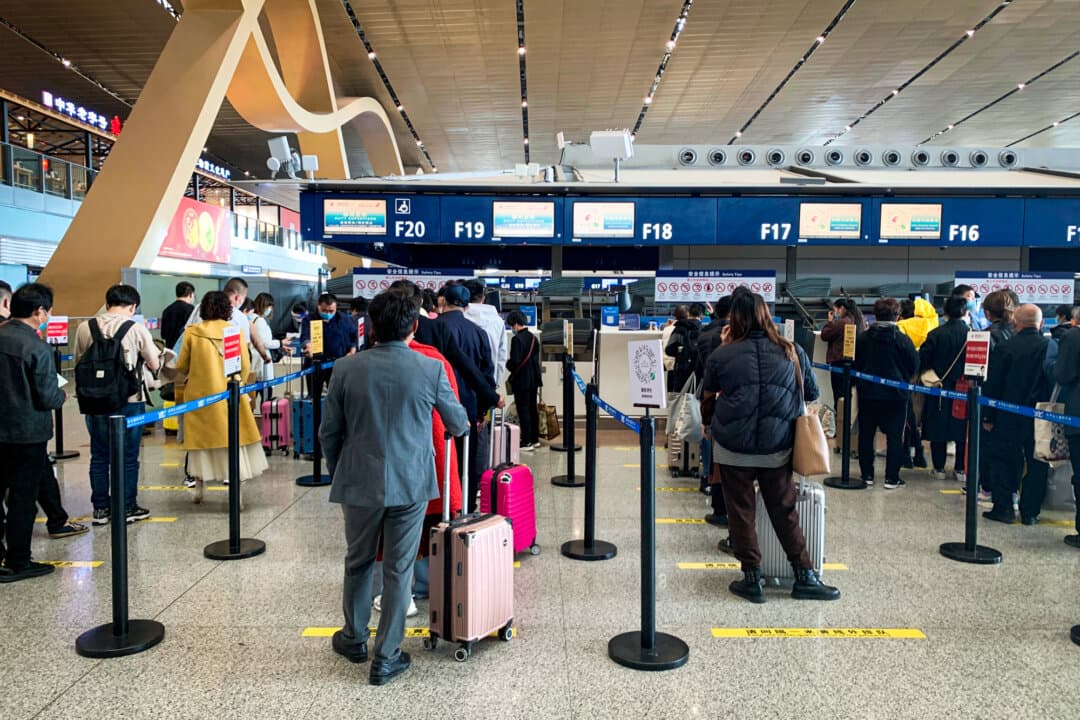
Travelers line up at the China Eastern Airlines check-in counter at Kunming Changshui International Airport in Kunming, Yunnan Province, China, on March 22, 2022. (Dake Kang/AP Photo)
In the weeks before and after the rules took effect, accounts on Chinese social media spread stories of travelers being questioned for hours, made to unlock their phones, or turned back at the gate, often without being told why. Many cannot be independently verified, but some match what people in China described to The Epoch Times.
In response, Chinese officials on Sept. 10 called the claims that citizens would find it harder to leave a “misreading.” The rules, they stated, are aimed strictly at those who go abroad under false pretenses to join gambling or telecom scam rings, as well as individuals taking restricted technology out of the country. Tourists, businesspeople, students, and family visitors, officials said, would be unaffected.
However, analysts and individuals who have been barred from leaving China told The Epoch Times that authorities have stopped people from leaving on thin or unstated grounds for years. What the new rules change, they said, is that the power is now written into law, making it easier to use and easier to justify. They said they expect more people to be stopped at the gate.
The timing, they said, comes down to money. With a struggling economy and weak consumer spending, local governments—short on land revenue—have turned to fines, back taxes, and asset seizures.
Analysts say the rules are targeting the people that China can least afford to lose: entrepreneurs with savings in the bank; families with homes, investments, or children abroad; and those with skills sought by foreign companies.
Formalizing Existing Controls
Frank Xie, a business professor at the University of South Carolina–Aiken, noted that the Sept. 15 start date mainly serves to give arbitrary enforcement “a formal legal basis going forward.”
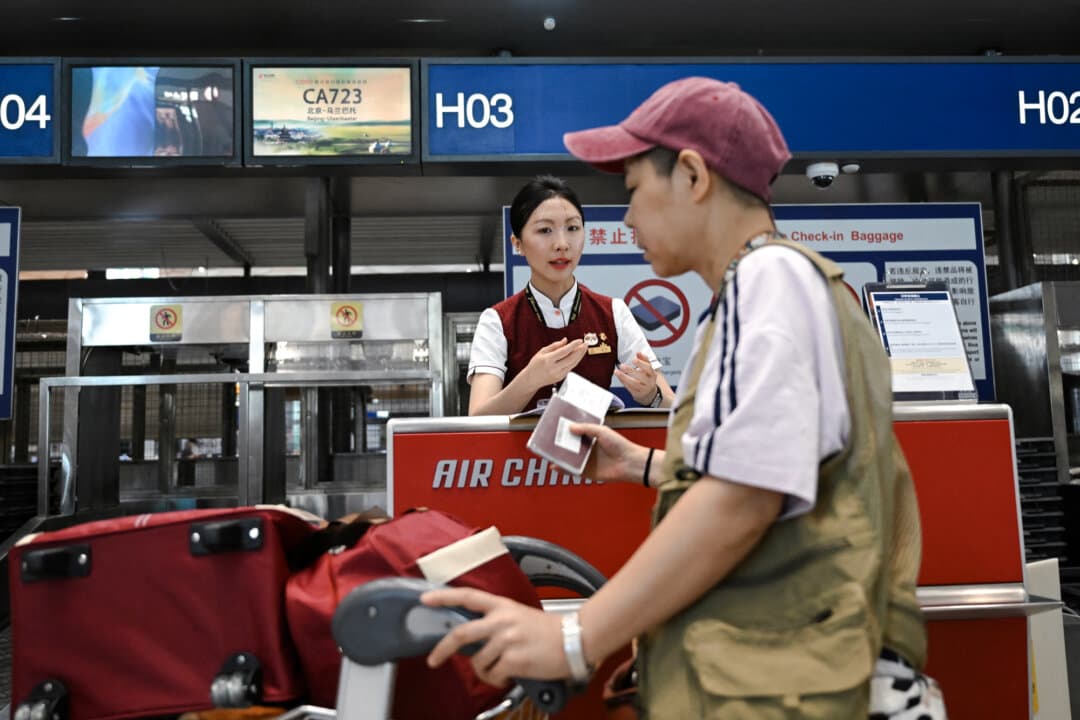
A passenger checks in at Beijing Capital International Airport on Aug. 12, 2026. (Pedro Pardo/AFP via Getty Images)
A public sector employee, who only provided the surname Ge for fear of reprisal, told the Chinese edition of The Epoch Times that border crossings and major airports began enforcing the rules on Aug. 1. The checks, Ge said, have expanded beyond state workers with security clearances to include key staff at private and foreign companies in finance, technology, semiconductors, and artificial intelligence.
On Sept. 15, a staff member at Shanghai Pudong International Airport—who requested to remain anonymous out of fear of reprisal—confirmed to the publication that internal screening checks were operating well before the official launch.
Even before the latest rules, China’s 2013 exit-entry law gave authorities wide latitude to prevent people from leaving—covering criminal suspects, individuals in unresolved civil cases, and anyone whose departure “may” endanger national security. The new rules build on that foundation, expanding the legal pretexts and placing more authority in the hands of officers at the gate.
Lu’s travel ban rests on that old law. On Dec. 31, 2019, police questioned him for nearly 24 hours and issued the ban under the law’s clause on criminal suspects, he told The Epoch Times.
Earlier that year, he had launched a petition calling for constitutional amendments and then went missing for 10 days, Radio Free Asia reported at the time.
Sun Yuanping, a 55-year-old activist from Shijiazhuang who was stopped at the border four times before he left China in July, said exit bans used to be approved by the Ministry of Public Security, the provincial police, and the city bureau.
“But look at it now. This Sept. 15 new rule says that if port officers questioning you feel you have a problem, they can put you under border control,” he told The Epoch Times. “That’s extremely arbitrary.”
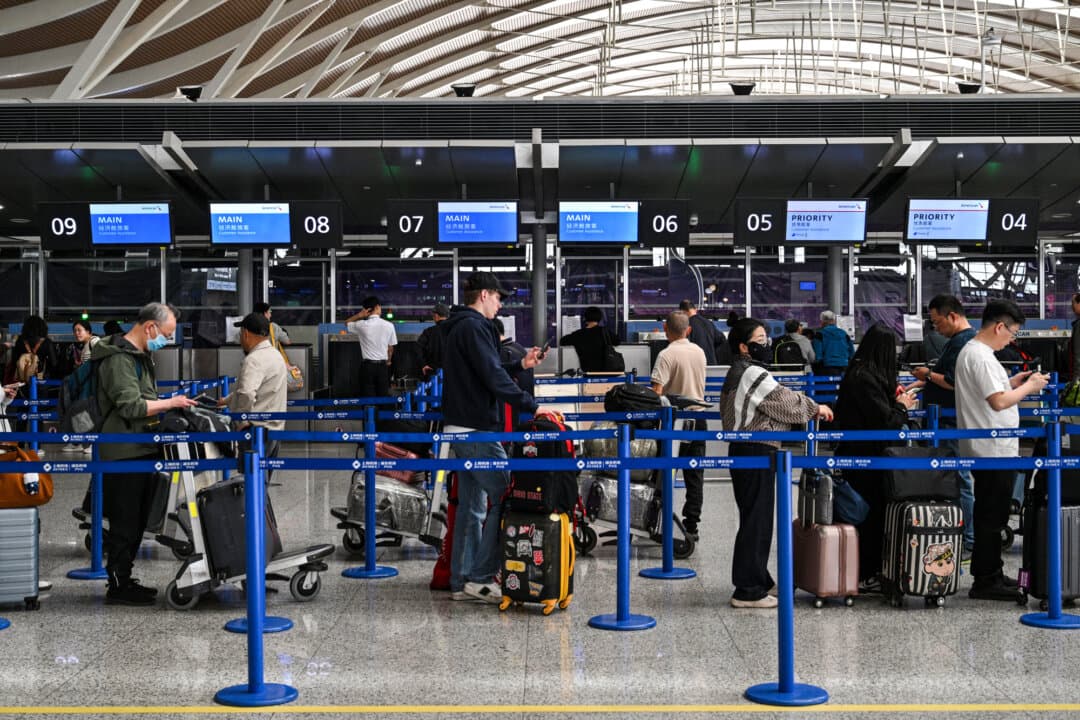
Passengers wait at an American Airlines counter at Shanghai Pudong International Airport on April 17, 2025. (Hector Retamal/AFP via Getty Images)
While the rules omit that exact phrasing, they explicitly allow officers to bar any traveler deemed to have made false statements, he added.
Cai Shenkun, a U.S.-based veteran commentator on China’s economy and politics with access to sources within the Chinese Communist Party (CCP), told The Epoch Times that such authority has spread so far down the system that even the lowest level of city government can now restrict travel.
Some of the screening now spreading across the country was tested years ago in the Xinjiang region. A 2017 handbook from the Ili Prefecture Public Security Bureau in the northern Xinjiang region instructed authorities to review an applicant’s family bank accounts before granting a passport and required travelers to surrender their passports to local police within seven days of returning. It also ordered relatives of those living abroad to cut ties and stop sending money.
The handbook is part of the Xinjiang Police Files, published by the Victims of Communism Memorial Foundation. Adrian Zenz, a senior fellow in China studies at the foundation, told The Epoch Times that the Xinjiang region “clearly has been a testing ground for repression, but it goes both ways,” with methods brought in from other provinces and refined there.
“There has been mutual learning,” he said.
Locking In Capital and Wealth
In the Xinjiang region, the targets were ethnic minorities with ties abroad. Now, Xie said, the target is money.
“The tax revenue the CCP gets through normal channels is shrinking rapidly,” he said, leaving the authorities to lean on “non-tax revenue—that is, arbitrary fines.”
Local governments in China control urban land and have long paid their bills by selling development rights. Those sales brought in 4.15 trillion yuan (about $620.2 billion) in 2025, less than half what they collected in 2021, according to official figures—a drop of more than 4 trillion yuan (about $600 billion) from the peak.
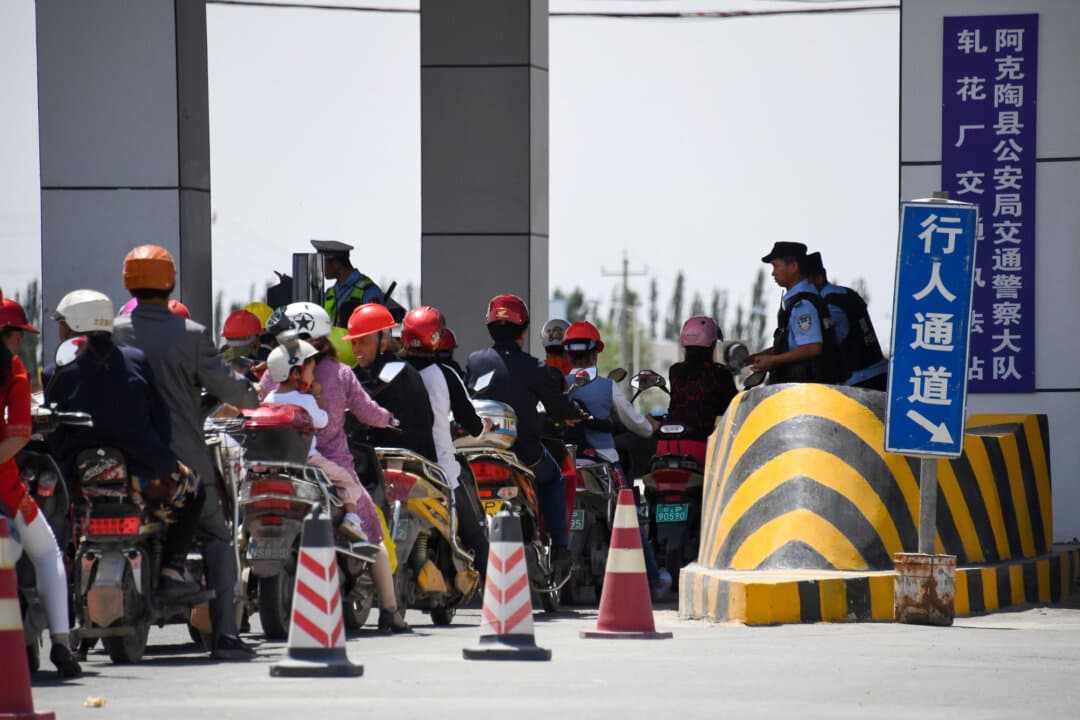
Travelers wait at a police checkpoint on a road near a facility believed to be a reeducation camp where mostly Muslim minorities are detained, in Xinjiang region, China, on June 4, 2019. One analyst called the region "a testing ground for repression." (Greg Baker/AFP via Getty Images)
Adjusted for inflation, home prices, which hold most Chinese families’ wealth, have fallen below their 2005 levels, according to the Bank for International Settlements, which is owned by 63 central banks.
To patch the deficit, authorities have turned aggressively to collecting fines and back taxes and to seizing assets. Ministry of Finance data show that while overall tax revenue fell by 3.4 percent in 2024, non-tax revenue—a category heavily weighted toward fines and confiscations—surged by 25.4 percent.
A Renmin University study of 279 cities found that fines and confiscations accounted for an average of 14.7 percent of local non-tax revenue from 2015 to 2023, and that this share continued to rise.
The push for revenue has become so aggressive that in December 2024, Premier Li Qiang publicly warned officials against “abnormal growth” in revenue from fines and confiscations and criticized the practice of “distant-water fishing,” in which local police travel outside their jurisdictions to detain out-of-province entrepreneurs and freeze their assets.
In May this year, the Chinese Ministry of Justice said a national campaign had uncovered more than 5,500 cases of arbitrary fines.
“What this really reflects is a shift in the fiscal model, from one that relies on new economic growth to one that harvests existing wealth,” said Davy J. Wong, a U.S.-based independent political economist.
“In the past the system mainly raised the cost of getting assets out; now it’s raising the cost of getting people and capital out.”
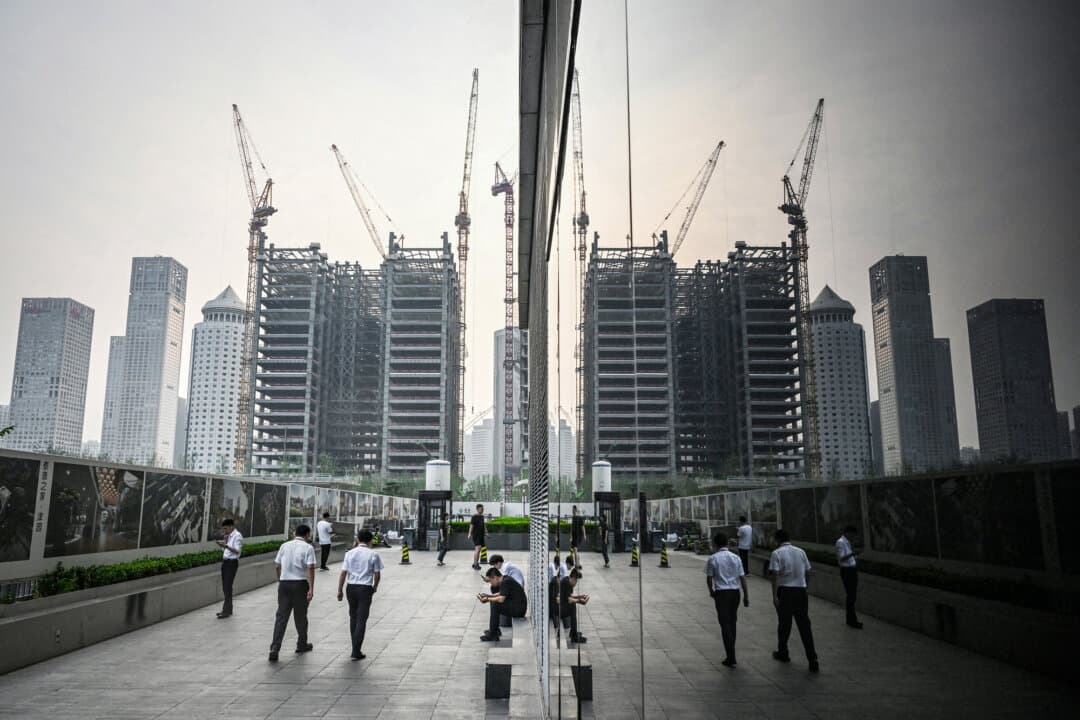
Office workers walk beside the wall of a construction site in the central business district of Beijing on July 11, 2024. Local governments in China control urban land and have long paid their bills by selling development rights. Those sales have dropped dramatically. (Greg Baker/AFP via Getty Images)
Holding on to money is not the rules’ only aim, he told The Epoch Times, but with capital flight, a shrinking tax base, and fiscal pressure all rising at once, the goal is to tighten the state’s grip on people, money, and ties abroad.
In late August, just weeks before the new rules officially took effect, border police at Shanghai Pudong International Airport fenced off part of the boarding hall and pulled aside some Chinese travelers, especially men older than 40, to fill out a form before they could board, according to a local public sector employee in Hangzhou, who asked not to be named out of fear of reprisal.
One of those pulled aside, a graduate student flying back to Tokyo, was asked about his employment status and income, his relatives’ jobs and contact details, his family’s assets, and whether his household carried large debts, the insider told The Epoch Times.
The system now works so that if police find a single answer on the form to be untrue, it could be grounds for them to stop a traveler from leaving the country in the future, he added.
Deepening Surveillance and Debt Traps
The extraction of wealth extends beyond municipal fines to explicit asset freezes and retroactively applied taxes.
Cai said an acquaintance cashed out more than 900 million yuan (about $126 million) in stocks in the first half of this year, only for the local government to take over the account and tell him that he needed official approval to touch a single cent.
“Anyone who may have deposits of 10 million yuan [about $1.4 million] or more in their name could be placed under border control at any time, anywhere, and barred from leaving,” Cai said. “You may have deposits in China on paper, but I’m afraid they no longer belong to you.”

An employee counts out 100 yuan notes at a bank in Shanghai on Aug. 8, 2018. Under China's new rules, "Anyone who may have deposits of 10 million yuan [about $1.4 million] or more in their name could be placed under border control at any time, anywhere, and barred from leaving," China commentator Cai Shenkun told The Epoch Times. (Johannes Eisele/AFP via Getty Images)
The state is also looking at money held abroad. Since 2025, tax offices have told residents to report overseas investment income going back to 2022 and pay 20 percent on gains and dividends.
This summer, Beijing extended that tax to income from offshore trusts, and the Financial Times reported that some banks had frozen wealthy clients’ accounts until taxes on their overseas assets were paid, in some cases reviewing records back to 2000.
Local police are also gathering details about people’s lives abroad.
In August, the Chinese edition of The Epoch Times reported that overseas workers returning home had been told by local police to submit seven items, including proof of employment abroad, a photo of their employer’s front entrance, and their exact overseas address.
“[The CCP] has no legitimate reason to know where these people live after they leave,” Xie said.
Debt keeps people in, too. Under a 2016 agreement among dozens of government agencies, individuals blacklisted by China’s courts for failing to pay court-ordered debts can be barred from flying, staying at upscale hotels, sending their children to private schools, and leaving the country.
China’s Supreme People’s Court data found that 34,000 people were placed under exit bans for owing money between 2016 and 2018, and mentions of exit bans in court judgments roughly doubled each year from 2021 to 2024, according to Safeguard Defenders, a human rights group that tracks the practice.
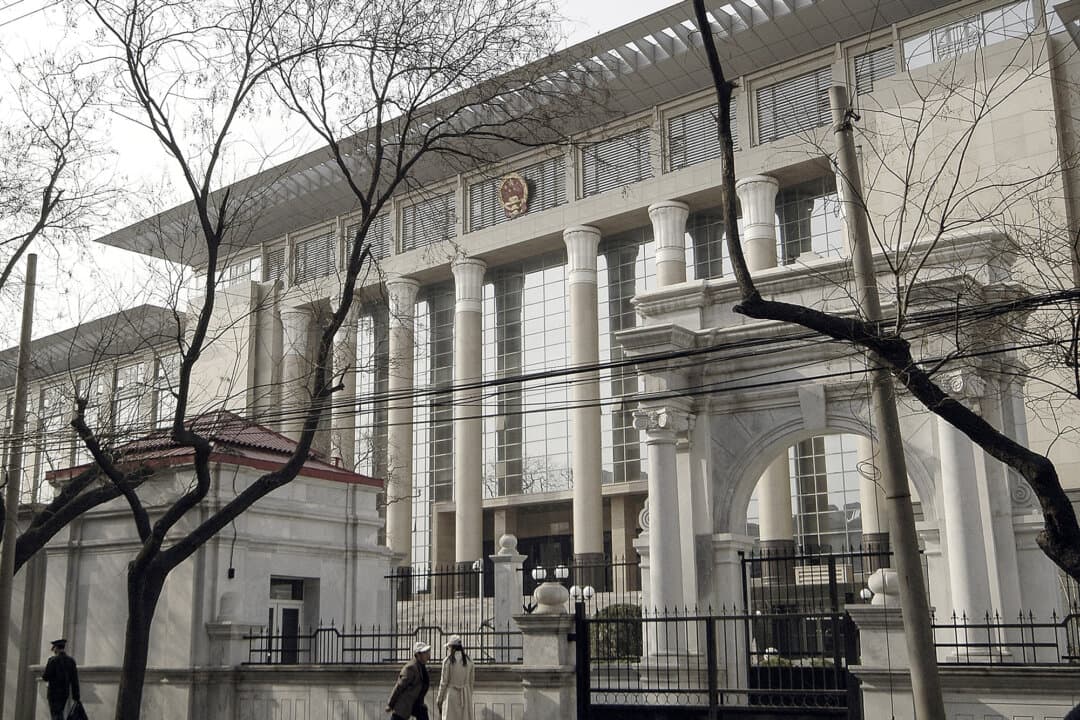
China's Supreme People's Court in Beijing, in this file photo. Individuals blacklisted by China for failing to pay court-ordered debts can be barred from flying, staying at upscale hotels, sending their children to private schools, and leaving the country. (STR/AFP via Getty Images)
Falling home prices are adding to that pressure, Wong said, adding that families whose homes are worth less than their mortgages, or whose property has been auctioned off by a court, may never face a formal ban and still have no way to leave.
“When prices rise, it locks wealth inside the country, and when prices fall, it uses debt to keep people locked inside the system they were already in,” he said.
What matters now, he said, is “whether the state is increasingly able to tie together a person’s wealth, debts, tax status, and cross-border movement.”
Americans, Foreigners at Risk
The same system reaches Americans with family in communist China.
In August, Chinese Ministry of State Security officers came to the door of a former regional manager at a property company in Jiangsu Province who was about to take his U.S.-born daughter, an American citizen, on a tour of Harvard and other universities, Cai said, relaying the account.
“You can’t go, and your daughter can’t go either,” they told the manager, Cai said. They gave no reason, but Cai said trips to the United States and Japan now draw particular scrutiny.
Beijing has warned its citizens against traveling to the United States and Japan since last year because of trade and diplomatic tensions.
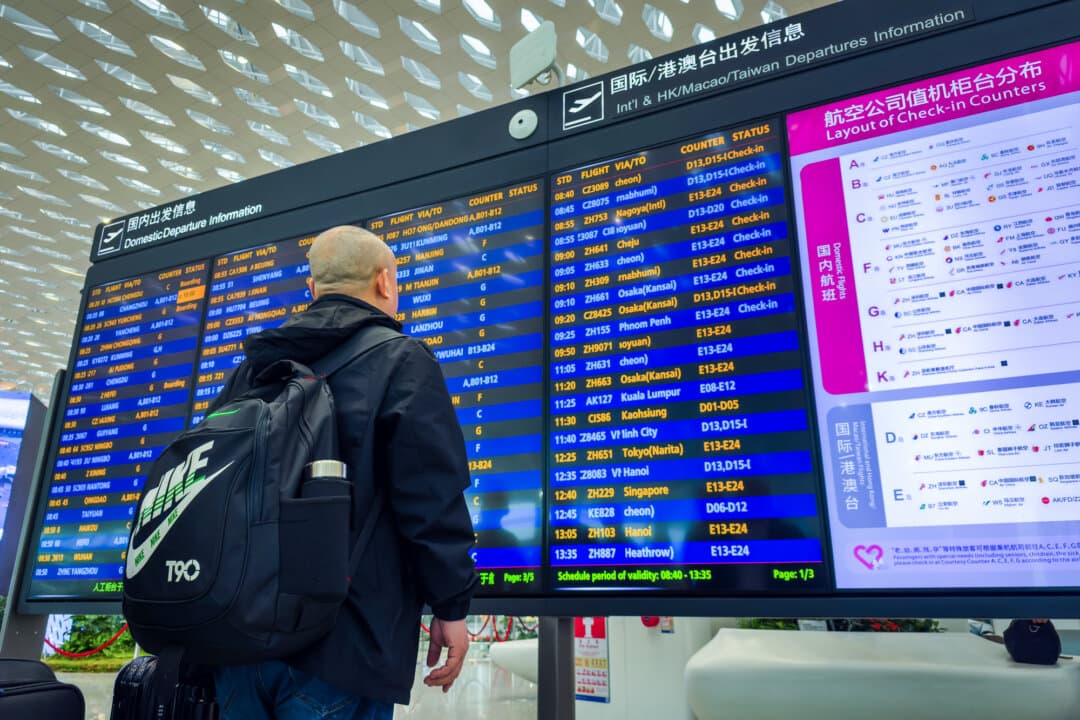
A traveler looks at a digital departure information board displaying domestic and international flight schedules at Shenzhen Bao'an International Airport in Shenzhen, China, on April 13, 2025. (Cheng Xin/Getty Images)
Some families have been stuck far longer. Gao Zhen, a 70-year-old artist based in New York City and a U.S. permanent resident, was detained in August 2024 while visiting family in Hebei Province and sentenced on Aug. 25 this year to three years for “defaming national heroes and martyrs” over satirical sculptures of Chinese leader Mao Zedong.
His wife, also a green card holder, and their son, a U.S. citizen, have been barred from leaving China since his arrest. Amnesty International has reported that Gao has collapsed several times in detention.
Business travelers face the same risk. In March, Beijing demonstrated its willingness to target foreign deals when it summoned the Singapore-based co-founders of Manus—an AI startup founded by Chinese entrepreneurs that Meta had agreed to buy for about $2 billion—to China for a meeting.
Once they arrived, they were told that they could not leave while the deal was under review. Beijing later ordered the deal withdrawn. Rules issued in April also allow exit bans on people suspected of moving supply chains out of China under foreign pressure.
The U.S. State Department’s Sept. 4 travel advisory warned “U.S. citizens might only become aware of an exit ban when they attempt to depart China.” An updated advisory Oct. 19 warned of “the risk of wrongful detention.”
Rep. John Moolenaar (R-Mich.), who chairs the House Select Committee on the CCP, said in a statement to The Epoch Times, “I urge every American to seriously reconsider any travel to China, because they could be arbitrarily taken hostage by the CCP under groundless charges.”
American businesses, he said, “must be vigilant against China’s depraved track record of exit bans and wrongfully detaining Americans.”

Rep. John Moolenaar (R-Mich.), chairman of the House Select Committee on the Chinese Communist Party, speaks during a news conference on Capitol Hill in Washington on March 19, 2026. (Madalina Kilroy/The Epoch Times)
Racing to Leave
Xie said the controls could backfire.
“Tightening controls now will actually accelerate the flight of money and people,” he said.
The wealthy have been leaving for years. China lost more millionaires to emigration than any other country every year for a decade until 2025, when it ranked second behind the UK, according to the investment migration firm Henley & Partners.
Shen Qijia, a 64-year-old entrepreneur from Liaoning Province, fled the country on Aug. 26, less than three weeks before the new rules officially took effect. District officials and police in Shenzhen seized his company’s shopping center in 2000, and he told the Chinese edition of The Epoch Times that the state still owes him more than 4.8 million yuan (about $700,000) for property it never returned.
When police in Dalian fined him 500 yuan (about $70) in April for using a virtual private network to circumvent internet controls, he refused to pay.
Recalling the story, he told them: “You people already cost me more than 4.8 million yuan, left me like this, and still haven’t paid it back. I can barely get by now, and I’m supposed to pay you a fine?”

Screenshots from videos from entrepreneur Shen Qijia's escape from China in September 2026. Qijia left the country less than three weeks before the new rules officially took effect. Police in Dalian fined him in April for using a virtual private network to circumvent internet controls, and he refused to pay. (The Epoch Times/ Courtesy of Shen Qijia)
Since the rules took effect, Shen said, people in China have been contacting him to learn about ways out.
“The CCP’s new border-control policy has already caused enormous panic in China,” he said.
For about 20 years, Cai said, any Chinese citizen with a passport could just buy a ticket and go.
“Now, people worry about something different: Even after you buy a ticket, you don’t know whether you’ll be able to leave,” he said.
Beijing has promised that ordinary travelers will not be affected, but with any department or work unit now able to bar anyone, Cai said, “nobody knows whether they count as ‘ordinary.’”
Meanwhile, nearly seven years after he was stopped from traveling for “provoking trouble,” Lu’s exit ban remains in force as he seeks legal redress.
“They deliberately find any excuse,” he said, “and then they restrict your exit.”
Gu Xiaohua contributed to this report.