
The Chinese regime has set this year’s economic growth target at the lowest level since 1991, as the growth model that elevated the country to the world’s second-largest economy has led to a host of thorny issues at home and beyond.
In an annual work report delivered on March 5 to the National People’s Congress—China’s rubber-stamp legislature—Premier Li Qiang set a target for gross domestic product (GDP) to rise by 4.5 percent to 5 percent.
This was more modest than the target of “around 5 percent” set for three consecutive years since 2023. But it represented the first time in more than 30 years that Beijing has set an annual GDP target below the 5 percent threshold.
Economists say the drop in projected growth was not a surprise.
“It is broadly in line with market expectations, given that recent GDP and consumer spending figures have shown signs of weakness,” said Samuel Siew, head of investment at Synergy Financial Advisers in Singapore.
“The target likely factors in the U.S. tariffs as well, which are expected to remain a headwind to growth.”
The Chinese premier defended the decision, saying that the new target was designed to leave room for risk prevention and “lay a solid foundation for delivering better performance in the coming years.”
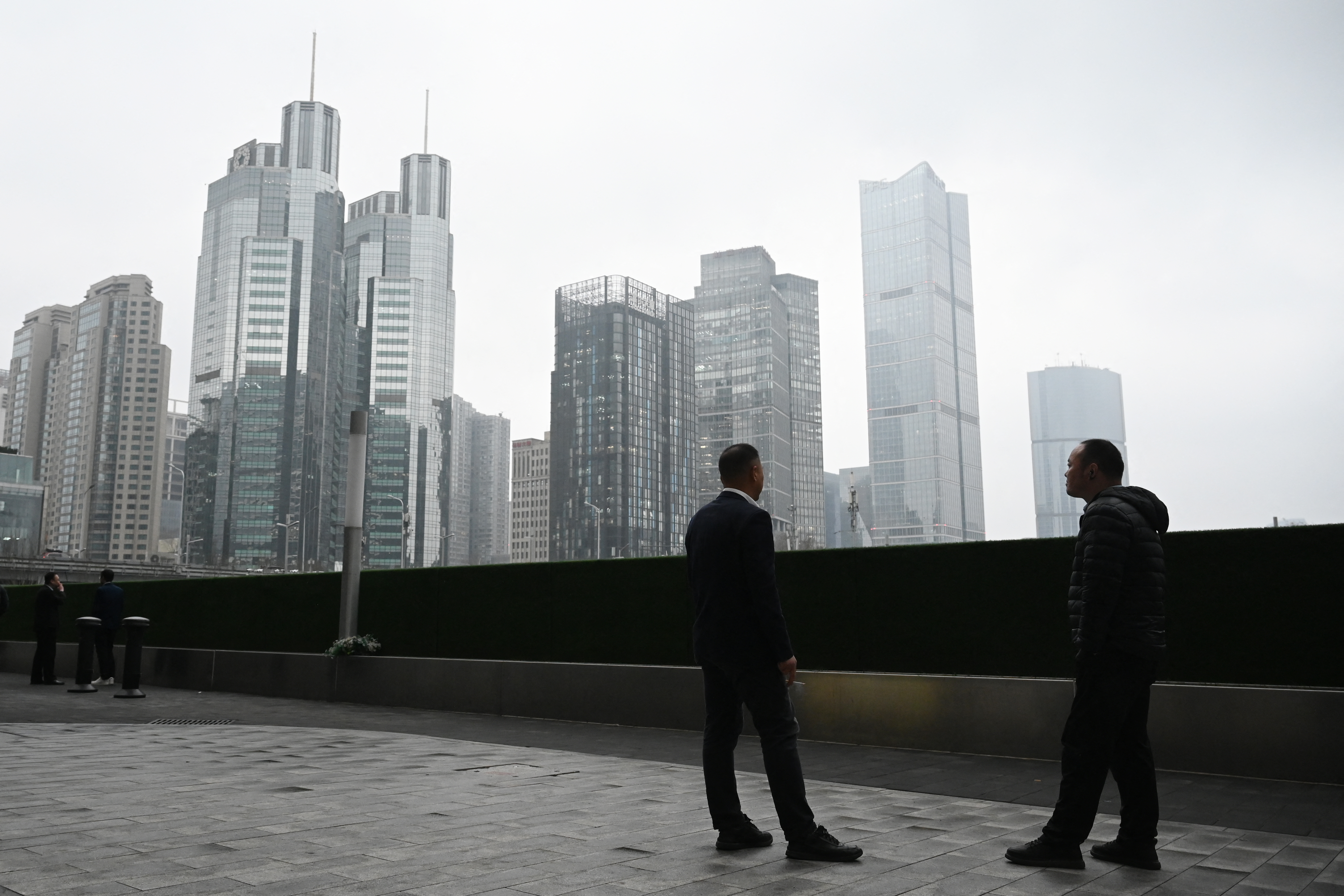
In recent years, the Chinese economy has faced persistent pressures from both inside and outside the country. A prolonged slump in the housing sector has left businesses wary of making new investments, while households are tightening their belts. Young people find it increasingly difficult to find jobs.
Adding to these challenges is a trade war with the United States. The additional U.S. tariffs have forced Chinese factories to find new markets and diversify their operations.
The export sector now faces new headwinds from U.S.–Israeli military actions against Iran. The threatened closure of the Strait of Hormuz, a critical Middle Eastern trade route, could disrupt global supply chains dominated by China.
Yuan Yuwei, a fund manager at Trinity Synergy Investment in Hong Kong, cautioned that Beijing’s growth and policy aims for this year, prepared at the end of 2025, do not account for the ongoing conflicts in Iran.
“If Iran surrenders, that’s very negative to China, which counts the Strait of Hormuz as a crucial trade route,” Yuan said.
Last year, official data showed that China met its 5 percent expansion target. That is largely because of robust exports, which contributed nearly one-third of the growth. As a result, the country posted a record trade surplus of $1.2 trillion in 2025.
China’s reliance on debt-driven exports for growth has drawn criticism from its major trading partners and the International Monetary Fund.
In a February report following the International Monetary Fund’s annual review of China’s economy and market policies, the organization called on Beijing to cut industrial subsidies by half and prioritize a transition to a consumption-led growth model.
Ahead of Li’s announcement, local authorities had already signaled a willingness to accept a lower pace of economic expansion. About 21 of the 31 provincial-level regions have set this year’s economic growth targets lower than those of 2025, according to accounts in state media of local governments’ work reports.
That includes the southern provinces of Guangdong and Zhejiang, known as the country’s top economic powerhouses and manufacturing hubs, which trimmed their 2026 GDP growth targets by 0.5 percent.
Speaking in Beijing on March 5, the Chinese premier acknowledged that transitioning to new growth drivers is “formidable.”
“The imbalance between strong supply and weak demand is acute,” Li said in his hour-long speech. “Market expectations are weak, and there are many risks and hidden dangers in key areas.”
Reuters contributed to this report.