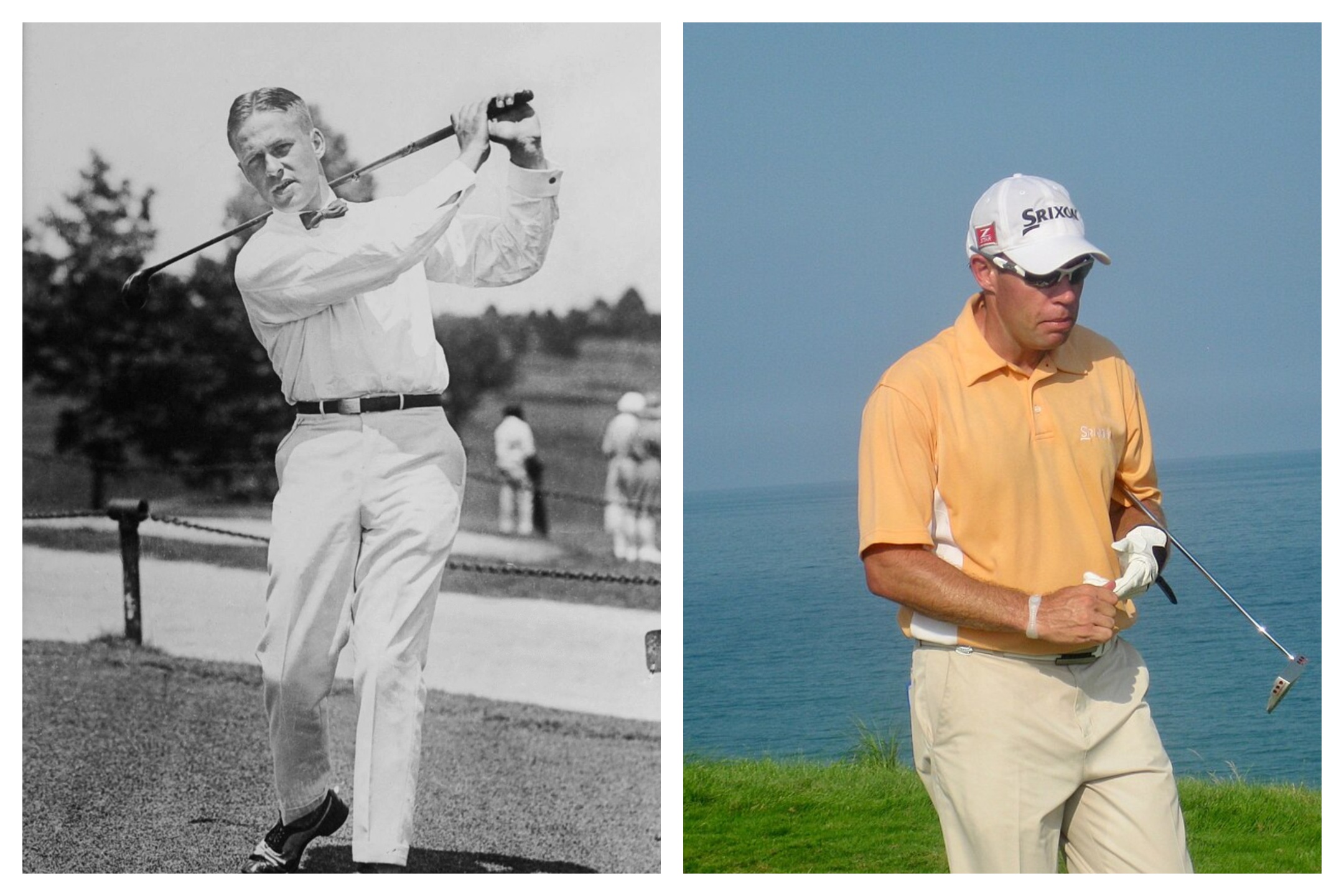
It was June 3, 1925, and tensions at the U.S. Open at the Worcester Country Club, Massachusetts, were running high. Willie Macfarlane and golfing great Bobby Jones were battling for final victory in a second 18-hole playoff.
On the 11th hole, Jones hit his ball into the rough. He studied the shot, then took his stance over the ball. It was then that his club ever so slightly made contact, and the ball moved. According to the rules, this meant that the ball was in play and carried a penalty.
Of all those watching—the spectators, his caddy, his competitor Macfarlane—only one man saw what had happened: Bobby Jones. He immediately called a penalty on himself. The officials hadn’t seen it and asked others present if they'd witnessed Jones make contact with the ball, but none had. Finally, the officials told Jones he must make the decision, and he penalized himself one stroke.
At the tournament’s end, Jones lost the championship to Macfarlane.
By one stroke.
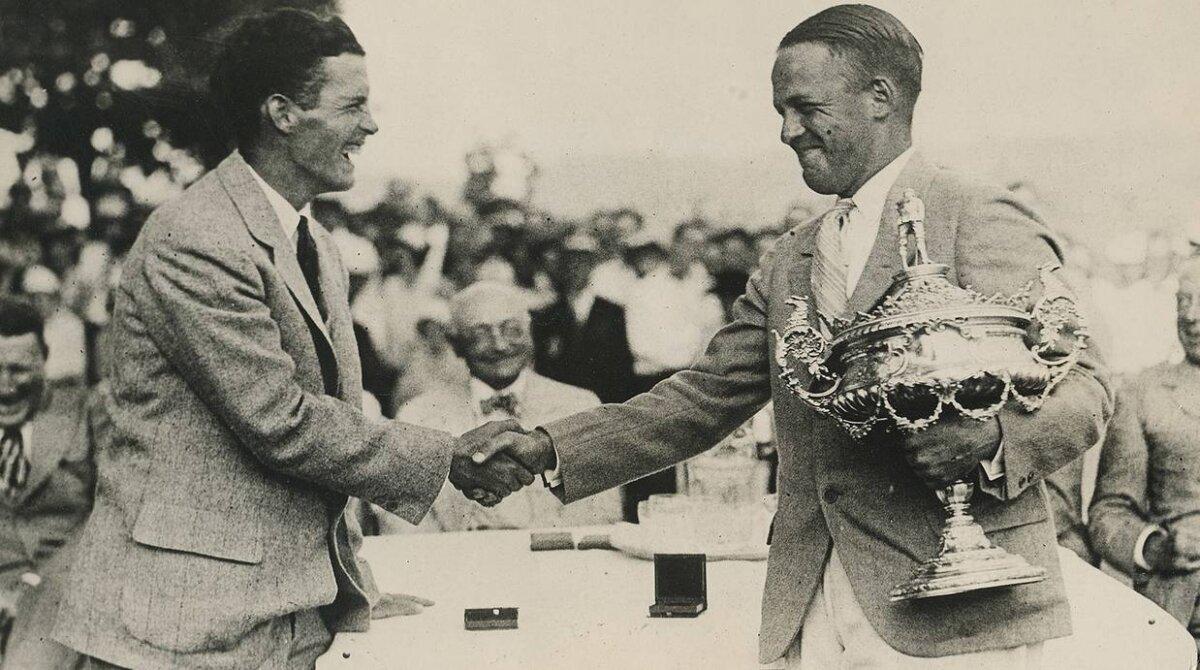
(L) Watts Gunn and Bobby Jones, holding the trophy, at the 1925 U.S. Amateur tournament. (Public Domain)
Fast forward 85 years to Harbour Town Golf Links in South Carolina, and a PGA Tour championship. A sudden-death playoff would determine whether Jim Furyk or Brian Davis would take home the win. Davis’s approach shot, that transition from the long march of the tee to putting, fell short and to the left of the green, landing in a hazard, a natural obstacle in which there were reeds.
Davis took his shot, his third, and put the ball on the green, but immediately waved to the official and called a two-stroke penalty on himself for striking a loose reed during his backswing, which wasn’t permitted by the rules at the time.
That penalty cost Davis his first PGA Tour championship.
Reactions
Bobby Jones remains a legend in the history of the sport. He’s the only golfer to win the four major championships of his era in one season. He spent much of his life promoting the sport, made instructional videos still used by some today, and helped design the course of the Masters Tournament at the Augusta National Golf Club.
Yet Jones is best remembered today for his sportsmanship, particularly for that moment in Massachusetts when he put personal honor ahead of victory. Since 1955, the U.S. Golf Association has annually bestowed its most esteemed prize, the Bob Jones Award, on the player who best “demonstrates the spirit, personal character and respect for the game exhibited by Jones, winner of nine USGA championships.”
Because of television, Brian Davis’s self-penalty was seen by millions across the country. With play on the course over, the media interviewed him about the contest and his self-penalty. For him, it was a tough aftermath to the day, deflated as he was by the loss.
When he finally drove away from Harbour Town, Davis was surprised and saddened to find no text messages or calls from friends and supporters consoling him for his loss. But crossing the bridge from Hilton Head Island restored service to his phone, and he realized a flood of texts and voice mails had poured in, including a bevy of calls from his agent. When Davis returned those calls, he was in for a shock.

Brian Davis at 2010 PGA Championship. (<a href="https://en.wikipedia.org/wiki/Brian_Davis_(golfer)#/media/File:Brian_Davis_at_2010_PGA_Championship.jpg">Jhansen23/CC BY-SA 4.0</a>)
“My agent ... told me, ‘Look, I don’t know if you have been paying attention, but this thing has completely blown up and I have already booked you for interviews tomorrow from 9 a.m. straight until 5 p.m,'” Davis told the PGA Tour.
“I got lots of letters of support from family and friends and people I didn’t even know,“ he said. ”But the one which really stands out was a letter I got from a teacher somewhere in Texas. She explained that she had used what I did for a project in her class about doing the right thing. She even had every kid in her class write me a letter. That’s when it really hit home. I was just, like, wow.”
A Poem Says It All
As we might expect, both these athletes responded to this publicity with humility and a sense of duty, having simply followed the rules. When officials at the Worcester contest praised Jones for his honesty, he responded, “You may as well praise a man for not robbing a bank.” To Jones, the integrity of the sport mattered more than personal gain.
Years after his self-penalty cost him a win, Davis also stressed that players must honor the rules and preserve the sports’ integrity. “When you’re on the PGA TOUR, you are on the main stage. We are self-governed out here, so I think that anytime we can exemplify that and it comes out good, well, then it’s a good thing—no matter who ends up holding the trophy that week.”
There’s an old bit of verse, “The Man in the Glass” by Peter Dale Wimbrow Sr., that speaks of men like these and the code they live by:
When you get what you want in your struggle for self
And the world makes you king for a day
Just go to the mirror and look at yourself
And see what that man has to say.For it isn’t your father, or mother, or wife
Whose judgment upon you must pass
The fellow whose verdict counts most in your life
Is the one staring back from the glass.
He’s the fellow to please—never mind all the rest
For he’s with you, clear to the end
And you have passed your most difficult, dangerous test
If the man in the glass is your friend.
You may fool the whole world down the pathway of years
And get pats on the back when you pass
But your final reward will be heartache and tears
If you’ve cheated the man in the glass.
Bobby Jones and Brian Davis were friends with the man in the glass.
What arts and culture topics would you like us to cover? Please email ideas or feedback to features@epochtimes.nyc