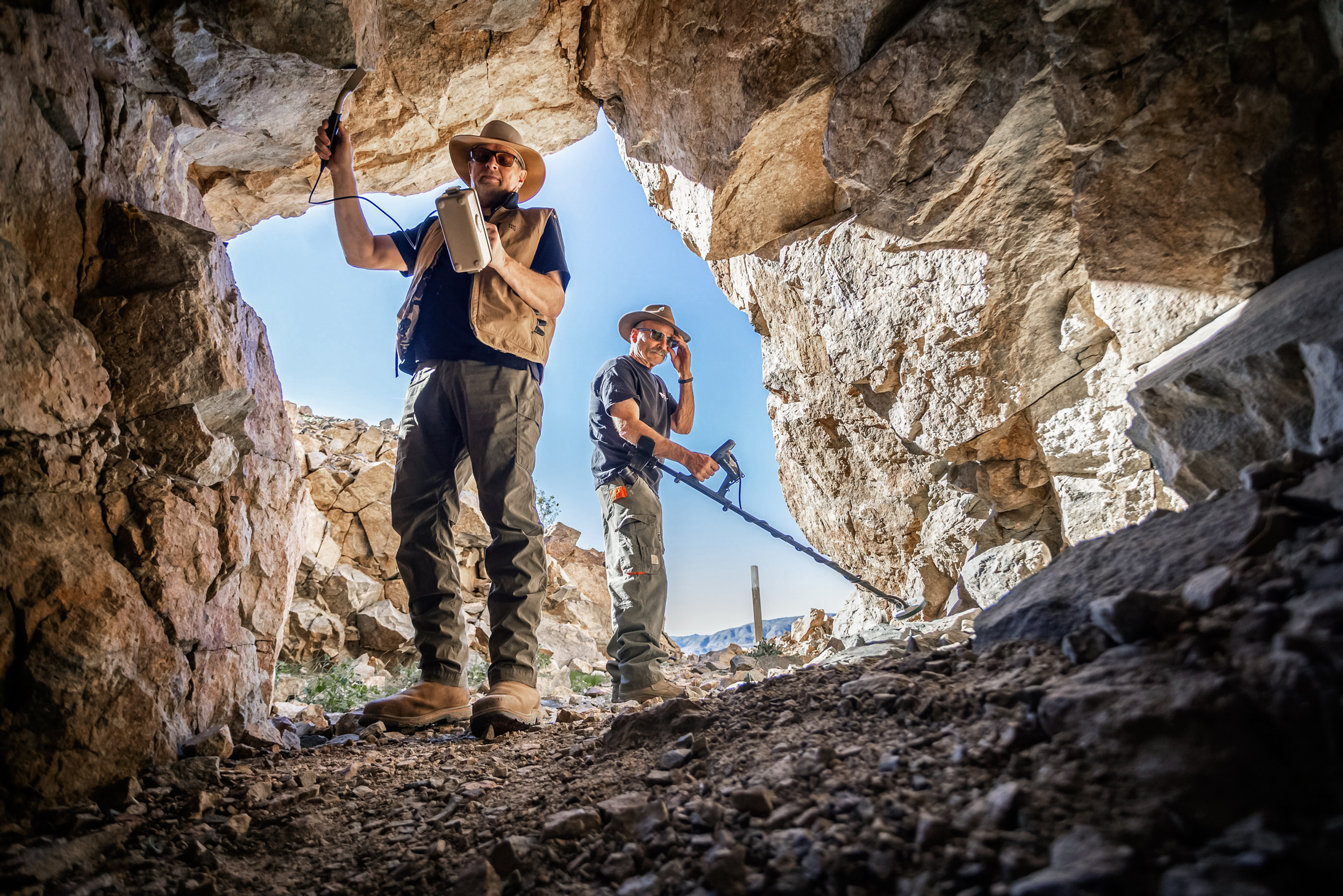
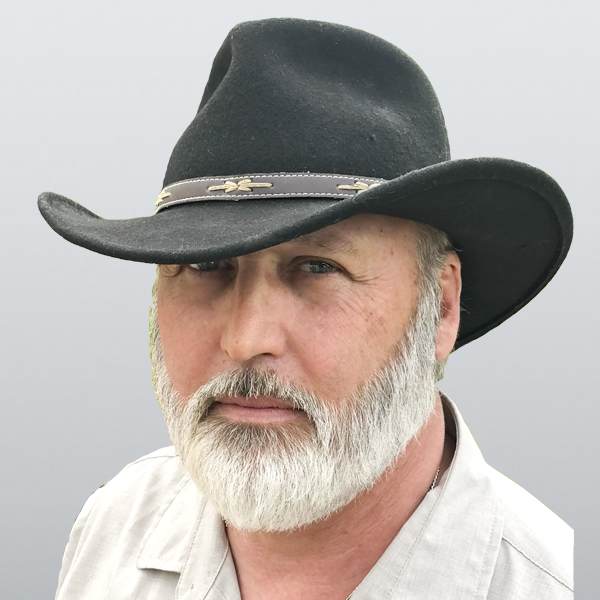
SAN BERNARDINO COUNTY, Calif.—With their four-wheel-drive trucks hugging the mountainside, prospectors Ron Kliewer and Sean Hart dodge tire-puncturing rocks jutting out of the narrow and steep road to their inactive uranium and rare-earth mineral mines in the Mojave Desert.
Aside from a large uranium deposit, their square mile of mining claims is rich in 14 other critical minerals, including many rare-earth elements. The uranium there was first discovered more than 70 years ago, during the uranium boom after World War II and the dawn of the nuclear age.
But the price of uranium dropped, and the family that owned the claim never mined it. In 2017, the family officially released the claim, and one of Kliewer’s partners at Sundown Resources obtained the mining rights.
While edging his way up the trail, Kliewer talks about his disappointment with the expense and the sometimes decades-long permitting process to get mining operations approved, despite the high demand for uranium and rare-earth elements in the United States.
“We’re importing rare-earth minerals from unstable regions and even countries that are not U.S. allies while ignoring viable shovel-ready deposits right here in California and other places in the U.S.,” Kliewer said. “It makes no sense.”
Relying on imports from foreign nations, especially adversaries, “is a national vulnerability [the United States] can’t afford,” according to Kliewer.
“Energy security starts with mining our own uranium and rare-earth minerals,” he said.
According to the Center for Strategic and International Studies, permitting delays and discontinuity in U.S. policies are two of the greatest challenges to overcome in achieving mineral security, especially amid China’s relentless efforts to dominate the markets and manipulate prices of rare-earth minerals.
Back at the mine, a wooden post marks the claim near the entrance, and a metal cap on the ground outside conceals a 1,000-foot-deep drill hole where uranium ore samples were taken.
Once inside, the uranium hidden in the tunnel walls reveals itself in fluorescent green under the beam of a blacklight, while the frenetic cacophony of Geiger counter clicks announces the radioactive metal’s presence and the squawking of a metal detector indicates other minerals.
As he hikes toward the back of the 300-foot tunnel, careful not to kick up radioactive dust, Kliewer points to blast holes where explosives were used in past excavations.
Resting at a small plateau overlooking the valley, they spot a suspected claim jumper carrying what looks like a sample bag approaching an ATV. However, by the time they prepare to head down the hill, the suspected mineral thief and a likely accomplice are already marking their escape with a long trail of dust along the desert floor.
From there, the rare-earth elements mine is an arduous hike higher up the mountain, so Kliewer and Hart tuck some water bottles into their backpacks and begin the trek hundreds of feet skyward with the desert sun—unusually hot for mid-December—beating down on their backs.
Geopolitics of Mining
As China continues to corner the market in rare-earth minerals, mining experts are pushing the United States and its allies to speed up permitting for domestic extraction.
Kliewer and Hart, business partners in Sundown Resources, a small prospecting and mineral exploration company with mining claims in California, told The Epoch Times that it is important for Americans to mine and refine rare-earth minerals in their own backyard rather than rely on a foreign supply chain heavily dominated by China.
As a prospector and proponent of land rights and small-scale mining projects, Kliewer said all mining companies, large and small, face the same frustration: overregulation and delays in permitting. However, small-scale miners usually do not have the resources to pay for sometimes decades-long delays.
“They’re crushing small-scale miners who just want to responsibly develop proven resources,” he said.
Before mining claim owners can extract minerals, they must submit a detailed proposal for mining activities, known as a Plan of Operations, to the federal Bureau of Land Management. This requires environmental review and reclamation plans to comply with federal and state mining regulations.
“The [Bureau of Land Management] raises claim fees every few years, and by the time you get a Plan of Operations approved, you spend more on paperwork and paying bureaucrats’ salaries, then on actual mining, producing wealth from the ground,” Kliewer said.
Large foreign mining companies, often partially or wholly owned by foreign governments, tend to have deeper pockets and political connections, and seem to be given preference over American prospectors for mining contracts in the United States, he said.
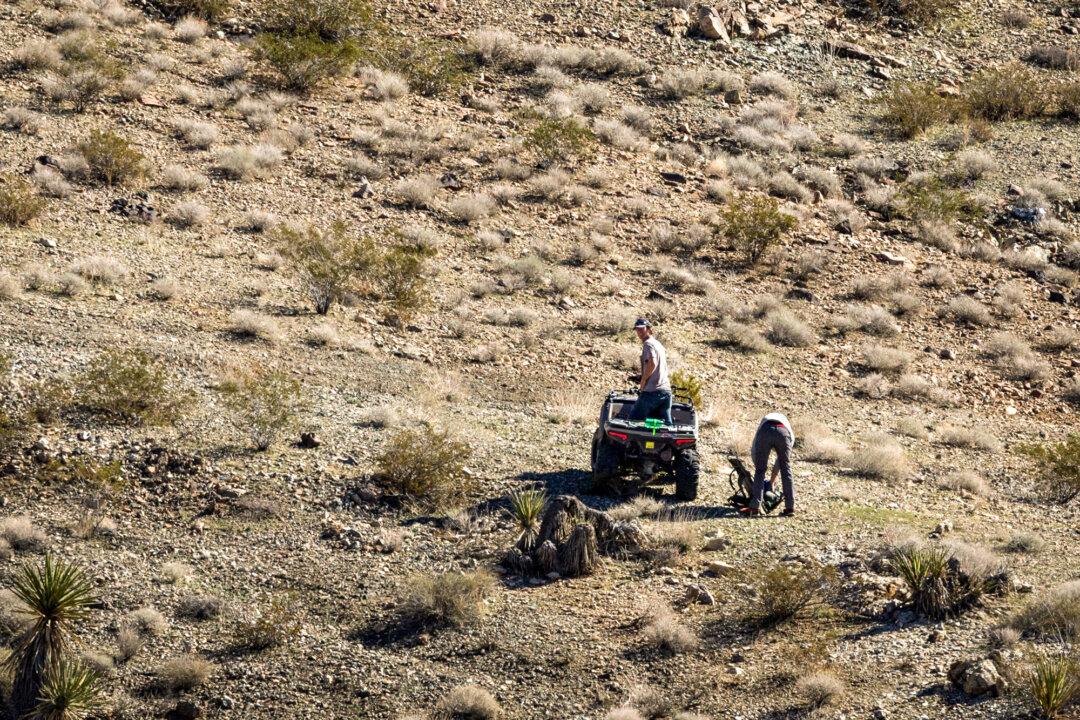
Men with portable mining equipment exit a preexisting mining claim area in San Bernardino County, Calif., on Dec. 10, 2025. (John Fredricks/The Epoch Times)
Uranium Deposits
Although it is not considered a rare-earth element, uranium is frequently found alongside rare-earth element deposits. Although uranium is best known as a fuel for nuclear power plants, it is also used to produce medical isotopes used in PET scans and other medical imaging procedures. Rare earths, on the other hand, are used to create permanent magnets, as well as personal tech devices and advanced military hardware.
“Some uranium deposits are mined with recirculation drills where they drill deep wells, and they pump solution in and leach it out of the ground, so it’s a lot cheaper to mine,” Kliewer said.
The Sundown Resources deposit is a hard rock mine, which means that it must produce high-grade ore at prices high enough to be profitable.
Kliewer said that 2 percent uranium ore is considered mineable and that some samples at their claim have been as high as 8 percent.
Uranium prices, driven by renewed nuclear energy demand and finite resources, have more than doubled over the past five years, now appearing steady at about $80 per pound, making it more viable to mine, Kliewer said.
“We needed $60 uranium to be profitable,” Kliewer said.
But even with current favorable prices, permitting delays and “multiple jurisdictions claiming regulatory authority” mean that it can take a decade or more to get a green light to start mining.
“Financing hurdles and political resistance in California are our biggest obstacles, not the geology,” Kliewer said.
“We have a truly shovel-ready uranium mine that could start delivering ore to a processing facility, literally in weeks, not months or years.”
The Center for Strategic and International Studies is pushing for the U.S. government to streamline the permitting process and end U.S. reliance on the Chinese-dominated supply chain. At a bipartisan event in mid-December 2025, Sen. Bill Hagerty (R-Tenn.) and Sen. Catherine Cortez Masto (D-Nev.) agreed that delays in the permitting process not only hurt U.S. mining efforts, but also present a national security risk.
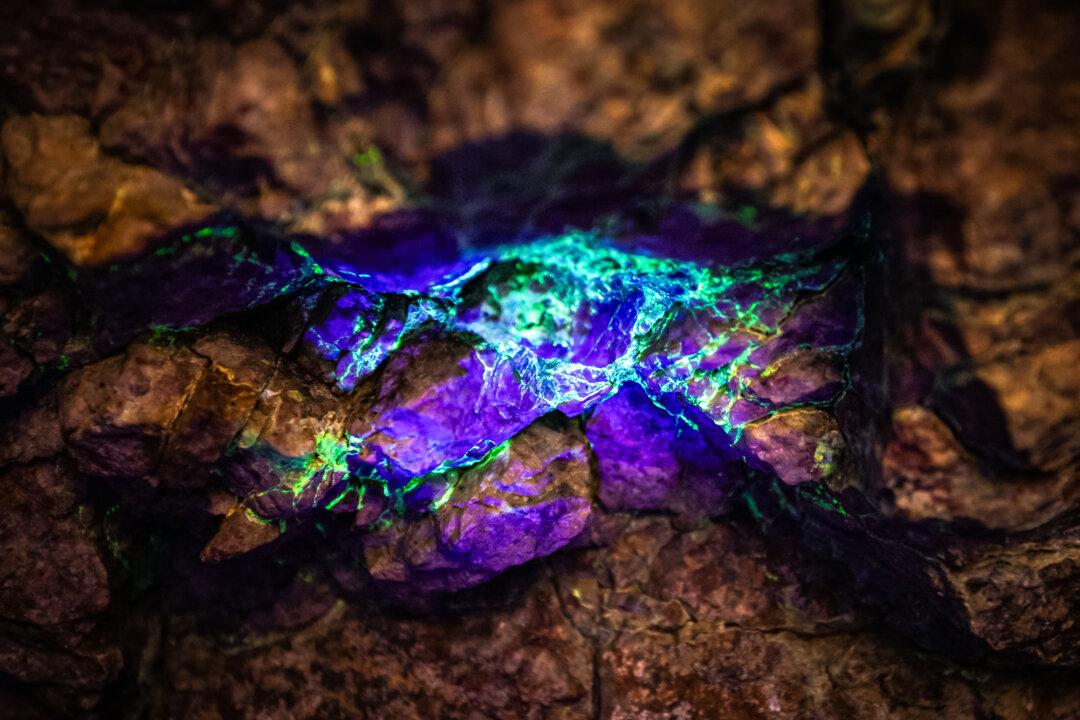
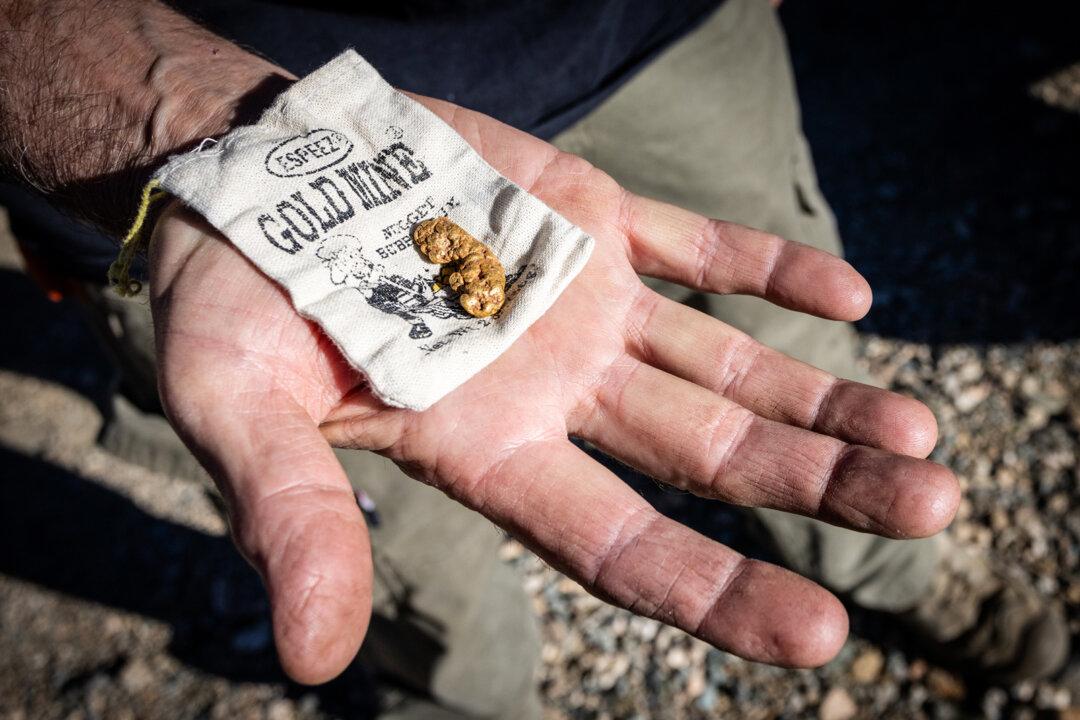
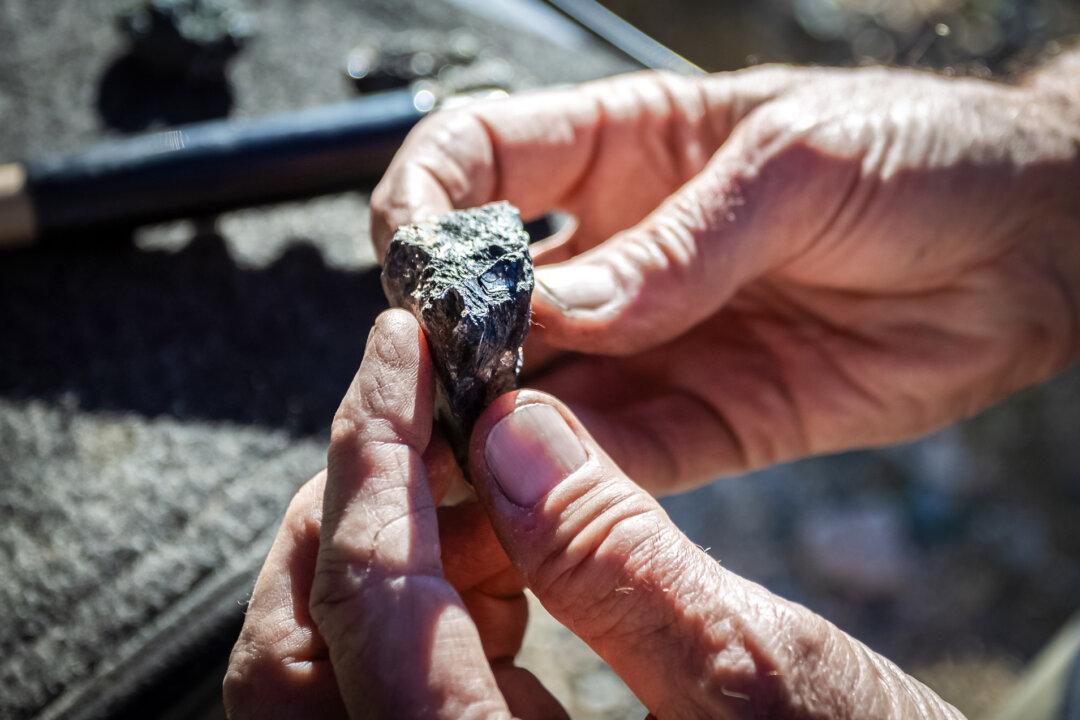
(Top) A blacklight reveals the colors of a uranium deposit in San Bernardino County, Calif., on Dec. 10, 2025. (Bottom Left) A miner holds a gold sample in San Bernardino County, Calif., on Dec. 10, 2025. (Bottom Right) A prospector displays a sample of rare-earth minerals from the same region on Dec. 10, 2025. (John Fredricks/The Epoch Times)
‘Nuclear Renaissance’
In May, President Donald Trump announced plans for a “nuclear renaissance” with a flurry of executive orders calling for a resurgence of nuclear energy to meet rising electricity demand, especially for artificial intelligence data centers.
The executive orders relate to accelerating commercial nuclear energy development such as that of the Tennessee Valley Authority, which on May 20 announced that it had submitted a permit to install the nation’s first small modular nuclear reactor, or SMR.
The orders require the Nuclear Regulatory Commission to complete license reviews within 18 months, provide federal land for reactor development, and streamline regulations and permitting processes.
Trump has repeatedly joked about a fabled married couple who could not watch him on TV because the wind was not blowing or the sun was not shining, making the point that wind turbines and solar panels are intermittent energy sources that are less reliable than nuclear energy.
“‘Darling, I would like to watch the president on television tonight,’” Trump said in 2023, making the joke he has since told in some variation at several speeches and rallies. “‘Honey, I don’t think we’ll be able to, the wind is not blowing.'”
Sundown Resources has held on to the mining claims for many years, hoping to develop it, but Kliewer said he and his partners might be forced to sell the claim.
![Kliewer shines his flashlight on a vein of rare-earth minerals deep inside the shaft in San Bernardino County, Calif., on Dec. 10, 2025. Relying on imports from foreign nations, especially adversaries, “is a national vulnerability [the United States] can’t afford,” Kliewer said. (John Fredricks/The Epoch Times)](/_next/image?url=https%3A%2F%2Fimg.theepochtimes.com%2Fassets%2Fuploads%2F2026%2F01%2F21%2Fid5974323-EpochImages-3401815004-xl-1080x720.jpg&w=3840&q=75)
Kliewer shines his flashlight on a vein of rare-earth minerals deep inside the shaft in San Bernardino County, Calif., on Dec. 10, 2025. Relying on imports from foreign nations, especially adversaries, “is a national vulnerability [the United States] can’t afford,” Kliewer said. (John Fredricks/The Epoch Times)
He said foreign buyers are actively shopping for U.S. uranium and rare-earth assets.
“I would like to see the deposits responsibly developed,” he said. “I don’t know if our small team has the horsepower to do that, so we would have to probably look at a sale, lease, or partnership, but I would like to see them producing critical minerals in the USA for the USA.”
The problem with renewables such as wind and solar is that they do not supply steady power, according to Kliewer.
“[Nuclear energy is] the only scalable carbon-free base load power,” Kliewer said. “It’s truly the cleanest, cheapest electric power there is.”
California, among other states, has moved away from nuclear power and put too much stock in renewable energy, he said.
“I believe it was short-sighted and too narrowly focused,” Kliewer said. “We need multiple clean energy sources, including wind and solar, though they are intermittent and can be problematic. Nuclear provides reliable clean power that California desperately needs.”
Hart told The Epoch Times that he wants to see the ore mined cleanly and safely and provide good-paying, American jobs.
The “huge push” for more electricity to power AI data centers will increase as more companies build prototypes for the potential advent of cold fusion, Hart said.
“If that hits, there’s going to be even more demand for uranium, and we want to be part of that,” he said. “We want to source that energy here.”
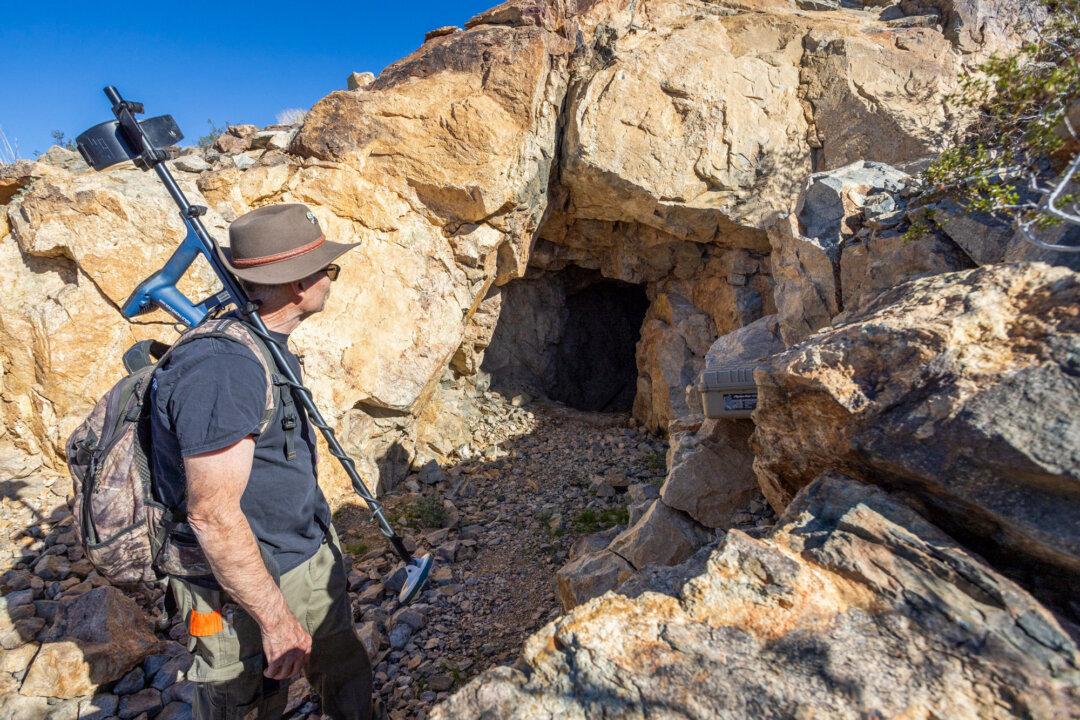
Prospector Ron Kliewer prepares to enter a mine in San Bernardino County, Calif., on Dec. 10, 2025. (John Fredricks/The Epoch Times)
Correction: A previous version of this article misstated the name of a prospector in a photo caption. The Epoch Times regrets the error.