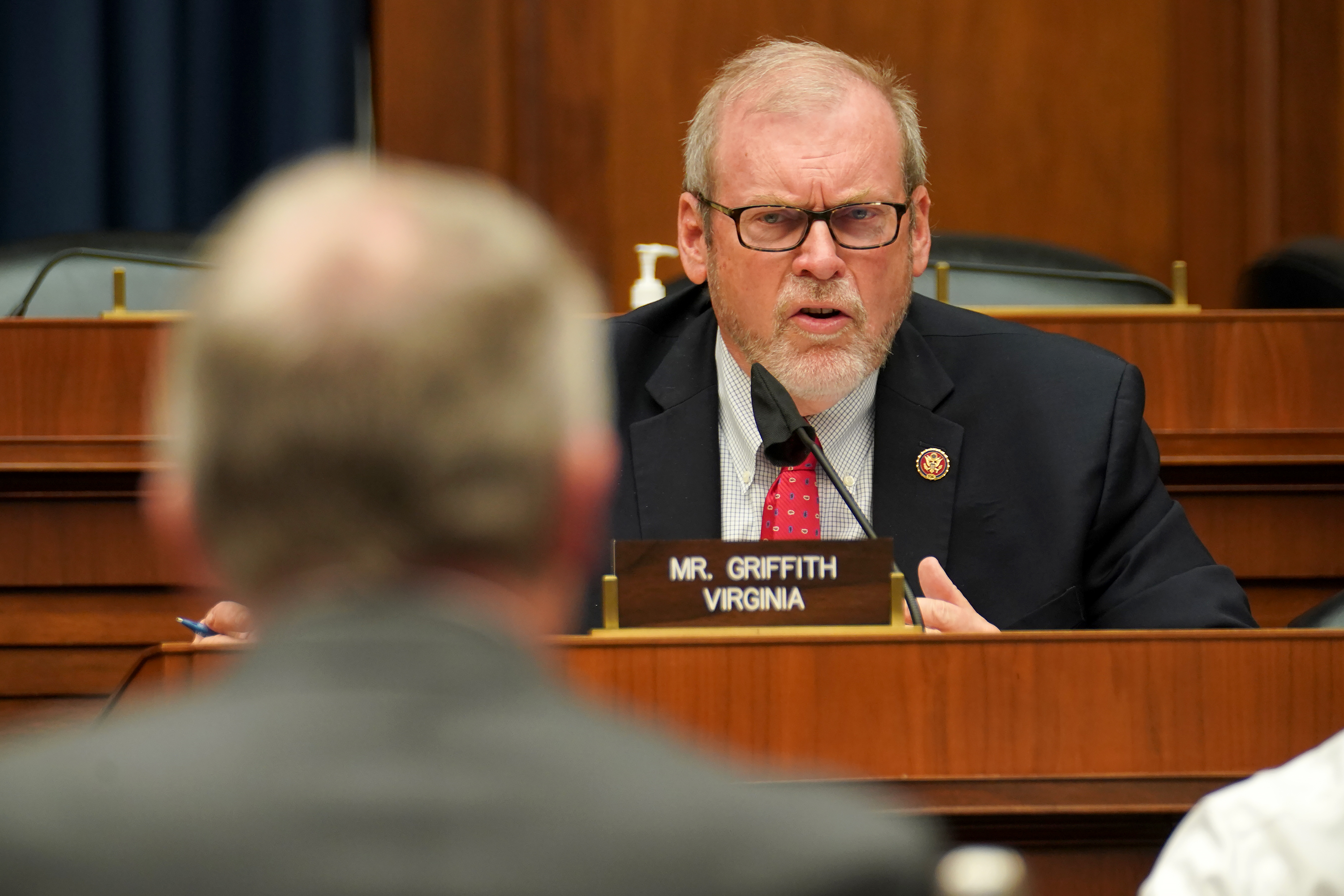
Bipartisan House members questioned pharmaceutical industry leaders on Feb. 11, seeking to learn how the complicated drug supply chain may increase the cost of prescription medications.
“One of the most frustrating aspects of the supply chain is that it operates as if in a black box,” Rep. Morgan Griffith (R-Va.) said in opening the hearing by the Health Subcommittee of the House Energy and Commerce Committee.
Pharmacy benefit managers drew much of the attention.
These companies negotiate prescription drug prices on behalf of employers and insurance plans, manage pharmacy claims, and provide other services such as tracking drug utilization trends.
Though Congress recently enacted some reforms to the industry, some members and witnesses expressed frustration with what they described as secretive practices of pharmacy benefit managers.
David Marin, president and CEO of Pharmaceutical Care Management Association, a trade organization representing pharmacy benefit managers, said his industry has been misrepresented.
“We will work with this committee to answer your questions, be a better partner, and help advance solutions that will make it easier and more affordable for your constituents to get the medications they need,” Marin told the committee.
Transparency
Congress recently enacted some reforms of pharmacy benefit manager practices, most involving Medicare Part D drug purchases.
Lawmakers called for more transparency in the industry to reduce prices.
“How they manage these benefits is a mystery at times and can lead in some cases to higher prices,” Griffith said.
John Crowley, president and CEO of the Biotechnology Innovation Organization, a group representing biotech companies, said middlemen in the supply chain drive up prices.
In addition to pharmacy benefit managers, drug wholesalers, insurers, and pharmacies profit from the sale of prescription drugs.
“America is the only country in the world where 50 percent of every dollar spent on medicines goes to middlemen, mostly toward the [pharmacy benefit managers]. Wealthy hospital systems regularly mark up the price of medicines,” Crowley said.
However, the net profit of each is lower than that of the manufacturer’s 15 percent, according to a 2024 report from the Department of Health and Human Services.
The wholesalers’ profit margin is 0.3 percent, insurers’ profit is 3 percent, pharmacy benefit managers’ profit is 2 percent, and pharmacies’ profit is 3 percent, according to the report.
Competition
James Gelfand, president and CEO of the ERISA Industry Committee, which represents employee benefit managers, said middlemen control the data from the health plans of the employers they serve.
“The data is not [the employers’] to access,” Gelfand said, adding that a third of employers cannot get complete access to the data from plans they pay for.
“Vendors simply refuse to provide access,” Gelfand said.
Marin said the industry has been making changes to become more transparent and to increase reimbursement for independent pharmacies. “The ... industry today is not the one of 10, five, or even a couple of years ago.”
Marin said the pharmacy benefit manager business is highly competitive.
“There are 73 full-service [pharmacy benefit managers], all different shapes and sizes, different geographic footprints, different service offerings, different focus,” Marin said.
In response, Griffith pointed out that the three largest pharmacy benefit managers control more than 80 percent of the market.
Gelfand later cited the example of a company, which he did not name, having a million employees that was unable to negotiate more favorable terms with each of the three largest pharmacy benefit managers.
“There’s no competition. If those guys can’t negotiate, trust me, the companies with 1,000 employees or 500 employees, they don’t stand a chance,” Gelfand said.
Some industry analysts defend the role of pharmacy benefit managers, pointing to an overall decline in drug prices.
“I would encourage lawmakers and any interested parties not to look at the individual practices, but to look at the overall effects,” Jeremy Nighohossian, a senior fellow and economist at the Competitive Enterprise Institute, told The Epoch Times.
“There are any number of industries that have three or four dominant companies, and competition works fine,” Nighohossian said.
Most-Favored Nation Deals
Members also questioned whether recent Most-Favored-Nation Prescription Drug Pricing deals negotiated by the Trump administration with pharmaceutical companies were effective in lowering prices.
The administration has negotiated 16 such deals since September. Complete details of the agreements have not been made public.
Ranking member Diana DeGette (D-Colo.) asked Lori M. Reilly, chief operating officer of Pharmaceutical Research and Manufacturers of America, to provide details of the agreements.
Reilly said the trade association did not have access to member business dealings due to antitrust concerns.
Rep. Frank Pallone (D-N.J.) asked, “How could I possibly know what’s in this program or whether it benefits anybody or lowers prices?”
Griffith said he would work with Pallone to get more information about the Most-Favored-Nation Drug Pricing agreements.
“We do need to know more about what’s going on,” Griffith said. “I’m a big believer in transparency, and the more we know, the better job we can do as congressmen.”