CAPE CANAVERAL, Fla.—For the first time in more than half a century, people around the world can look to the sky and know somewhere up there a crew of astronauts is on its way to the Moon.
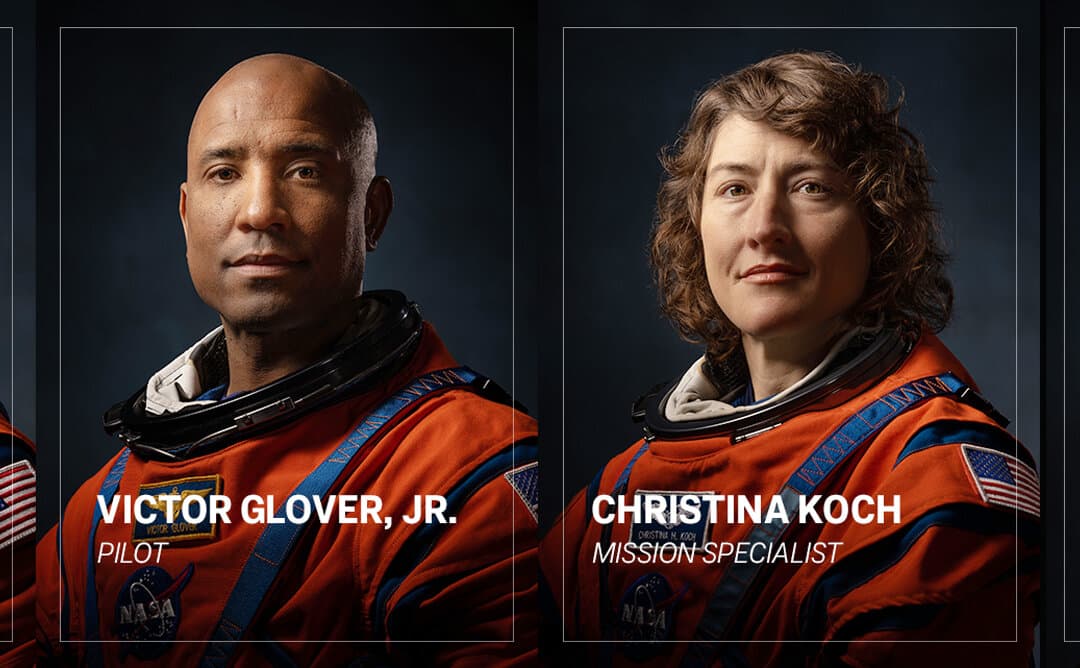
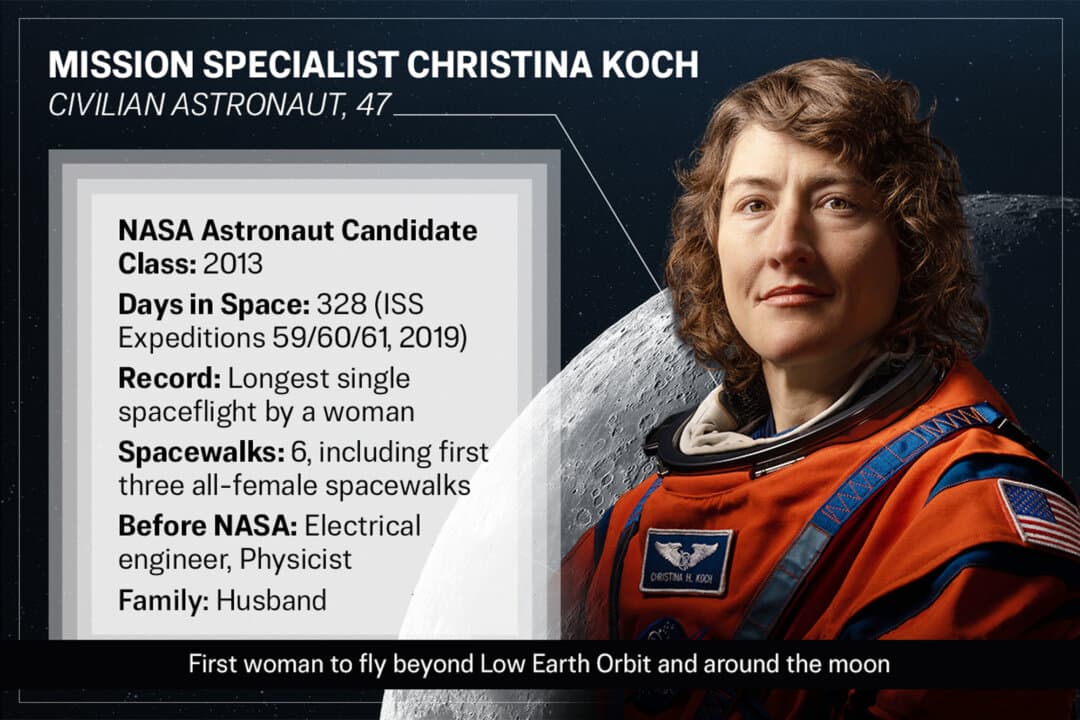
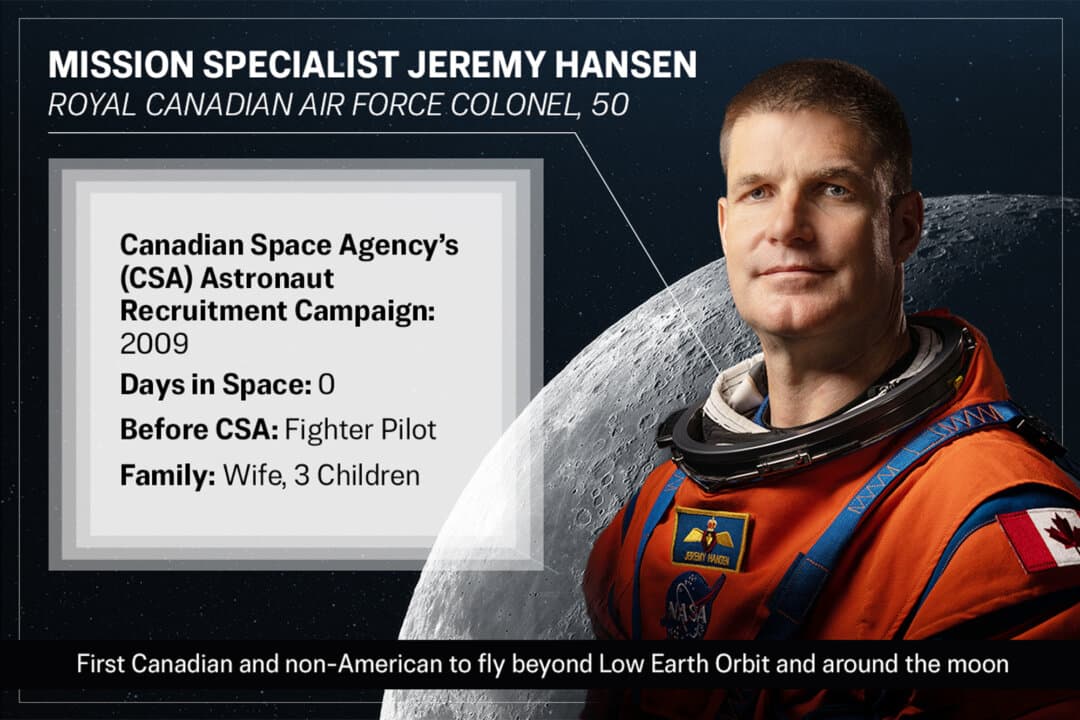
They are NASA astronauts Reid Wiseman (commander), Victor Glover (pilot), and Christina Koch (mission specialist), and Canadian Space Agency astronaut Jeremy Hansen (mission specialist).
At 6:35 p.m. ET on April 1, they charged off the launch pad at Kennedy Space Center in Florida aboard the largest spacecraft built to carry humans into deep space and atop the most powerful human-rated rocket NASA’s ever constructed.
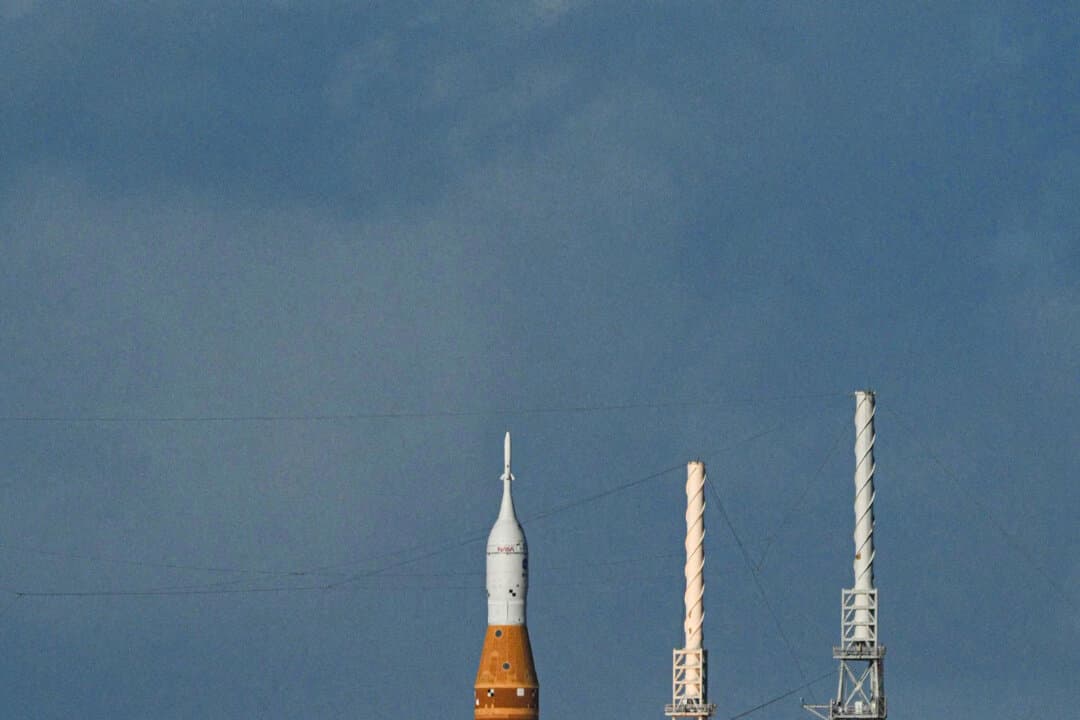
The Artemis II crewed lunar mission launches from Pad 39B at Kennedy Space Center in Cape Canaveral, Fla., on April 1, 2026. (Jim Watson/AFP via Getty Images)
Their mission is Artemis II, a 10-day test flight around the moon and back. It is the first crewed flight of NASA’s flagship Artemis campaign to return astronauts to the lunar surface and establish a permanent international human presence there.
Here is what to know:
Mission Highlights
Artemis II’s flight plan is chock-full of different tests, checkouts, scientific experiments, and various other tasks, from setting up the first operational toilet to go to the moon to using the first exercise machine mandated on a lunar flight.
But there are some major milestones that folks following along from home should look out for.
Launch
Artemis II’s launch marked the first time astronauts flew aboard NASA’s behemoth moon rocket, the Space Launch System, and the new Orion crew capsule.
Four core-stage engines and two solid rocket boosters unleashed 8.8 million pounds of thrust—more than 1 million pounds of thrust more than the Apollo Program’s Saturn V.
The engine’s roar rose in volume with the visual brilliance of the controlled explosion as it pushed the vehicle into the Florida sky.
In less than 60 seconds, the moonship was supersonic.
After just eight minutes, the white solid rocket boosters and orange core stage burned all their fuel and fell back to Earth.
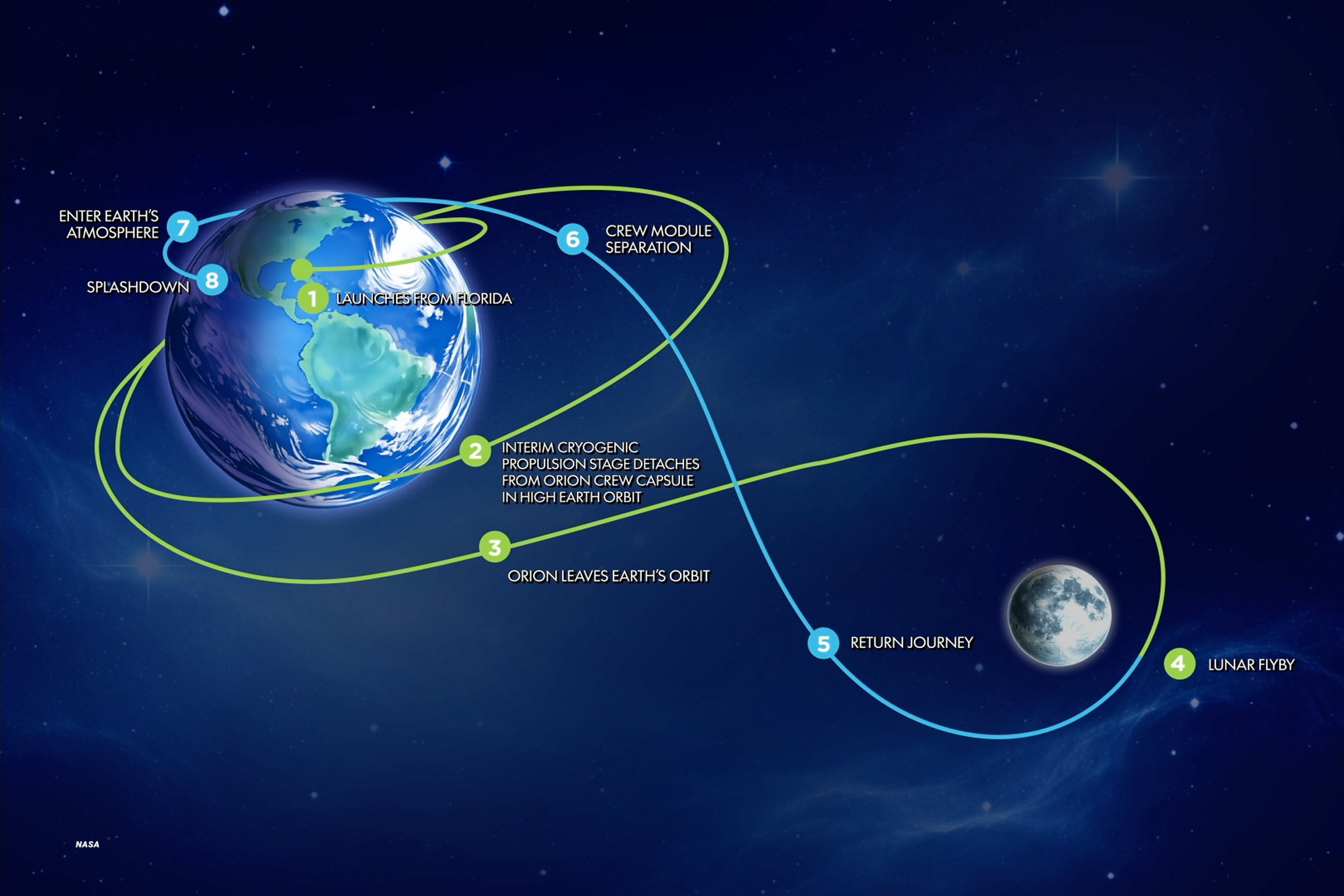
The rocket’s smaller, single-engine upper stage then assumed responsibility to place the Orion spacecraft into a unique elliptical high Earth orbit.
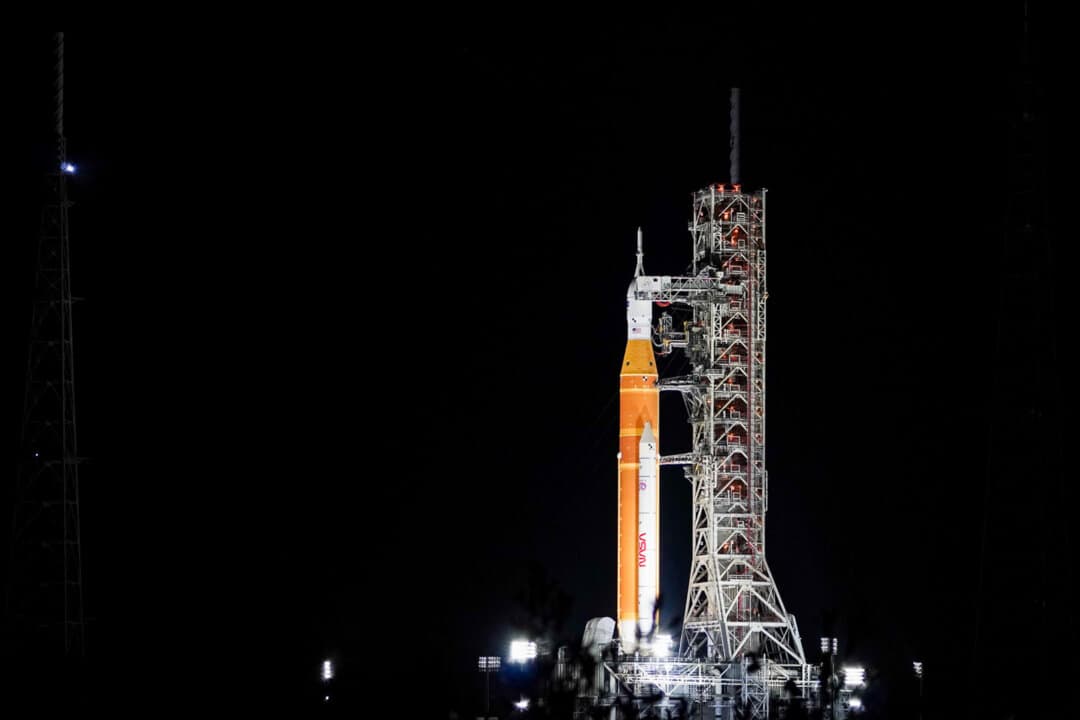
NASA’s Orion crew capsule sits atop the Space Launch System moon rocket ahead of the Artemis II mission on Launch Complex 39B at Kennedy Space Center on Merritt Island, Fla., on Feb. 1, 2026. (T.J. Muscaro/The Epoch Times)
Manual Test Flight
Once in high Earth orbit, approximately three hours and 24 minutes after liftoff, the Orion spacecraft and its service module will separate from the second stage and perform a manual flight test. Glover will be at the controls and will attempt to maneuver the spacecraft back toward the separated rocket stage, as if it were the lunar landing spacecraft that will dock with the Orion spacecraft on future missions.
All four crew members will have a part to play in the demonstration. Wiseman will run the procedures while Glover will ensure that he has full directional control of the spacecraft and provide constant verbal feedback on how the spacecraft is handling compared to the simulations. Koch will monitor the timing of the procedure and stand by to lead any nonoptimal procedures if necessary. Hansen will keep an eye on the target, ready to call out any noticeable dangers and to get the crew to back away.
“It’s really a crew experience to fly that vehicle,” Glover said.
Live video of this procedure is expected to be available. Another manual test flight is expected to occur later in the mission.
Translunar Injection
This is what NASA calls the moment when a spacecraft flies beyond Earth’s orbit and sets off for the moon.
Approximately 25 hours into the mission, with Mission Control’s go-ahead, the main engine on the Orion’s service module will fire.
Artemis II will accelerate to approximately 25,000 miles per hour—the velocity needed to escape Earth’s gravity—and begin a three-day journey to the moon. Aside from some course correction, this moon-bound engine burn will be the last major burn of the mission.
The crew will then be on a path called a “free return trajectory.” That means that it will pass by the moon at the correct speed and distance to perform a truly out-of-this-world U-turn.
Using free lunar gravity, Artemis II will essentially slingshot around the far side and head back to Earth without having to burn more fuel.
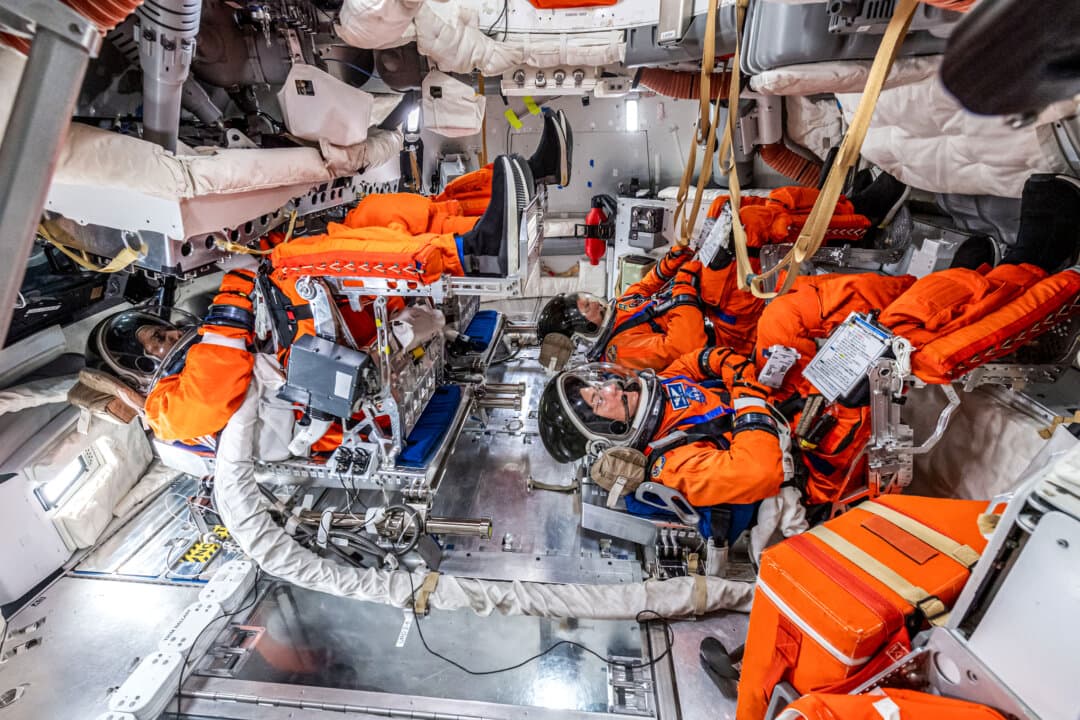
Artemis II crew members Reid Wiseman, Victor Glover, Christina Koch, and Jeremy Hansen take part in a training at the Space Vehicle Mockup Facility at Johnson Space Center in Houston on Jan. 30, 2025. As soon as 6:24 p.m. on April 1, the three Americans and one Canadian could launch on the first crewed mission around the moon in more than 50 years. (Mark Sowa/NASA)
Eclipse
The crew will witness a full solar eclipse.
As the four astronauts cross the proverbial channel of deep space between the Earth and the moon, they will see their destination pass completely in front of the sun.
Hansen said he and his crew had just learned about this opportunity a little more than a week before launch, but praised NASA scientists for how they were able to rapidly prepare the astronauts to get the most data possible. Observations will be focused on confirming Apollo reports of how the sun and magnetic fields can actually pick up and move lunar dust across the moon, as well as examining the sun’s corona.
The Orion spacecraft is powered by solar panels fixed on its service module, so being out of the sunlight will put stress on the spacecraft’s power and thermal systems. Howard Hu, manager of NASA’s Orion program, told The Epoch Times that the spacecraft will remain sufficiently powered throughout the event.
Lunar Flyby
Artemis II will enter the moon’s gravity approximately four days into the mission, and then enter its U-turn-enabling flyby around the far side more than 12 hours later. For anyone watching from home, the flyby will take place on April 6. That is, if the crew is able to execute its translunar injection.
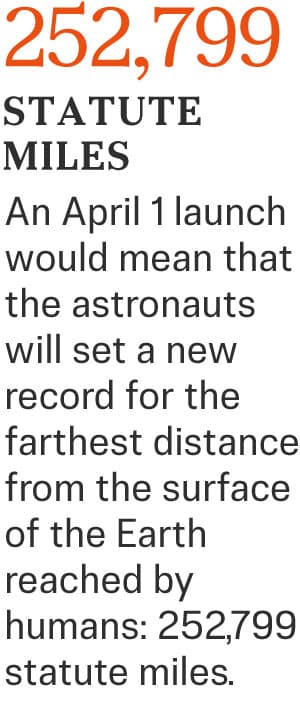
The successful April 1 launch means that Wiseman, Glover, Koch, and Hansen will set a new record for the farthest distance from the surface of the Earth reached by humans: 252,799 miles. That is 4,144 miles farther than the previous record set by Apollo 13 in 1970.
They will then pass behind the far side of the moon at a much greater distance from the lunar surface than the preceding Apollo missions. That perspective is expected to allow the astronauts to see parts of the far side with human eyes for the very first time.
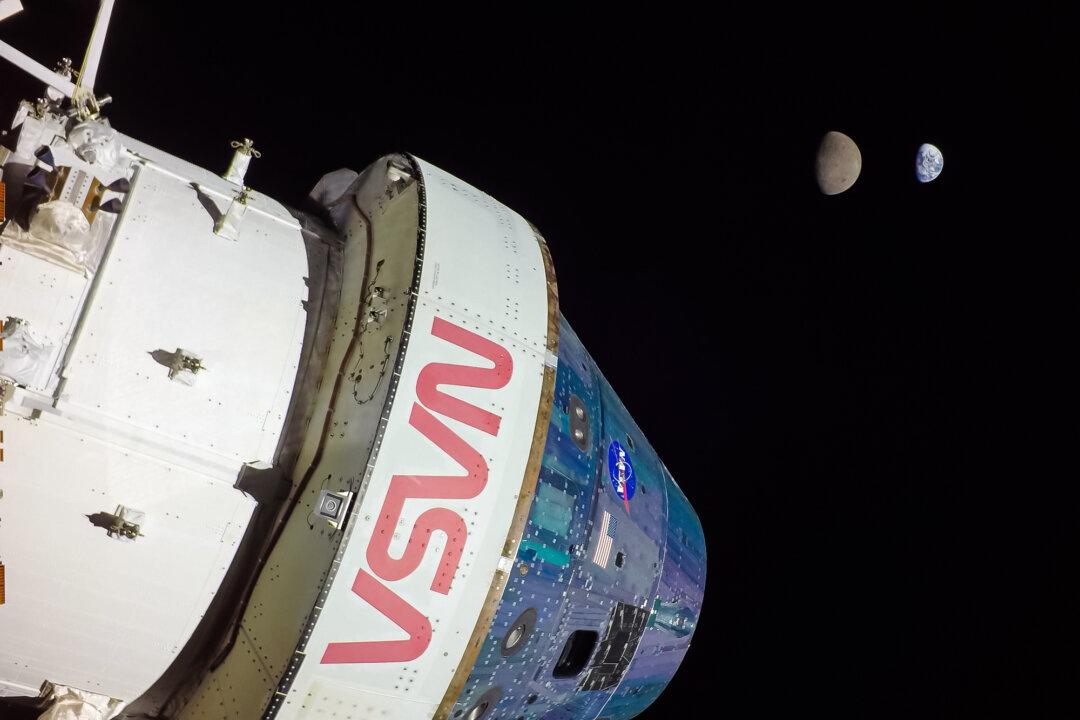
NASA’s uncrewed Orion spacecraft during the Artemis I mission on flight day 13 on Nov. 28, 2022. (NASA)
One of the sights they hope to see is the Orientale Basin.
“No one has ever seen this full crater on the far side of the moon, and so this would be really neat,” Hansen said. “I’m excited to have a look at it. It’s just enormous, super complex, and you could stare at it probably for hours.”
If they are successful in reaching lunar space, the four-person crew will also set a record for the largest crew to fly around the moon. All previous Apollo missions had three-person crews.

Communication With the Space Station
The crew have several tasks scheduled during their “cruise days,” as Koch called them, through deep space before and after the lunar flyby. One of those tasks will be having a ship-to-ship call with astronauts on board the International Space Station, including NASA astronauts Jessica Meir, Chris Williams, and Jack Hathaway.
The goal is to have this communication while Artemis II is under the moon’s gravitational influence, marking the first time that ship-to-ship communication is shared between a spacecraft in lunar space and Earth orbit.
Reentry and Splashdown
Mission leaders anticipate that Artemis II will begin its reentry into the Earth’s atmosphere nine days and one hour after liftoff.
Separated from its service module and falling backward with its heat shield facing home, the Orion capsule Integrity will reach its top speed of the entire mission. That could be as fast as 39 times the speed of sound, or roughly 28,900 miles per hour.
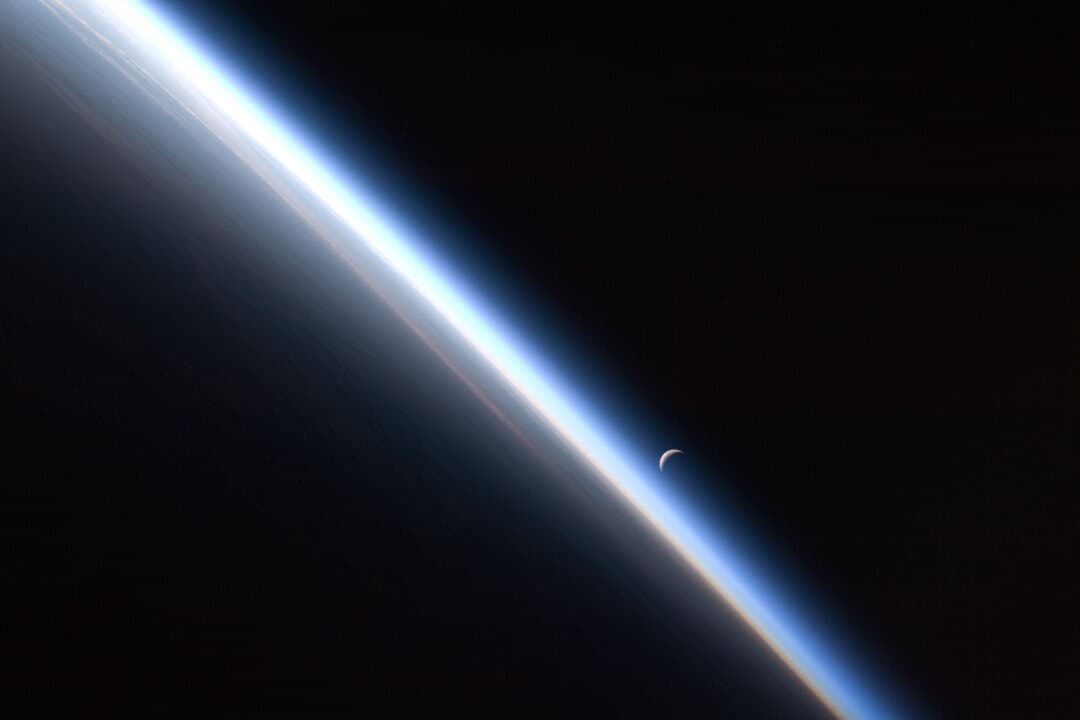
A waning moon sets above the thin line of Earth’s atmosphere in this image taken by an Expedition 24 crew member aboard the International Space Station as it passed over central Asia on Sept. 4, 2010. (NASA/Public Domain)
Beginning its reentry at an altitude of 400,000 feet, Integrity will streak through the atmosphere like a comet and gently parachute into the Pacific Ocean off the coast of Southern California less than 15 minutes later.
Chief Flight Director Emily Nelson said that if the astronauts launch on April 1, they will splash down at roughly 5 p.m. PT on April 10. But the actual return time will ultimately be determined by the trajectory taken.
The Crew
From December 1968 to December 1972, only 24 representatives of the human race made the journey from the Earth to the moon. Three of them were able to make the journey twice.
Now, more than 53 years later, the names of the next four representatives will be added to the list.
Here is a glimpse of who they are.
Reid Wiseman
The commander of Artemis II is a retired Navy captain with decades of experience as a naval aviator and test pilot that have taken him around the world multiple times at the controls of fighter jets, including the F/A-18F Super Hornet and the F-35 Lightning II.
He joined NASA as a member of the 20th Astronaut Candidate Class in 2009 and flew aboard a Russian Soyuz spacecraft to the International Space Station in 2014. He spent 165 days aboard the orbital outpost as a flight engineer for the liveaboard Expedition 41 mission, conducting two spacewalks and executing more than 300 scientific experiments with his crewmates. He later served as chief of NASA’s Astronaut Office.
The Baltimore native is also a single father. His wife, Carroll Wiseman, passed away from cancer in 2020. He has said that raising his two daughters on his own has been the biggest challenge of his life. But, to his surprise, his daughters were in full support of his flying this mission.
Victor Glover
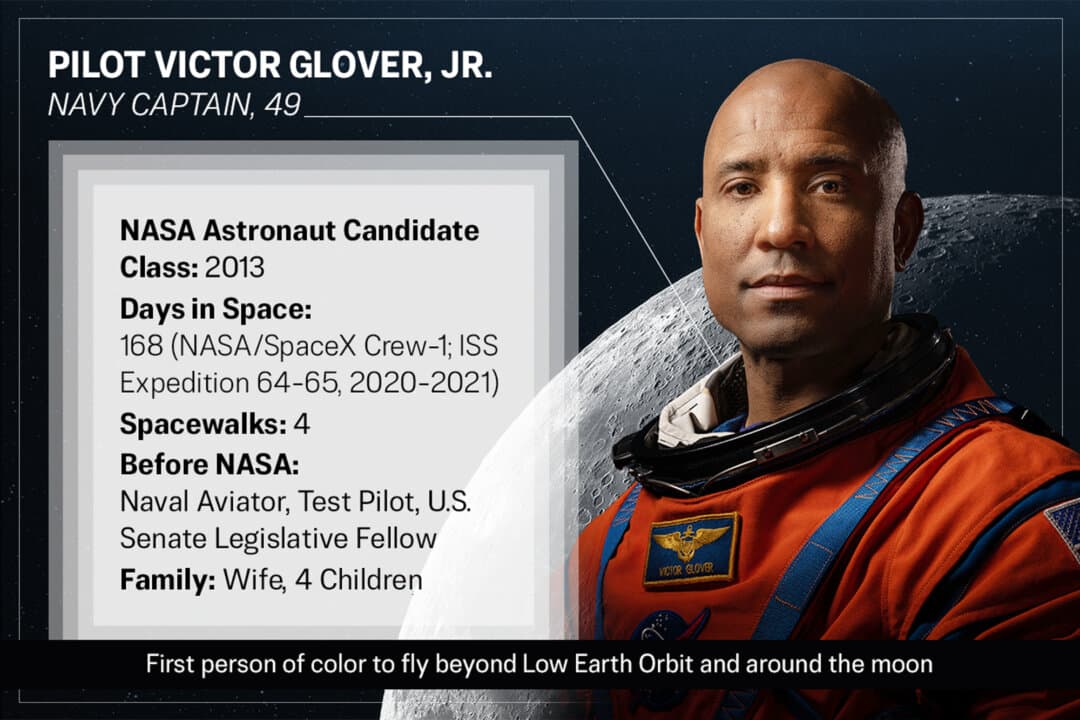
Sitting next to Reid Wiseman will be Artemis II’s pilot, another Navy captain with extensive experience as a naval aviator and test pilot. Glover was selected for NASA’s 21st Astronaut Candidate Class in 2013 while serving as a legislative fellow in the U.S. Senate.
The Pomona, California, native knows what it is like to fly a new spacecraft. He served as the pilot on NASA/SpaceX’s Crew-1 mission to the International Space Station in 2020, the second crewed flight of the SpaceX Crew Dragon capsules, now in regular use. While in orbit, Glover racked up 168 days in space as a crew member of Expedition 64/65, including four spacewalks.
Back on Earth, one of his most challenging yet rewarding ground assignments was serving as the family escort for several of his fellow astronauts flying Soyuz and Crew Dragon launches. Now, as he prepares to launch on his adventure around the moon, he will leave his wife, Dionna Glover, and their four children with their own escort, as will the families of all his crewmates.
Christina Koch
Joining Glover as a mission specialist will be another member of his astronaut candidate class. Koch is the only civilian astronaut on the mission and the only record holder in terms of spaceflight.
After a pre-NASA career that featured extensive field research in Antarctica, Greenland, Alaska, and American Samoa, the electrical engineer and physicist set a record for the longest single spaceflight conducted by a woman. In 2019–2020, Koch accumulated 328 days in space—nearly all of Wiseman’s and Glover’s time put together—serving on Expeditions 59, 60, and 61.
Her record-setting spaceflight featured six spacewalks, including the first three all-women spacewalks in history that she conducted with Meir.
Koch was born in Grand Rapids, Michigan, and raised in Jacksonville, North Carolina. She leaves behind a supportive husband.
Jeremy Hansen
Artemis II’s second mission specialist will be making his first trip to space. Like Wiseman and Glover, Hansen joined NASA after serving his country as a fighter pilot. But rather than flying for the U.S. Navy, the London, Canada, native earned his wings with the Royal Canadian Air Force, ascending to the rank of colonel. He was one of only two recruits chosen by the Canadian Space Agency for its third astronaut recruitment campaign in 2009.
Hansen then served as capsule communicator for the International Space Station, and has conducted his own exploratory missions around the world, which included living underground in Sardinia for six days as part of the European Space Agency’s CAVES program and living underwater off the coast of Key Largo, Florida, for NASA’s NEEMO 19 mission. He was also put in charge of training American and Canadian astronaut candidates.

As Hansen leaves behind his wife and three children, he hopes to inspire more of his fellow Canadians to follow in his footsteps. He will be the first Canadian, let alone non-American, to venture beyond low Earth orbit and around the moon.
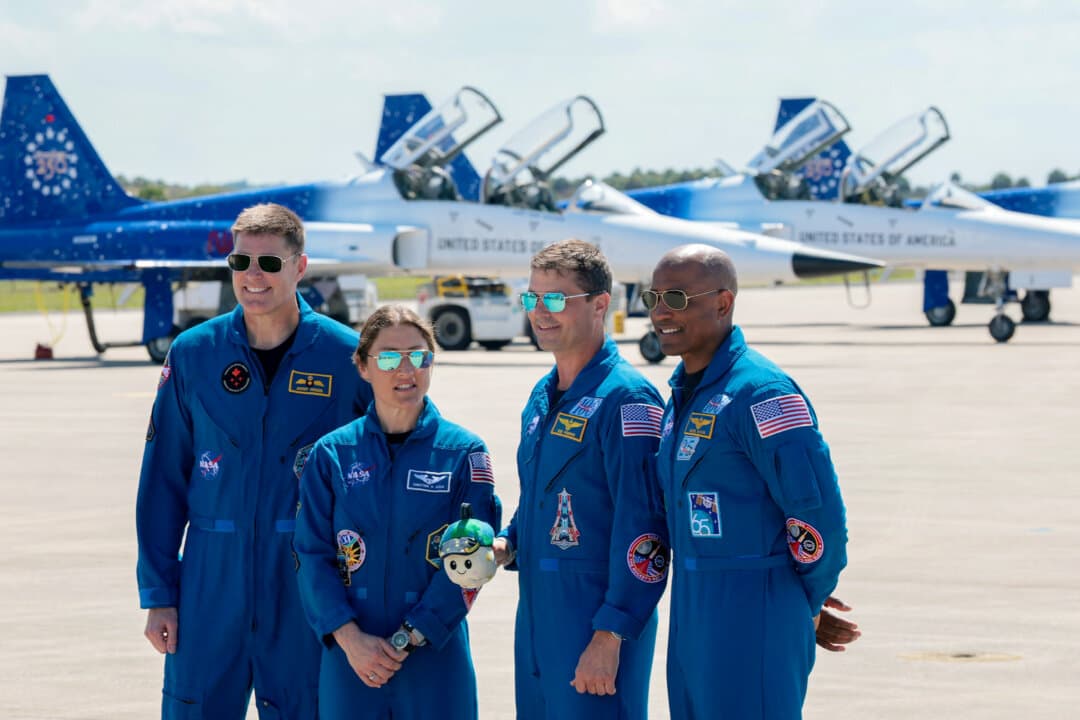
(L–R) The Artemis II crew: Mission Specialist Jeremy Hansen of the Canadian Space Agency, Mission Specialist Christina Koch, Commander Reid Wiseman, and Pilot Victor Glover stand together after arriving at the Kennedy Space Center in Cape Canaveral, Fla., on March 27, 2026. (Joe Raedle/Getty Images)
That demographic first will be joined by Glover, the first black man and person of color to make that journey, and Koch, who will become the first woman to do so.
However, although all three crew members appreciate and are proud to make those milestones, they made it clear that their focus lies beyond the superlatives.
“I also hope we are pushing the other direction, that one day we don’t have to talk about these firsts,” Glover said. “That one day ... this is human history. It’s about human history. It’s the story, not black history, not women’s history, but that it becomes human history.”
Foundation for Future Missions
Artemis II is the pathfinder of every crewed Artemis mission set to follow.
The crew will have to demonstrate how to live and work inside the Orion capsule. This includes using exercise equipment—and working as efficiently as possible while a crewmember uses the exercise equipment—as well as using the toilet, sleeping, and setting up and stowing equipment.
They will also have to demonstrate how to take radiation readings and execute emergency procedures, such as donning pressure suits and seeking refuge in a special area of the capsule with extra radiation protection.
But Artemis II could offer scientific breakthroughs regarding human flights to the moon. One onboard program called AVATAR offers the possibility of providing bespoke medical treatment for each astronaut before he or she even flies.
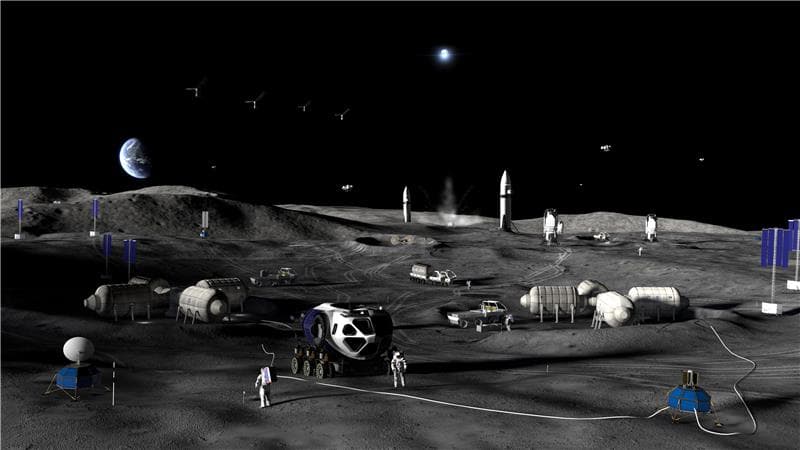
An artist’s concept shows phase three of NASA’s moon base, planned near the lunar south pole and designed to support a continuous human presence with nuclear power. The base is envisioned as a staging point for missions to Mars and the outer solar system. (Courtesy of NASA)
Short for “A Virtual Astronaut Tissue Analog Response,” AVATAR features thumbsized chips of “organ cells” that can be flown aboard other missions to learn how an astronaut’s different organ tissues, such as those in the brain, heart, and liver, would respond to the environmental stressors found in deep space, such as radiation exposure.
Artemis III is due to launch in mid-2027 on an Earth-orbiting mission focused on rendezvousing with one or two of the human-rated lunar landers currently being built by SpaceX and Blue Origin. Then, if successful, Artemis IV would launch in early 2028 and make the first attempt of the campaign to put human beings back on the lunar surface.

That landing will be a prelude to a decade-long international endeavor to establish a surface base near the lunar south pole that would eventually be equipped with nuclear power and capable of supporting continuous human presence. And that base will be a jumping point to Mars and the outer solar system.
But everything begins with Artemis II—a mission whose success, according to its commander, will ultimately be measured by its forgetfulness.
“I hope we’re forgotten,” Wiseman said during a news conference last September. “If we are forgotten, then Artemis has been successful. We have humans on Mars. We have humans out on the moons of Saturn. We are expanding into the solar system.”