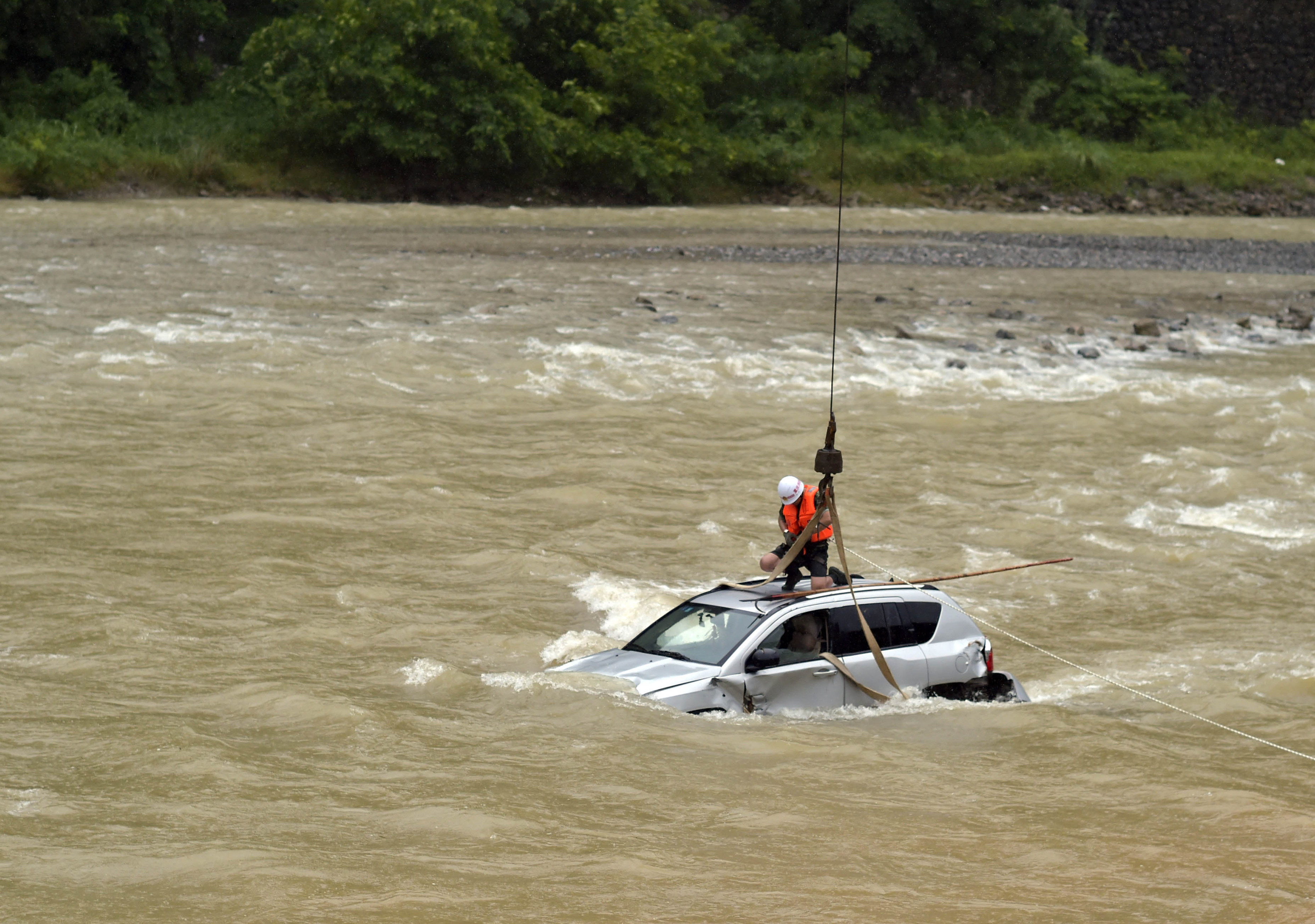

Torrential rain triggered flash floods, mudslides, and landslides across Chongqing in southwestern China from the night of May 23 into the early hours of May 24, killing at least nine people and leaving 11 missing in Yongchuan District, the hardest-hit area, according to state broadcaster CCTV.
Two more people were unaccounted for in Beibei District. As rescue efforts continued, residents and experts began questioning whether reservoir releases or dam problems had contributed to the disaster.
Chongqing sits on one of southwestern China’s densest networks of reservoirs—more than 3,000, according to past water conservancy records—yet authorities have said nothing about how those facilities managed flood discharge during the storm, or whether any dams failed.
Two recent Chongqing government articles touting the city’s reservoir-building program and flood-season preparations were briefly removed as The Epoch Times reviewed them in the days after the disaster. The pages have since become accessible again, but residents had already begun raising questions about the disconnect between the official messaging and the scenes on the ground.
In Yongchuan’s Chashan Zhuhai Subdistrict, 296.6 millimeters of rain fell in two hours between 2 a.m. and 4 a.m. on May 24, with peak hourly rates of 103.6 millimeters—what Chinese meteorologists classify as an “extraordinary rainstorm.”
A separate monitoring station in Shuangshi Township logged the same total over six hours, the highest level recorded in Chongqing since meteorological observations began, according to state media. Authorities described the event as a “small watershed flash flood” caused by “intense short-duration rainfall.”
Videos posted by residents showed streets buried under muddy water and debris, with shops submerged across the district. One resident said it was the worst flooding in three or four decades.
Chongqing City University of Science and Technology, near Guangcai Avenue in Yongchuan, was among the institutions hit hardest. A student told The Epoch Times that low-lying parts of the campus were heavily flooded.
“Building 7 was hit the hardest. The entire first floor was submerged, including shops and vendor stalls. There used to be a long wooden bridge there, but it’s gone now,” said the student, who requested anonymity out of fear of reprisal. “The school also lost water and electricity, and classes were suspended.”
The student said three or four package delivery stations, supermarkets, and cafeterias on the first floor were flooded, but a few shops on higher ground were still serving meals. The administration had told students not to remain on campus because of the utility outages.
Some students publicly criticized how the university handled the situation, accusing administrators of trying to dodge responsibility for housing them.
“The school doesn’t want to pay for students to stay in hotels outside, but it also doesn’t want to declare a holiday, so students are just stuck outside waiting around,” one student told The Epoch Times, adding that hotel prices nearby had surged because of the flooding.
Reservoir Questions Mount
The Chongqing Hydrological Monitoring Center reported on May 24 that 22 small and medium-sized rivers in the city had exceeded warning levels, with 12 passing their guaranteed safety thresholds—meaning water levels had moved beyond the theoretical limits for flood-control safety, raising the risk of embankment failures and overflow.
Online comments from residents asked whether the sudden river surges were caused by upstream releases, overflow from small reservoirs, or breaches at mountain ponds.
Wang Weiluo, a Germany-based Chinese hydrologist, told The Epoch Times that upstream reservoir releases—likely unannounced—contributed to or caused the downstream flooding in Yongchuan, and that the reservoir management system is structurally responsible for this happening.
“The CCP has always treated reservoirs and dams as the primary tool for flood control, but hundreds of thousands of reservoirs and dams cannot actually control floods,” he said.
Wang said that since China assigned local officials direct responsibility for individual reservoirs under the country’s river and reservoir management system, unannounced reservoir discharges had increased rather than decreased.
“Look at the floodwaters submerging towns in the videos—they are muddy yellow waters. Do you think that’s simply urban flooding caused by inadequate drainage systems? Of course not,” he said.
Wang noted that one Chongqing government article that briefly went offline, titled “By 2030, Chongqing Will Basically Establish a Modern Water Network System and Build More Than 100 New Reservoirs,” reported that the city had completed or largely completed two large reservoirs—including Guanjingkou—along with 104 small and medium-sized reservoirs.
Another 93 reservoirs were under construction, including the Zaodu Reservoir, with five large water conservancy facilities under construction at the same time, described in the article as a historic high. The city’s water storage and regulation system, it said, was “more stable and reliable” than ever.
A second article that briefly returned a 404 error, published April 27 under the title “Chongqing Takes Multiple Measures to Safeguard Reservoir Safety During Flood Season,” described an April 24 citywide video conference where officials highlighted “prominent risks from extreme disasters,” reinforcement of dangerous reservoirs, “AI plus water-area safety,” and a citywide early warning system.
Wang said with those measures publicly touted just weeks earlier, residents have been asking why—if AI warnings, drones, digital twin systems, and around-the-clock monitoring were in place—people are still missing, why some residents were not evacuated, and why some neighborhoods flooded without warning.
Luo Ya contributed to this report.