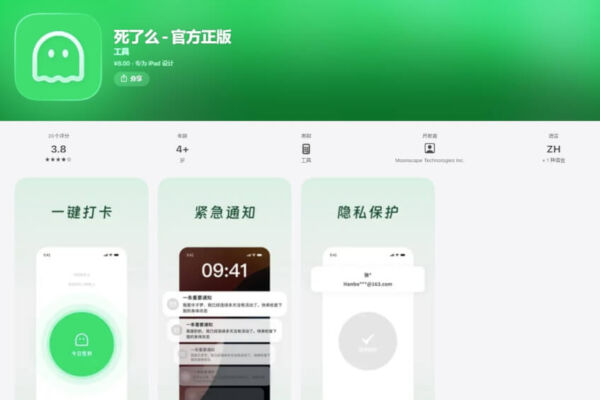
A newly released Chinese app called “Are You Dead?” has gone viral in China in recent days. Earlier this week, it climbed to No. 1 on Apple’s top paid utilities chart in China, before falling to No. 2 on Wednesday.
The app’s functionality is starkly simple. Users designate an emergency contact and check in periodically. If they fail to do so for two consecutive days, the system automatically sends an email alert to that contact. This app is targeted toward people living alone.
Its overnight success has turned an obscure three-person startup into a viral phenomenon, and analysts say this is an unsettling mirror of modern life in China.
A Booming Market for Living Alone
The app’s success showcases China’s increasing trend of people living alone. According to a 2023 report by the Beike Research Institute cited by Chinese state media Xinhua News Agency, the country’s solo-living population is expected to reach 150 million to 200 million by 2030, which will account for approximately 30 percent of the adult population.
Creators of “Are You Dead?” say they were responding to this demographic reality.
The app was developed by Yuejing Technology Services Co., founded in mid-2025. Its creator, who identified himself to Chinese media outlet Lanjing News by his surname Guo, said development took less than a month and cost roughly 1,000 yuan (about $140). Initially free, the app now costs 8 yuan (US$1.10) and is currently available only on Apple’s app store.
Guo said the idea and its deliberately blunt name came from online discussions among young people worried about medical emergencies or accidents going unnoticed while living alone.
‘A Basic Safety Need’
Chinese political commentator Tang Xiaolan
wrote in Chinese state-controlled media China Jilin Network this week that the app’s popularity reflects a widespread fear of what is known in East Asia as “lonely death”—dying unnoticed and alone.
“In modern society, rapid population mobility has eroded traditional family and neighborhood networks,” Tang wrote. “Medical emergencies at night, moving house alone, seeking treatment without someone to sign consent forms—these are everyday risks for people who live by themselves. Safety alerts have become a basic necessity.”
While apps offering health tracking or emergency alerts are common globally, analysts say the Chinese case is distinctive because of what the app has come to symbolize.
“The shock isn’t that such an app exists,” said Lai Jianping, former Beijing lawyer and president of the Canada-based Federation for a Democratic China, to the Chinese edition of NTD. “It’s that so many young people feel they need it.”
Lai argued that China lacks a comprehensive, institutionalized social safety net that people can rely on in moments of vulnerability.
“No one knows when something might go wrong,” he said. “[In China], there are fears of forced disappearances, organ harvesting, being lured by fraud syndicates, or even being kidnapped and taken abroad. All of these things are possible. Taken together, these risks help explain why some young people turn to tools like this.”
Economic Anxiety
Chinese culture traditionally avoids public discussion of death, making the app’s blunt branding all the more striking. Wang, a university lecturer in China who spoke to NTD and revealed only her surname due to safety concerns, said older people she knows find the name unsettling, suggesting the app’s main user base is younger.
“Young people feel trapped,” she said. “The economy is slowing, jobs are hard to find, housing is unaffordable, and marriage feels out of reach. Many are just renting small apartments and getting by.”
Underlying these pressures is the limited scope of public welfare spending. According to World Bank data, China’s spending on health care for the general population accounts for only 5.37 percent of GDP—lower than most BRICS countries, including Brazil and Russia, and below many developed economies.
The surge of the “Are You Dead?” app comes amid broader signs of economic pessimism in China. Analysts have observed rising “defensive savings” by the Chinese public due to fears of personal emergencies and weakening consumer confidence, trends often associated with uncertainty about the future.
Yang Xu contributed to this report.