

Street protests have continued in some major cities as state and local officials battle the Trump administration’s effort to use National Guard troops to protect federal property during Immigration and Customs Enforcement (ICE) operations.
Portland, Oregon, and Chicago have seen sustained protests and some violence as the Trump administration carries out large-scale operations to deport illegal immigrants.
When President Donald Trump ordered National Guard troops to be deployed, Oregon and Illinois sued to block the move. A federal judge blocked the Oregon deployment. The Illinois case is pending.
Trump deployed National Guard troops and U.S. Marines to Los Angeles in June in response to anti-ICE protests, and to Washington in August to support crime fighting. Both deployments survived legal challenges.
Local officials’ efforts to block the federal troop deployments have focused on questions of constitutional authority and presidential power, while federal officials have pointed to the cities having high levels of violent crime and lawless protests.
Attacks on ICE personnel shot up more than 1,000 percent since January, according to the White House. And an attack on an ICE facility in Dallas on Sept. 24 left two dead, including the shooter.
Local officials have claimed that the levels of crime and lawlessness are overblown and can be easily handled by police.
On-the-ground reporting by The Epoch Times in three major cities reveals a mixed picture of how local officials and private citizens perceive the violence in their streets.
Portland
Hundreds of protesters lined the entrance of the ICE building in Portland on Oct. 3, chanting anti-ICE slogans and shouting threats at the federal agents behind a metal gate.
“That overhang would be great to hang you all,” a black-clad woman said through a loudspeaker, pointing at the building. “We could fit 12 of you on each side ... now that would be efficient.”
The next night, protesters staged a larger demonstration there, which included an Antifa presence. There was also a small group of ICE supporters.
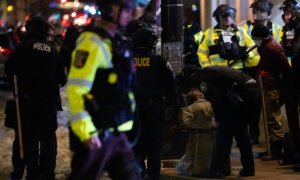
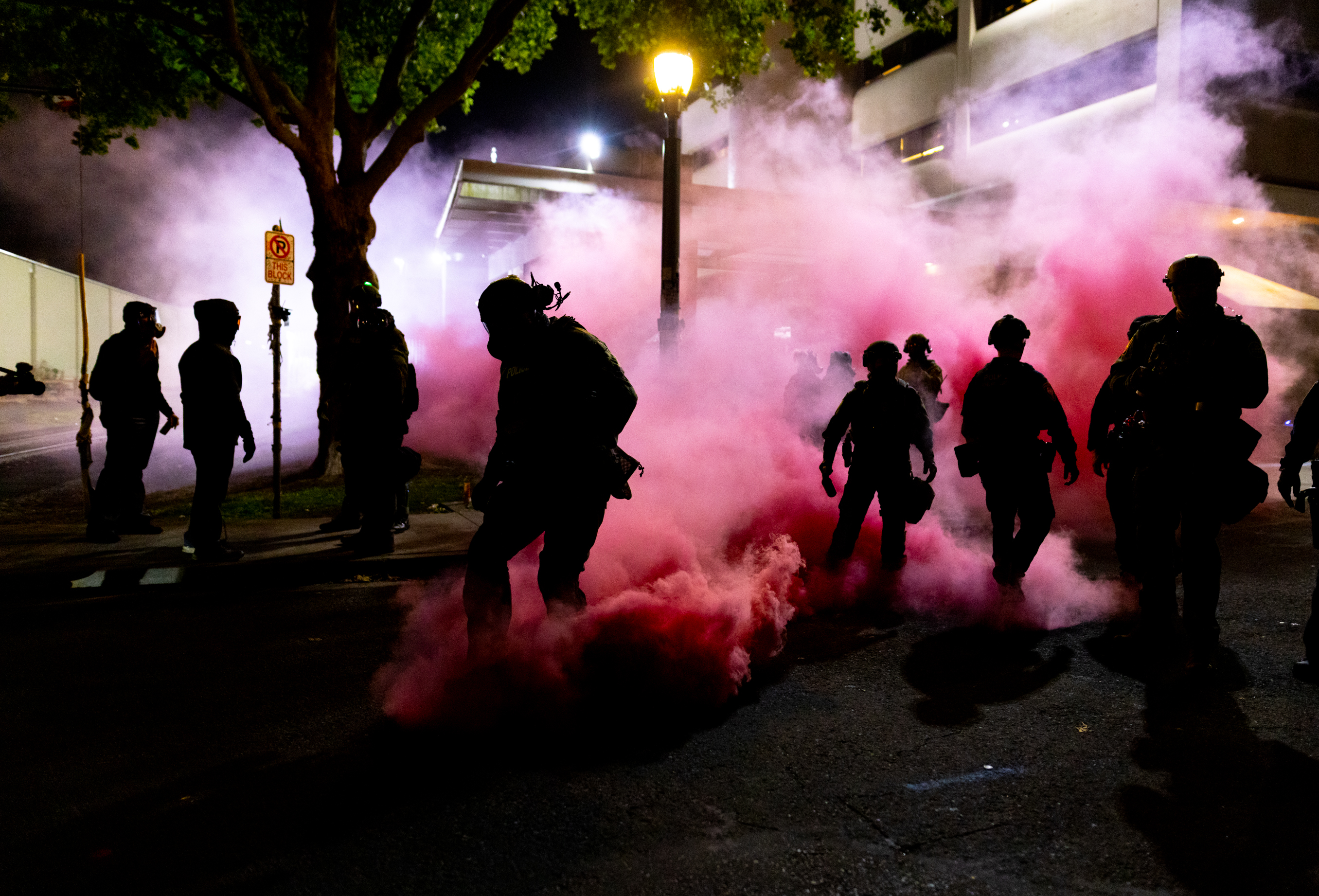
Shortly before 9 p.m., dozens of federal agents pushed back the crowd to allow vehicles to exit the facility.
Agents fired pepper balls, a powdered chemical agent with similar effects to pepper spray, to drive protesters nearly a block from the facility.
White House press secretary Karoline Leavitt called the protests riots and said the protesters have incited violence.
“For more than 100 days, night after night after night, the ICE facility has been really under siege by these anarchists,” she said in an Oct. 6 press briefing.
Portland police have made 36 arrests since ICE protests began in June, according to Bob Day, chief of the Portland Police Bureau. Yet Day said federal intervention is unnecessary.
“I’ve said several times now that we do not need the National Guard at this point to address the issues in the South Waterfront,” Day said in an Oct. 6 interview televised by KGW News.
However, Day conceded that there has been violence.
“I would be naive or not really being accurate if I didn’t recognize that we have had assaults down there,” Day said. “We have had conflict.”
The chief also said local resources were stretched thin, even in routine circumstances, due to a lack of staffing.
Chicago
ICE officers were targeted in a pair of violent attacks in the Chicago area on Oct. 2, the Department of Homeland Security (DHS) reported.
Two illegal immigrants allegedly attempted to ram ICE officers. One perpetrator was allegedly armed with a semiautomatic rifle.
ICE has arrested more than 1,000 suspected illegal immigrants in Illinois since Sept. 8. On Sept. 30, officers entered a five-story apartment building on the city’s South Side, making 37 arrests, according to DHS.
Officials said the operation targeted those with connections to the Tren de Aragua gang.
Illinois State Police made multiple arrests on Oct. 3 and 4 following clashes between protesters and police near the ICE facility in the Broadview area west of Chicago. Fencing was recently installed around the one-story brick building in a working-class area of the city.
City officials have joined the state’s lawsuit challenging a deployment of federal troops in Chicago.
“We do not need or want the National Guard to police our streets,” Chicago Mayor Brandon Johnson told reporters at an Oct. 6 press conference.
Johnson said the city had experienced its safest summer in 60 years.
The city has seen a drop in most violent crimes in 2025, experiencing 331 murders through Oct. 4, down from 456 in the same period last year.
Despite that, the city’s official website states, “Chicago experiences devastating levels of violence, and this has been especially true since 2016.”
Johnson signed an executive order on Oct. 6 declaring city-owned property an “ICE Free Zone.” The order prohibits federal immigration officers from using city-owned property in their operations.
Memphis
Trump has announced that he would send National Guard troops to Memphis, Tennessee, where the rate of violent crime was six times higher than the national average in 2024. For that year, the city ranked first in the nation in per capita violent crime as well as property crime.
“The Tennessee National Guard should be coming in the next few days or in the next week or so,” Memphis Mayor Paul Young said in an interview televised by ABC24. “We expect to see them on the ground, but they are not here yet.”
Unlike Portland and Chicago, Memphis and its home state have been more welcoming of federal help in combating violent crime.
Tennessee Gov. Bill Lee joined the president in the Oval Office last month when Trump signed an order establishing the “Memphis Safe Task Force.”
“We’ve made significant investments to address crime throughout my seven years in office, and thanks to President Trump’s leadership, the Memphis Safe Task Force will ensure we have every resource at our disposal to create significant change,” Lee said.
Young said he hoped federal authorities would build on the efforts of the Memphis Police Department.
“That’s going to allow us to really get the individuals directly responsible for violent crime off the streets,” he said.
Most residents The Epoch Times spoke with in Memphis favored federal intervention in helping reduce crime.
“It’s really good to have the National Guard coming here,” Daphne Carpenter, 37, told The Epoch Times.
Crime is harming the community, she said, recounting multiple shootings that occurred in the area recently, including one incident where a newly graduated 18-year-old female was killed.
Other locals emphasized the work of Safe and Clean Memphis, a joint task force to identify and detain hardened career criminals.
“I definitely feel safer because I know they’re doing fugitive ops and they’re looking for people with open warrants,” Kourtney Winters of Memphis told The Epoch Times on Oct. 5.
Many of those living in Memphis said their experiences don’t necessarily match the national headlines that label the city as dangerous.
“It affects the life of my kids, and it affects people,” Cosandra Neely, a longtime Memphis teacher, told The Epoch Times. “I just have not seen it on the scale that everybody is talking about that don’t live in Memphis.”
Memphis native Sarah Tims said, “Definitely, there are issues, but it depends where you go.”
Tims said she feels comfortable living alone in the city.
Some who were critical of the operation said the money would better serve the community if used for education and anti-poverty measures.
“Memphis has a long history of crime problems. It’s not new,” Michelle, a young woman meeting friends for a birthday gathering, told The Epoch Times. “This is not like a sudden crisis.”
Some visitors to the city noticed marked improvement from the last time they were in Memphis.
“It’s a huge transformation tonight from when I previously encountered it,” Chad Cassells, 54, visiting Memphis from Englewood, Florida, told The Epoch Times.
“Before, it was a little bit sketchy. I wouldn’t come out here by myself.”
After hearing news reports that federal support for law enforcement was underway, his family decided to revisit Memphis. Satisfied with the progress made, he said Trump’s law and order policies are benefiting communities nationwide.
Correction: An earlier version of this article misspelled the name of Sarah Tims. The Epoch Times regrets the error.