The daughter of two drug addicts, Liz Murray grew up in poverty in the Bronx, often hungry and often living in the streets. When Murray was 11, her mother tried to exchange a coat for drugs, but the dealer refused the offer, told her to get some help, and gave her a medallion with the Serenity Prayer on it. Her mother ignored the Narcotics Anonymous token, but Murray tucked it away and looked at it from time to time, treating it as a novelty rather than as a pathway to a better life.
Murray was 15, homeless, and a school dropout when her mother died from AIDS. Shortly afterward, still homeless, she looked at a worn and treasured photo of her mother and saw her own future. “Like my mother, I was always saying ‘I’ll fix my life someday.’ My time was now or maybe never,” she said.
It was then she remembered the medallion. She reread the words inscribed there and realized: “This is something I can actually change. I have the wisdom to do it.” She reenrolled in high school, and though still living part of this time hand-to-mouth and homeless, she graduated at the top of her class, won a major scholarship, and gained admission to Harvard. From there, she became an inspirational speaker and a successful author. Perhaps best of all from her perspective, she is married with two children and has created the home she never knew.
The Prayer
“God grant me the serenity to accept the things I cannot change, courage to change the things I can, and wisdom to know the difference.”
Known as the Serenity Prayer, this 25-word petition is offered up daily in countless Alcoholics Anonymous (AA) meetings and other 12-step recovery programs. Found on wall art, medallions, and coffee cups, it’s the most popular version of a prayer attributed to prominent theologian and pastor Reinhold Niebuhr.
Its universalism is one reason for that popularity. Its message is basic to all faiths, even to those for whom religion is of little importance. It contains touches of philosophies such as stoicism with the folksy adages uttered by a front porch grandfather. It’s short, rhythmic, and easily memorized.
And tucked away in that single sentence are three of the four cardinal, or classical, virtues. Courage and wisdom, also known as prudence, are directly referenced. A third virtue, temperance—it also goes by the name of moderation or self-control—is the prayer’s message. Only justice is missing from this mixing bowl of virtue.
But the main reason why so many people make this prayer their mantra is simple.
It works.
Or rather, as one AA adage goes, it works if you work it.
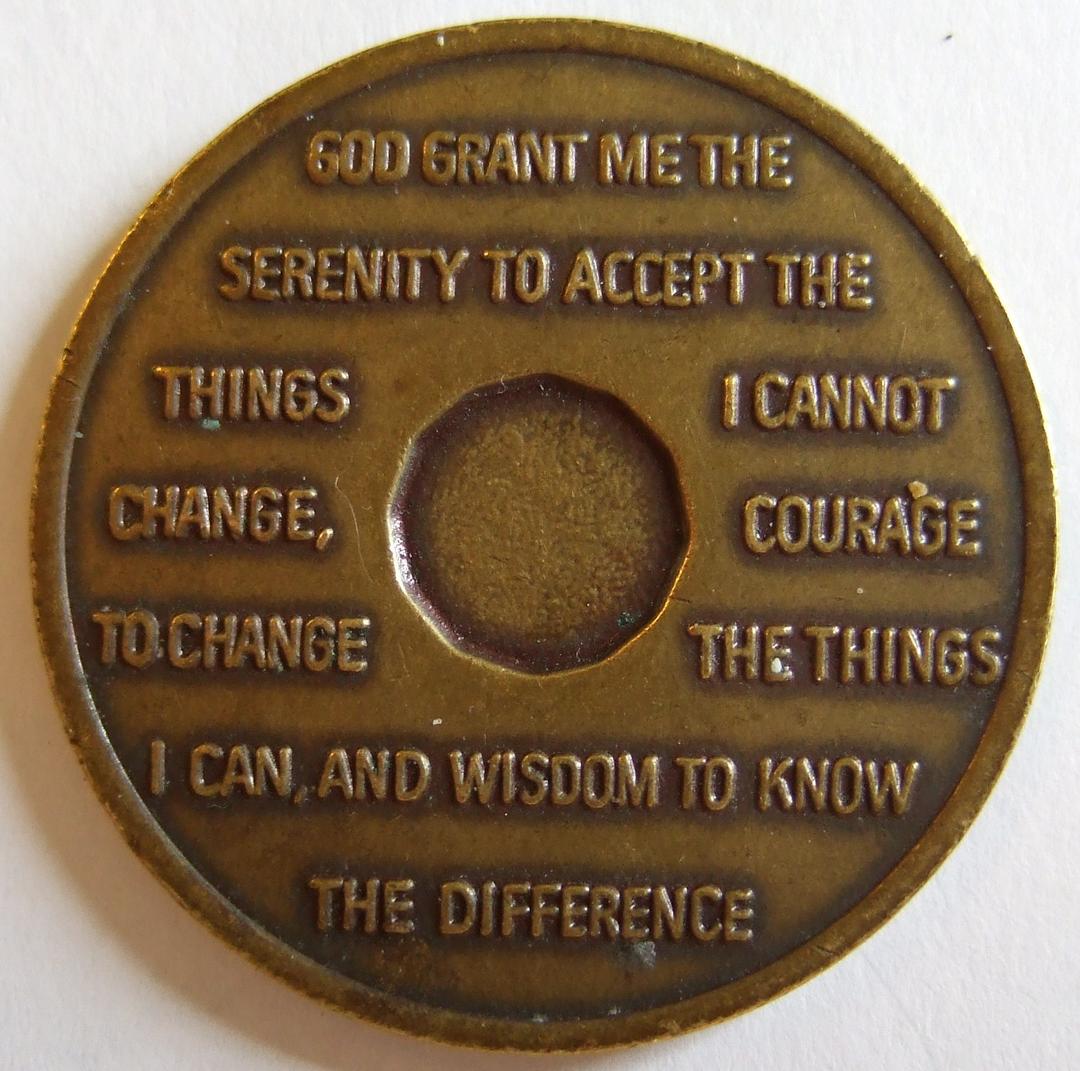
Short, rhythmic, and direct, the Serenity Prayer speaks to universal human struggles. (Jerry "Woody"/CC BY-SA 2.0)
Acceptance
This is a tough one.
We have only to look at our current political wars to find millions of people made miserable and angry over election results they cannot change. Acceptance of what we cannot change grows even more painful the closer it comes to home.
Consider, for instance, the surging number of parents and their adult children who have severed all ties with one another. Therapist Paula Rinehart reports that some 38 percent of families have at least one estranged relative, while “about 1 in 4 adult kids has reportedly gone ‘no contact’ with a parent.” Such divisions are growing and have become so commonplace that most of us either know someone in this situation or are experiencing it directly.
So how do parents who love their children accept with serenity being cut out from the lives of one or more of them? The short answer is, they don’t. Serenity may never patch up that sadness. But the long answer is that they can continue to hope and to pray that the wounds will be healed and a reunion will occur. They can keep sending their children and grandchildren gifts or cards, and if those are rejected, then perhaps the parents can reconcile themselves with patience and low expectations.
Some AA members put this twist on the Serenity Prayer: “God, grant me the serenity to accept the people I cannot change, the courage to change the person I can, and the wisdom to know that person is me.”
Humorous, yes, but there’s truth in that witticism.

Rebuilding a life is carried out one ordinary day at a time. (Catherine Delahaye/Getty Images)
Courage
In many ways, this part of the prayer—“to change the things I can,” or as some people prefer to say, “to change the things I should”—comes easier, because here action and outcomes depend on us. We make the choice to change.
Our New Year’s resolutions, whether to lose weight, give up smoking, or treat our fellow employees with more kindness, all depend at least in part on courage. When more sweeping challenges, often unsought, confront us, courage becomes absolutely vital for any hope of success. Abraham Lincoln, Winston Churchill, and many others are exemplars of that virtue. When things went terribly wrong and needed to be changed, they had the guts to do it.
Here, my mother comes to mind. She had devoted her life to her family, her husband, and six children, and when Dad divorced her, she visibly fell into the lowest point of her life. Yet we were there and watched as she shook off that disaster, moving 500 miles back to a Carolina town familiar to her, finding employment she loved and for which she was valued, speaking her mind more freely, and immeasurably deepening her spiritual life. In her final days, on her own bed and surrounded by her children and the first of her grandchildren, through her courage and grace, she gave all of us a lesson in dying.
Mom had the courage to change her life.

Courage is seen in humility, persistence, and a willingness to learn from experience. (Maki Nakamura/Getty Images)
Wisdom
Wisdom is made up of an accumulation of book learning, knowledge gleaned from others, experience, humility regarding what we know and don’t know—think of Socrates—and sound judgment. It’s the trickiest of the three virtues present in the Serenity Prayer, for it also involves conjecture about the future. Only hindsight, and sometimes not even then, confirms the wisdom of our decisions.
The broken parent–adult child relationships afford many examples of having to make choices in which wisdom or its absence is in play. One man I know, for example, wronged his son, who then refused to have anything to do with him. With his apology rejected, the man resorted to the tactics of patience and prayer. After four years, father and son reconciled.
On the other hand, several people whose stories I know, parents and adult children alike, have refused to acknowledge any wrongdoing. They long for a restoration of their relationship, but the words “I’m sorry” are absent from their vocabulary.
This kind of pride is the enemy of wisdom.

Wisdom grows through humility and reflection. (thianchai sitthikongsak/Getty Images)
Virtue Brings Happiness
Aristotle, Plato, and a platoon of other philosophers, as well as religious thinkers, have long argued that the reward of virtue is happiness. This happiness has little to do with the fleeting sensations of some special moment or reward but is what the ancient Greeks called
eudaimonia, a deep-down satisfaction with oneself and with life, which can, and often does, produce a profound inner joy.
Some modern-day thinkers have revived this idea. Psychologist and writer Tim LeBon, for instance, writes that for the ancients, “cultivating the virtues was the secret to living both a happy life and an ethical life” and that “recent research supports this notion.”
As Liz Murray and countless others have discovered, the Serenity Prayer, with its virtues and power, can help us deal with everything from day-to-day troubles to major life transitions. If you decide to follow in their footsteps, don’t forget—it only works if you work it.