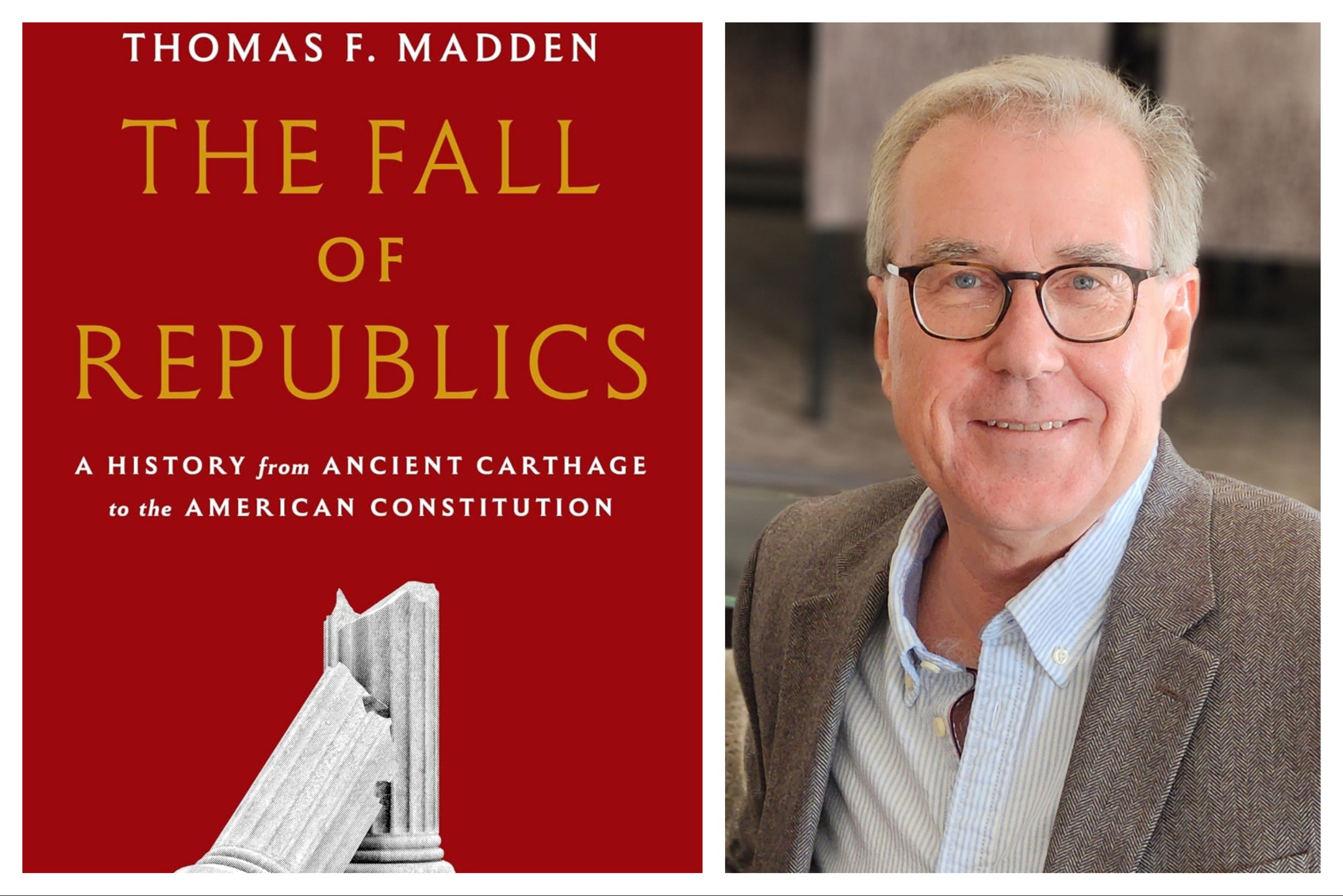
The collapse of any government is dramatic, at times tragic. Thomas F. Madden’s new work, “The Fall of Republics: A History From Ancient Carthage to the American Constitution,” succinctly captures the drama and tragedy of the fall of Carthage in his opening pages.
The city’s fall is seen through the eyes of its conquerors, specifically Scipio Aemilianus, the great Roman general, and his Greek tutor, Polybius. Madden quotes the distraught general, “A glorious moment, Polybius, but I have a dread foreboding that someday the same doom will be pronounced on my own country.”
The year was 146 B.C. It marked the end of the Carthaginian republic, which had for several centuries successfully blended three forms of government—monarchy, oligarchy, and democracy. According to Madden, the year also marked the beginning of the end of the Roman Republic, which was first established in the sixth century B.C. with the overthrow of the king. The dichotomy between these two republics was that Carthage was destroyed by outside forces, while Rome would be destroyed by internal ones.
Contrasting Carthage and Rome in the opening quickly allows Madden to exemplify the fact that republics can fall for varying reasons. The author then begins with a chronology of republics, starting with Sparta and treading through the millennia to reach the American republic.
Evolving Republican Ideas
As Madden notes, in the context of human history, the idea of government is a relatively recent construction, and republican forms of government even more recent. The republican style of government Americans enjoy today is certainly only a few centuries old, molded by history, formulated by political theory, and cemented by experience.
Each city-state or nation that practiced republicanism, in its various and ever-evolving forms, is thoroughly explained by the author. Sparta had its two kings, gerousia (a group of 28 respected elders), ephors (a group of five formed later in the city-state’s history), and an assembly (the people). Carthage had sufetes (dual executives), adirim (a group of 200 to 300 that acted like a senate), and the assembly, which elected officials and military officers. Rome with its two consuls, senate, tribunes, plebs, decemvirate, and popular assemblies. The long-enduring Venetian republic, which along with Rome, constitutes a large portion of the book, had its doge (executive), tribunes (aristocracy), and arengo (democracy), as well as its consilium sapientium (a large council that was later established to select the doge).
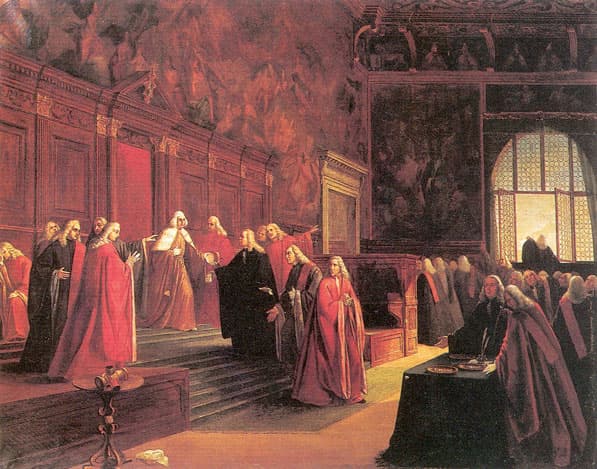
A portrait painting the fall of the Republic of Venice (1797): the abdication of the last doge, Ludovico Manin. (Public Domain)
Madden discusses the many changes that took place in each of these republics, why they were necessary, and how they succeeded or failed. It is a plethora of information that requires one’s full attention and, I would recommend, careful note-taking. One should note the lessons proffered by each of these republics so as not to be captured by contemporary hyperbolic suggestions that the American republic is destined to falter and collapse due to any one or two things.
There’s also a more common analysis that America’s republic is destined to decline and fall in the same pattern as the Roman Republic. Certainly, this latter analysis seems the most apt because both republics are so similar, a point Madden rightly clarifies in the final section of the book.
A Learned Citizenry
This book is not merely a study of historical republics but also a cross-comparison. It allows readers to size up the American republic in comparison to others, and, thus, Madden leaves out history’s short-lived republics, those that lasted only a few years. He dedicates his efforts to those republics that succeeded—none longer than Venice—and how each countered, or attempted to counter, external and internal forces to maintain the highest level of personal freedom, which is what republicanism offers. That freedom, as Madden indicates, was often a negative, internal force that weakened or destroyed a republic.
Republicanism, as understood and practiced today, is not simply a separation of powers. That form, as noted above, was part and parcel for early republicans. The major change, which is somewhat recent, is the capacity of each of those powers to check each other, even that of the people, in order to maintain governmental balance and societal order. This idea of “checks and balances,” as noted by Madden, was fully articulated by Montesquieu, the French Enlightenment political philosopher.
In an age when most Americans are no longer taught civics, an issue Madden writes about with understandable alarm, citizens do not understand how the country’s republican form of government works. This has enabled Americans of practically every age group to advocate for changes that would weaken the republic. An uneducated citizenry is indeed a danger to a republic since a republic by its very nature requires knowledgeable democratic involvement.
Madden strongly advocates for reform in this area and notes how a number of post-secondary institutions are meeting the need. But he emphasizes that it is at the secondary education level that this need must be met. “It is above all imperative that American history and civics be taught in schools at all levels,” Madden writes. “Citizens are free to criticize their republic, but it would help if they knew something about it.”
‘If You Can Keep It’
In the final section of “The Fall of Republics” Madden itemizes aspects that can lead to a republic’s downfall, the most important being a member or section of the government, like an executive, receiving the support of the military. According to Madden, the history of republics has shown that a “final collapse cannot occur without the support of the military.” Along with the warnings, Madden lists the “hallmarks of a truly broken republic” which coincide with all the past republics he described.
The author discusses how America’s Founding Fathers were well-versed in the history of governments, from monarchies to confederacies to republics, and that they had identified past errors. They also adhered to the ideas and warnings presented by philosophic-political thinkers like Polybius, Cicero, Montesquieu, and John Locke. Their adherence is the reason that America’s republic has endured, even through some of the most intensive upheavals, none more convulsive than the Civil War. It is the ideals of freedom and order, law, and liberty, that have profited the nation and, indeed, the world. As Benjamin Franklin once stated after the conclusion of the 1787 Constitutional Convention in Philadelphia, a convention thoroughly discussed in the book, Americans were given a republic, “if [they] can keep it.”
Madden’s exhaustively researched book is a phenomenal work that expresses how difficult it is to keep a republic intact and how easy it would be to snip the threads that hold it together. I cannot recommend this book highly enough. It is an absolute necessity in an era where many Americans do not know what America is, much less how we arrived here.
“The Fall of Republics” is an academic work yet will keep any reader’s attention. Full of interesting historical details and political insights, it’s a book to read, keep, and study through the years.
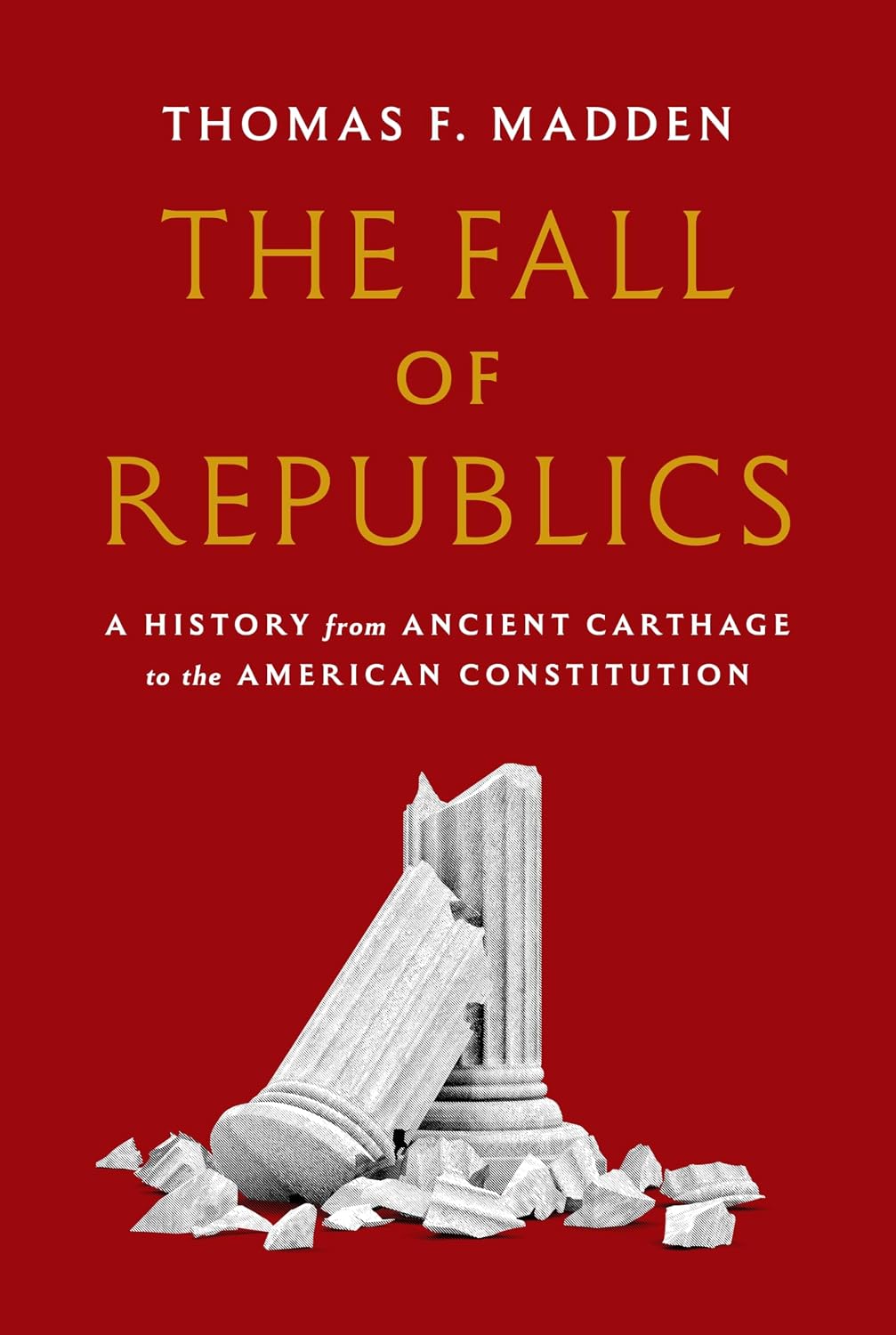
‘The Fall of Republics: A History From Ancient Carthage to the American Constitution’
By Thomas F. Madden
Princeton University Press: June 9, 2026
Hardcover, 448 pages
What arts and culture topics would you like us to cover? Please email ideas or feedback to features@epochtimes.nyc.