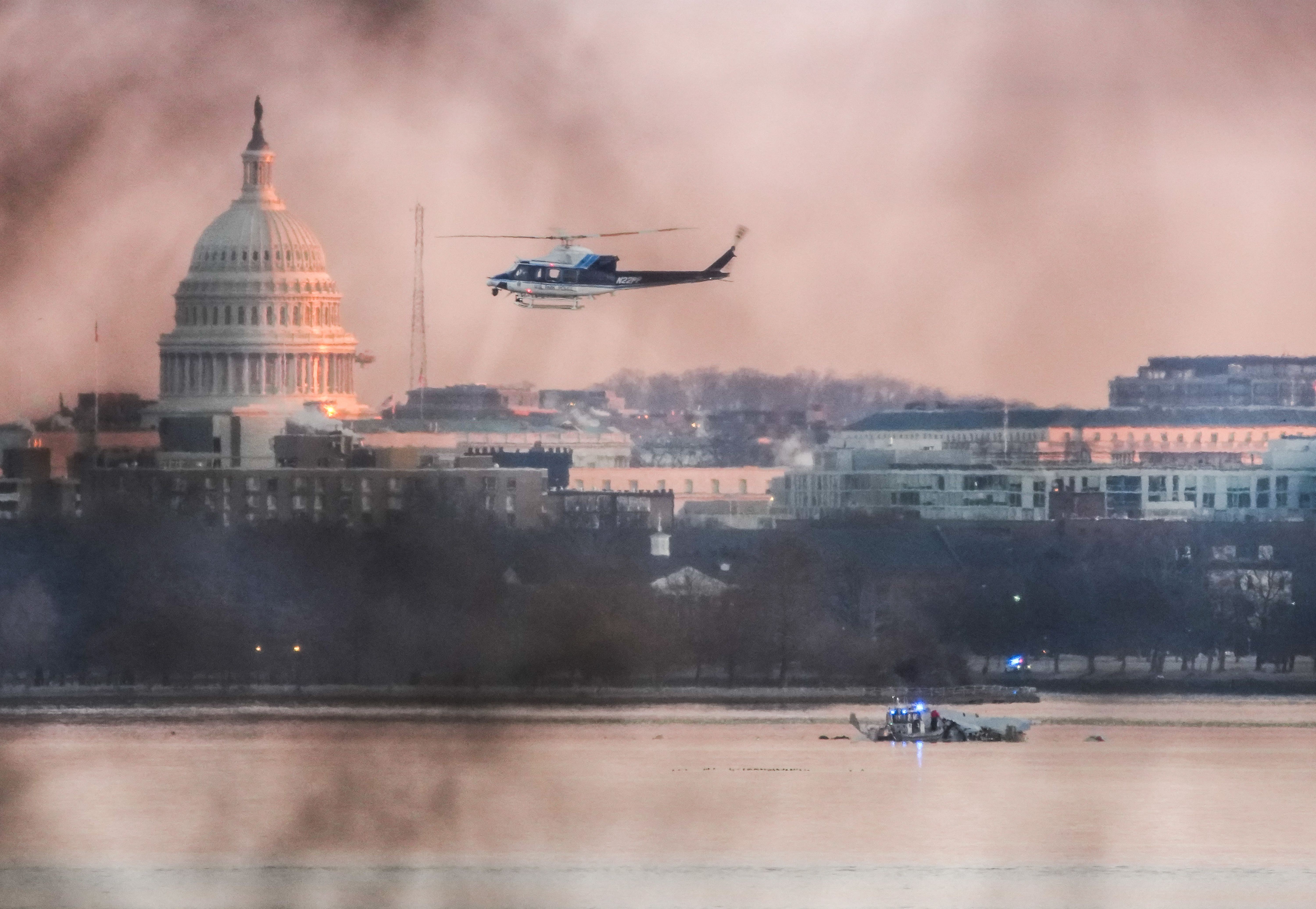
WASHINGTON—Three days of “fact-finding” hearings into a catastrophic crash between an Army Black Hawk helicopter and a commercial jet concluded on Aug. 1, with new information shedding light on the events leading up to the collision near Ronald Reagan Washington National Airport earlier this year.
The National Transportation Safety Board (NTSB), an independent agency tasked with investigating transportation accidents, has led the probe into the disaster, releasing preliminary reports in the months since the Jan. 29 crash.
The agency’s final report, which will reveal the probable cause of the accident, is expected next year.
The three-day “fact-finding” hearings hosted by the NTSB revealed critical details about the incident, including inconsistent altitude readings on the helicopter, persistent staffing issues at Reagan National’s air traffic control tower, and criticism concerning the Federal Aviation Administration (FAA) response to the disaster.
Here are seven revelations from the NTSB’s hearings into the midair collision.
Crew Had Inconsistent Readings
While the NTSB had already determined earlier this year that the helicopter was above its 200-foot maximum allowed altitude for its route along the Potomac River, new details this week revealed that its crew
was operating with incorrect altitude data.
The Sikorsky Black Hawk was equipped with a radio altimeter and a barometric altimeter.
The first, which uses radio waves to determine altitude, is considered more accurate.
However, panelists at the hearing on July 30 said the crew was trained to use the barometric altimeter, which uses barometric pressure to determine distance from the ground.
Throughout its flight, the crew called out elevations to air traffic control that were roughly 80 feet to 100 feet lower than what their radio altimeter was recording, the NTSB said.
Investigators also tested three other helicopters of the same model after the collision and recorded similar discrepancies between the two altimeters, with the differences in altitude increasing when the rotors were activated.
Struggled to Hear Air Control
Roughly two weeks after the collision occurred, the NTSB
announced that the helicopter crew likely did not hear a critical air traffic control instruction in the moments before the crash.
According to the aircraft’s cockpit voice recorder data, the controller’s instruction to “pass behind” the CRJ700 jet was “stepped on” when the crew engaged a microphone.
However, that was not the only time that the crew struggled to hear air traffic control.
At one point, the pilot asked her instructor if the control tower’s audio was muffled.
Then her instructor said after another exchange that he “definitely didn’t catch” what was said, and told the pilot, “I’m glad you did.”
Chair Rips Into FAA
Jennifer Homendy, chairwoman of the NTSB, did not hold back this week when grilling officials from the FAA.
Details emerged that a working group of air traffic controllers had suggested changes to the helicopter routes near Washington in 2022, but were told that the addition of new collision risk areas, including to the helicopter route implicated in the crash, was “too political.”
Homendy ripped into the FAA, criticizing its response to the disaster as overly bureaucratic.
“You know what FAA did after the accident ... you transferred people out, instead of taking ownership over the fact that everybody in FAA in the tower was saying there was a problem,” she said.
“Are you kidding me? Sixty-seven people are dead. How do you explain that?
“Fix it; do better.”
Helicopter Not Using Location Tech
A key location transmitting technology, known as ADS-B Out, was not engaged on the helicopter at the time of the crash.
The Army has a policy of disabling the tracking technology during certain flights in the Washington area, including on sensitive or classified missions with commander approval.
It wasn’t previously known if the Black Hawk crew had chosen to leave the technology off or if it was inoperable during the flight.
NTSB investigators determined that the ADS-B Out systems on the Army’s fleet of older Black Hawk helicopters were not working because of a time-setting issue.
While the army has purchased new ADS-B systems to upgrade its fleet, it’s not clear if using the technology would have helped avoid the crash.
Testimony on Aug. 1 indicated that the CRJ700 jet did not have ADS-B In, which is needed to receive ADS-B Out signals.
Since the crash, the FAA has mandated that all aircraft use ADS-B In and Out.
On July 29, Sen. Ted Cruz (R-Texas) introduced legislation that would mandate it on all aircraft.
The military would have to request an exemption to turn it off if Cruz’s bill gets signed into law.
Chronic Staffing Issues at Tower
While The Epoch Times has previously reported on the nationwide shortage of air traffic controllers in the years following the COVID-19 pandemic, new details this week revealed that the control tower at Reagan National was
chronically understaffed.
Nick Fuller, acting FAA deputy chief operating officer of operations, defended the staffing levels and suggested the control tower was nearly fully staffed on the night of the collision.
However, a contractor hired by the FAA to conduct compliance verifications at the airport’s control tower said it had “always been on the lower number of staffing, not necessarily healthy.”
He said the staffing was a “concern,” but was rebuffed when he called for adding another operations manager and staff specialist to assist with the tower’s workload.
An NTSB investigator also criticized the FAA for overworking its controllers with a “just make it work” mentality when fewer workers are available for high-demand tasks.
American Airlines Boosted Flights
The NTSB revealed that American Airlines had been increasing the number of its flights during specific times within the hour, a practice known as “front loading” and “back loading.”
Clark Allen, who was operations manager at Reagan National when the accident occurred, said it was a concern for air traffic control.
Conversations were conducted between the control tower and the airline’s scheduling team to address the schedule.
Eric Silverman, who is an air traffic control and airfield operations manager for American Airlines, said the scheduling increase happened in early 2022, and “then we made changes where we could within the FAA-mandated slot program.”
Robert Clifford, the attorney representing family members of the crash victims, criticized American Airlines for the flight load.
“The evidence presented thus far reveals that American Airlines’ actions to maximize [Reagan National] arrival rates and hourly operations that help drive its profits directly led to flight 5342 being switched from the runway one approach to the higher risk runway 33 approach where the runway was shorter and helicopter route 4 intersected the approach path,” Clifford told The Epoch Times. “This put all 67 people into a perilous and disastrous collision course.”
American Airlines did not respond to a request for comment.
FAA Allegedly Knew About Risks
The NTSB alleged that the FAA had known for years about serious safety risks in the airspace around Reagan National, especially with the inclusion of military aircraft flights.
“Every sign was there that there was a safety risk, and the tower was telling you that,” Homendy said.
Rick Dressler, an aviation site manager for Metro Aviation and a former Army aviator and retired Air Force officer, said his community was particularly concerned whenever the 12th Aviation Battalion was operating in the Washington airspace.
That is the same battalion that was operating the Black Hawk helicopter on the night of the crash.
“I don’t like saying that [the] 12th Aviation Battalion gives us all pause in the community,” Dressler said.
“We are all very uncomfortable” whenever that battalion is operating in the area, he said.
The Army did not respond to a request for comment.