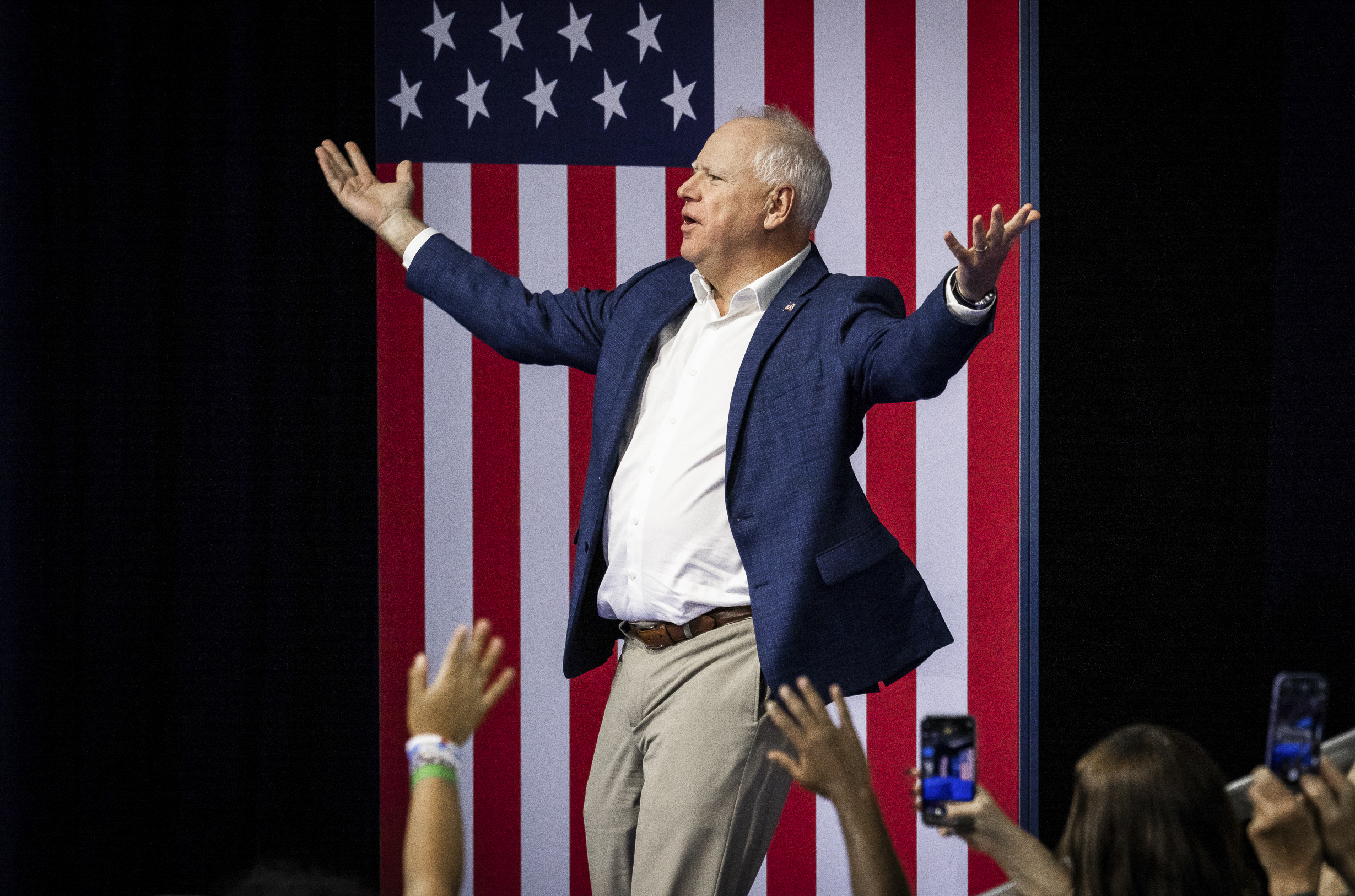

Minnesota Gov. Tim Walz, who was the Democratic vice presidential nominee in 2024, said during a speech on June 13 that his party needs to sharpen its message and reach more voters.
Speaking at an event hosted by the liberal Center for American Progress, Walz expressed alarm over recent developments, including the removal of Sen. Alex Padilla (D-Calif.) from a press conference Padilla interrupted that was being held by Department of Homeland Security (DHS) Secretary Kristi Noem.
Walz described the incident as part of a broader pattern of overreach—although DHS and the White House defended the actions as necessary.
Walz said he first learned about the incident while testifying before the House Oversight Committee.
“They were grilling us because we have committed, I guess, the incredible crime of treating people like human beings,” he said, describing a tense hearing on sanctuary state policies.
The governor, who served 24 years in the National Guard and sat on the House Armed Services Committee while in Congress, voiced particular concern about President Donald Trump’s deployment of federal troops to California over objections from state officials.
“It’s an inappropriate use,” Walz said, adding it was “unprecedented” and “dangerous.”
When asked about the direction of the country, Walz said, “We have to buckle up a bit.” Still, he expressed optimism that state-level leadership could offer a model of Democratic resilience, pointing to California Gov. Gavin Newsom’s “standing up” to the federal government.
While he did not announce any formal plans for higher office, Walz repeatedly emphasized the importance of Democrats engaging nationally.
“Every time they do a press conference, we need that press conference,” he said, urging party leaders to show “what the alternative is.”
The former congressman also defended his willingness to campaign in Republican-leaning areas.
“I think these town halls—going into these places—engaging people in nontraditional settings, is the way to do it,” he said.
He also weighed in on immigration, saying that, “Democrats need to seize upon what would we do about that,” adding that he thought the immigration debate “is a good one” for the party.
“We lead with our hearts, we lead with compassion, but we let them own that issue,” he said, adding that he and New York Gov. Kathy Hochul and Illinois Gov. J.B. Pritzker tried to emphasize in the hearing that they “comply with federal law” but don’t notify DHS until someone has “gone through due process.”
“If someone is arrested and is a convicted felon, before they are released, we call DHS,” he said. “That doesn’t make us horrible people. That has us following federal law, but what we don’t do is when someone has not had due process yet, we don’t call ICE, we don’t call DHS, because they haven’t gone through due process yet.”
He added, “If we do call DHS and they don’t come, we’re not going to hold them forever waiting for you to come because they’ve gone through their due process, they’ve served whatever they needed to do in Minnesota.”
The governor also answered questions about rural outreach, bipartisanship, and young voter engagement. When asked how Democrats could reconnect with rural working-class voters, Walz acknowledged party challenges.
Walz said division between rural and urban communities has been stoked, and that he believes Americans have been separated as “‘real America’ versus the big cities run by liberals.”
“Folks who are born in cities are afraid to go to small towns, small-town people are afraid of the cities,” he said.
Walz said the Democratic Party must reclaim its identity as the party of labor and working people. He said characterizations of him as an “elite” were misplaced.
“I grew up in a town of 500 people, 24 classmates, 12 cousins, went to state school,” he added. “They don’t see me.”
Walz has previously ruled out a campaign for the open U.S. Senate seat in Minnesota, which Sen. Tina Smith is vacating in 2026.
A spokesperson said in February that Walz “loves his job as governor” and is considering seeking a third term. Minnesota has no term limits for governors.