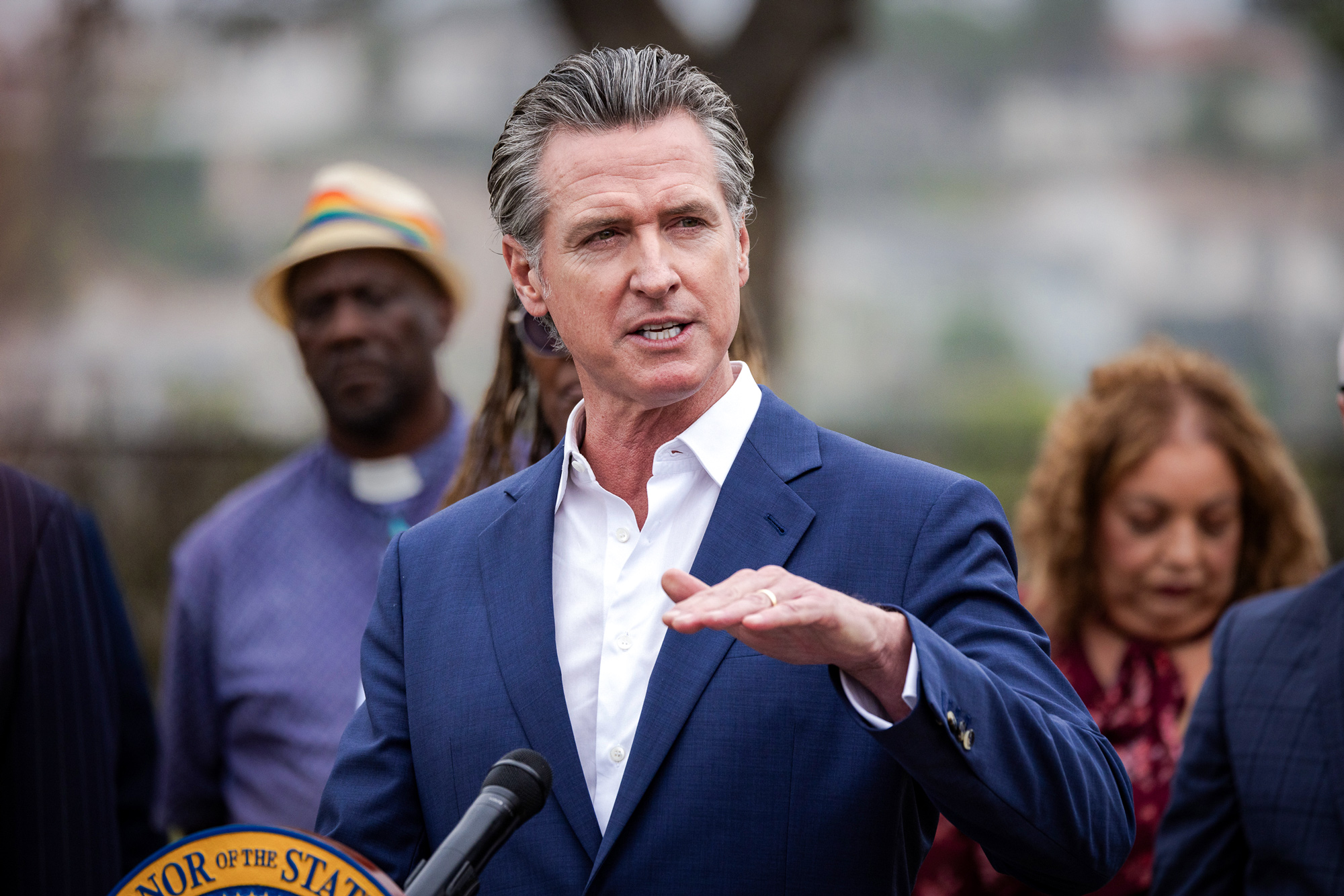
California Gov. Gavin Newsom has unveiled a proposal to increase the state’s ability to oversee the AI industry and impose stricter regulations, framing it as a model for the nation to follow.
Newsom, who is term-limited, presented the 85-page proposal during a trip to the nation’s capital. The plan, which builds upon the state’s existing AI safety framework, would grant California officials emergency shutdown authority in if there is “imminent risk from AI models of a catastrophic event or major loss-of-control event that the developer cannot or will not address,” the proposal states.
“Two-thirds of all the large AI companies, in terms of market cap, are in the state of California, the center of this debate,” Newsom said in a Wednesday video posted to X. “So we’re also the center of the responsibility to address, in the absence of any federal leadership … the anxiety that all of us are feeling.”
He cited recent technology outages—including at various banks, Microsoft, the Federal Aviation Administration, and the National Security Agency—that he said have sparked concerns and a need for guardrails to guide how the tech industry continues to develop.
According to the governor’s office, it is the state, instead of individual companies, that should establish the baseline standards for all AI companies to follow, including required independent safety testing and verification at each stage of AI model training, development, and deployment.
“The Governor is calling on Congress and President Trump to review and adopt the state’s framework, or use its nation-leading regulation as a floor, not a ceiling, for the benefit and safety of all Americans,” Newsom’s office stated.
The report describes recommendations in four areas: establishment of safety standards, independent verification organizations, critical safety incident reporting, and emergency shutdown requirements.
The proposal encourages establishing safeguards against the potential for AI models to be misused on a large scale.
“Bad actors seeking to misuse AI models for chemical or biological weapons or for cybercrime will use the models with the weakest safeguards,” the report states. “The state should set general criteria for safeguards that [independent verification organizations] can develop against chemical, biological, and cyber misuse of models that developers serve via the cloud.”
It also recommended that the state be able to cap the use and development of recursive self-improvement to limit AI models from developing AI without human input.
The report also called for more transparency between frontier AI companies and the public to better assess AI risks.
Newsom had ordered state agencies to fast-track the implementation of two bills signed earlier this year, according to the press release.
Senate Bill 813 establishes a framework for independent verification organizations to conduct safety and risk assessment of AI systems. Assembly Bill 1405 created a state registry for auditors who assess AI systems and established standards for their independence and integrity.
Newsom appointed four experts to give advice for the report: former White House Chief Digital Officer Jason Goldman, Johns Hopkins University professor Gillian Hadfield, former acting director of the Office of Science and Technology Policy Alondra Nelson, and Stanford professor Rob Reich. They explored options for companies and the state to shut down dangerous AI models before they can cause more harm.
Potential shutdown capability examples include separate control systems to revoke credentials, tamper-evident logs of all actions the models take, automatic pauses when oversight systems are compromised, and limiting sensitive information access to only staff who need it.
Newsom’s proposed framework follows a string of legislation signed in recent years to regulate the AI industry. His 2023 executive order required reporting and risk assessments on generative AI. In the following years, he signed legislation on AI transparency and oversight, safeguards for children, and bans on deepfakes, among other things.
However, as Newsom’s governorship ends at the beginning of next year, Gov.-elect Xavier Becerra and the new state lawmakers will decide whether to build on or shelve the proposal.