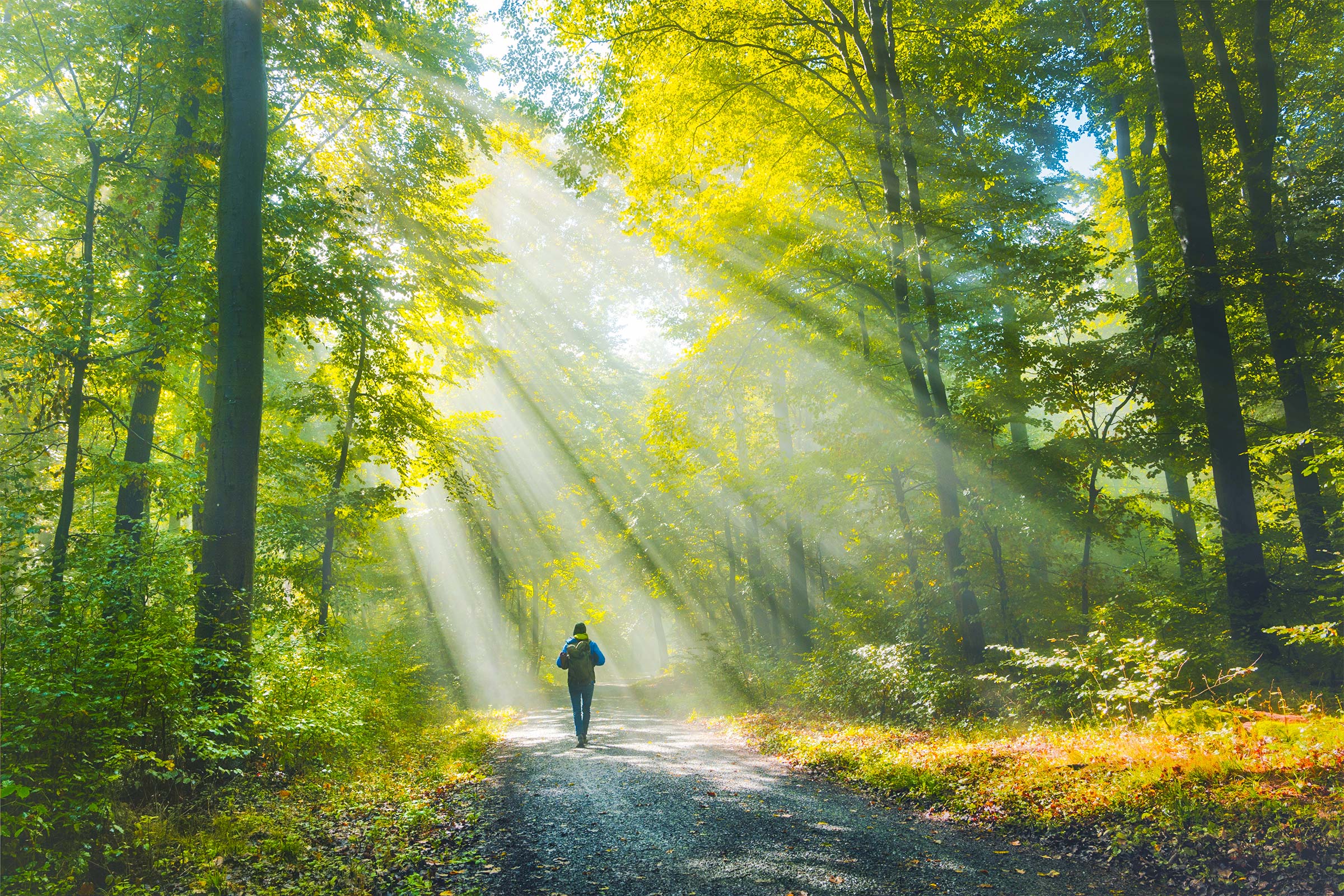
You’ve likely noticed it: You step into a forest, stand by the ocean, or pause beside a stretch of trees—and something shifts. Your shoulders loosen. Your breathing slows. The mental noise softens.
That calming effect can feel almost automatic—which may be why people have been turning to nature when they need a break for centuries.
Only now are scientists beginning to map, in precise neurological detail, exactly what’s going on inside the brain during those types of experiences.
A scoping review of more than 100 peer-reviewed brain-imaging studies, published in Neuroscience & Biobehavioral Reviews, offers one of the most comprehensive neurological pictures yet of how nature affects the human brain.
The results showed that exposure to nature doesn’t merely feel restorative—it triggers a measurable cascade of changes that quiet the brain’s stress circuitry, replenish depleted attention, and produce neural states that closely resemble those seen during meditation.
A Cascade Toward Calm
The review, which drew on studies ranging from real-world outdoor exposure to laboratory photos and videos, immersive virtual reality, and indoor greenery, found a consistent pattern across methods and neuroimaging techniques: Natural environments shift the brain toward a calmer, more regulated state.
Constanza Baquedano, the study’s corresponding author and an assistant professor of psychology at Universidad Adolfo Ibáñez in Chile, told The Epoch Times the team proposes that nature’s effects on the brain unfold in a cascade across several interconnected levels, although she frames this as a working model rather than settled science.
“These levels interact dynamically: Sensory features of nature initiate the cascade, which then propagates through stress regulation, attention, and ultimately how we experience ourselves,” she said.
1st Level: What Your Eyes Are Doing
The first stage of the cascade begins with how the brain processes what it sees. Natural environments contain
patterns such as fractals—self-similar structures seen in leaves, tree branches, and coastlines—that the brain can process efficiently. Because these structures align with how the visual system organizes information, they require less effort for the brain to interpret.
“This reduces perceptual load in early sensory areas like the visual cortex,” Baquedano said.
Studies suggest that the visual characteristics of nature can influence how strongly the brain responds. Scenes with deeper green tones and more coherent natural layouts have been linked to stronger relaxation and mental restoration, while fractals and other natural patterns appear to promote brain activity associated with relaxed attention and meditative states.
2nd Level: Turning Down the Stress Response
As the brain processes natural scenes with less effort, activity in the stress and threat-detection systems begins to ease.
Brain imaging studies have consistently shown reduced activity in limbic regions involved in stress and threat detection, particularly the amygdala, as well as reduced activation in parts of the prefrontal cortex linked to rumination and cognitive strain.
These brain changes are mirrored in the body. Studies measuring heart rate variability, a marker of how flexibly the heart responds to stress, found increases following exposure to nature. Higher heart rate variability reflects stronger parasympathetic activity, the body’s “rest and digest” system that counterbalances the “fight or flight” stress response.
These changes suggest that natural environments quiet the brain’s stress circuitry while shifting the body toward physiological recovery.
3rd Level: Restoring Attention and Quieting the Inner Voice
With stress reduced and sensory load lowered, nature then helps replenish the brain’s directed attention systems after they become fatigued by sustained mental demands such as prolonged concentration, problem-solving, decision-making, and maintaining focus throughout the day.
Brain scans showed increases in alpha-theta activity, patterns associated with relaxed, inward-focused attention and reduced cognitive load.
“Nature tends to engage what psychologists call soft fascination—a gentle, involuntary form of attention that allows directed attention systems in the prefrontal cortex to recover,” Baquedano said.
This type of mental restoration may also quiet the brain’s default mode network, a system involved in self-focused thinking and, when overactive, repetitive negative thought.
These shifts may help explain why time in nature often feels mentally clarifying. Several studies in the review also reported reduced rumination following exposure to nature, suggesting a shift away from repetitive negative thoughts toward a calmer, more integrated state.
Like Meditation—Without the Training
EEG studies in the review repeatedly showed that exposure to nature produces brain patterns similar to those seen in meditation.
These include increases in frontal alpha waves linked to calm wakefulness and inward-focused attention, as well as heightened theta activity associated with deep relaxation and sustained focus. Researchers also observed reduced activity in stress-related circuits.
Some studies suggest that these effects can emerge after about 30 minutes to 90 minutes in quiet natural settings such as forests or parks, while other research suggests that measurable shifts can occur far sooner. EEG recordings have detected relaxation-related changes within as little as three minutes of exposure to natural environments.
Physiological responses may begin even faster, according to Yoshifumi Miyazaki, a Japanese researcher and pioneer of forest therapy whose decades of work have helped establish the scientific basis of “shinrin-yoku,” or forest bathing.
“In our evidence, we observe a calming of prefrontal cortex activity within a few seconds after exposure,” Miyazaki said.
He said that parasympathetic activity increased within about 30 seconds.
According to Baquedano, the key factor may be the type of attention the environment invites. In this sense, nature can act as a “scaffold” for mindful awareness, even for people without formal meditation training.
“Environments that allow people to slow down, walk quietly, and engage their senses—rather than highly stimulating or crowded settings—are more likely to support mindfulness-like states,” she said.
Repeated Exposure Supports Resilience
Growing evidence suggests that regular contact with nature may have cumulative brain benefits.
Large-scale neuroimaging studies have found that people living in greener environments often show structural differences in brain regions involved in stress regulation, emotional processing, and cognitive control, suggesting that repeated restorative experiences may gradually reshape the brain in ways that support long-term resilience. Similar patterns have been observed in educational settings and among adults who regularly exercise outdoors.
Small but repeated exposures may matter as much as long retreats, Baquedano said.
“The brain seems to respond not only to dramatic wilderness experiences but also to consistent everyday contact with green environments,” she said.
Although the ideal “dose” of nature is still being studied, frequent exposure several times a week combined with occasional longer immersive experiences may be especially beneficial for supporting stress regulation, mood, and attention, she said.
However, Miyazaki told The Epoch Times that the idea of a strict “dose-response relationship” may not fully capture how nature affects the body.
Individual preferences and physiological differences mean responses vary widely from person to person, Miyazaki said. His team has also identified what they call a “physiological adjustment effect”: Nature appears to regulate the body toward balance rather than producing a single uniform response. For example, forest walks may lower high blood pressure while raising unusually low levels.
The review also found that people with a stronger psychological bond with the natural world, which researchers call “nature connectedness,” tended to experience stronger restorative effects, suggesting that our relationship with nature may shape how deeply it can restore us.
Real Nature Beats a Screen
Even simulated or indoor forms of nature can produce measurable cognitive and emotional benefits. Plant walls, natural lighting, and nature-themed imagery all showed reductions in stress compared with standard built environments, findings that may have implications for offices, hospitals, and schools.
However, direct exposure to natural environments tends to produce stronger, longer-lasting effects.
Researchers attribute this to the multisensory richness of real settings, where tactile sensations, natural scents, dynamic visual patterns, and ambient sounds interact in ways that indoor or digital simulations still cannot fully replicate.
Miyazaki pointed to one key advantage of real environments that is easy to overlook: They are never quite the same twice, which makes virtual environments inferior to real forest bathing experiences. Despite this, he said virtual environments also have clear advantages.
“They are easy to use, can be tailored to preferred sensory modalities, and can be modified effortlessly,” he said.
More Than a Wellness Trend
The brain benefits of authentic natural environments underscore the need to treat access to nature as a fundamental component of public health infrastructure, Baquedano said.
From a neuroscience perspective, she added, natural environments are not merely aesthetic amenities. “They are contexts that help regulate stress, restore attention, and support mental well-being at a population level.”
That means embedding contact with nature into the everyday functioning of cities, Baquedano said, including “tree-lined streets, green corridors, urban parks, and natural elements integrated into the paths people take when moving from home to work, school, or other daily activities,” so that the restorative effects of nature aren’t reserved for those with the time and resources to seek them out, but available to everyone, every day, as a matter of course.
Investing in urban nature is also an investment in collective brain health, she said.