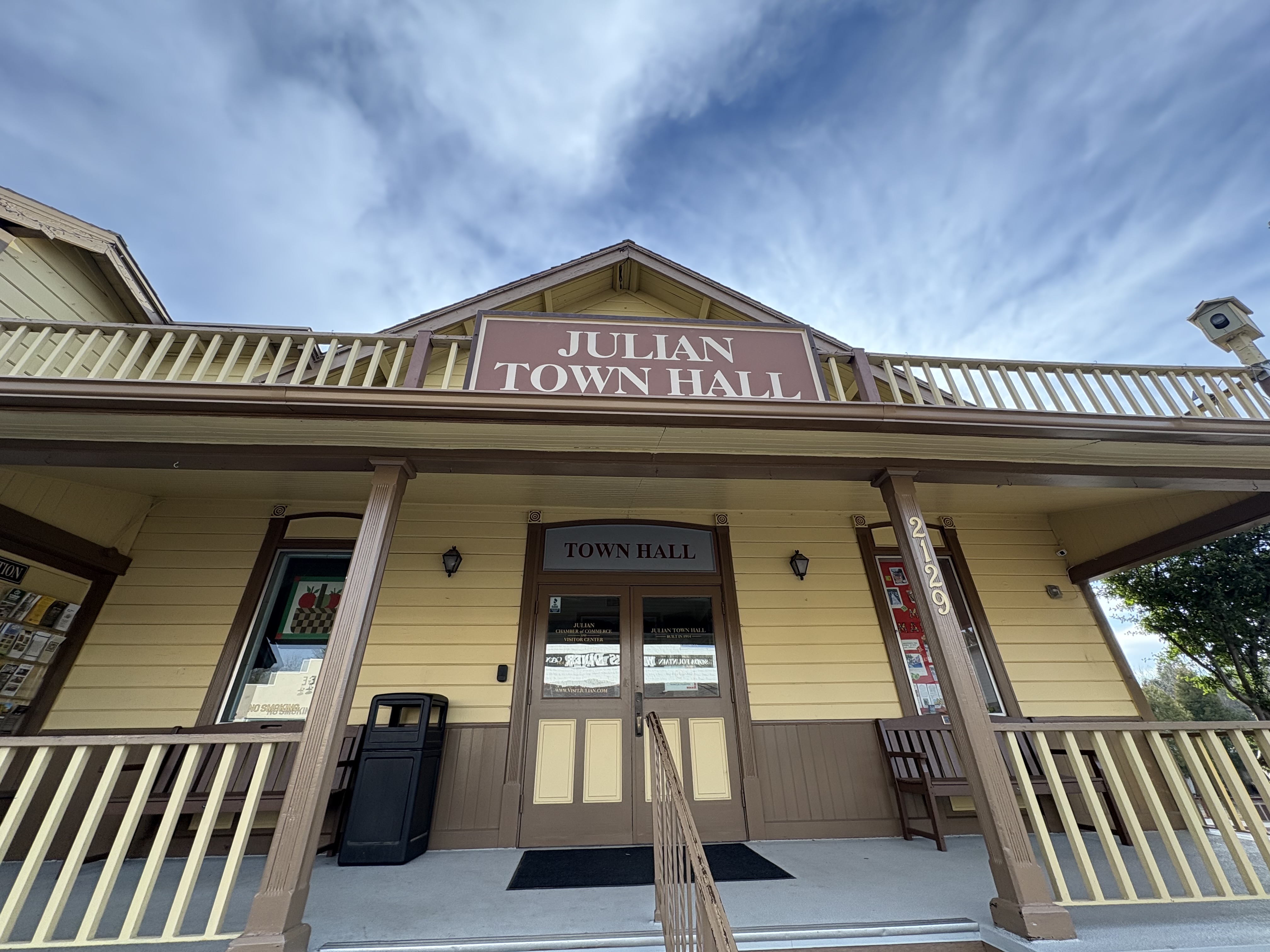

Squint your eyes in Julian, California, and it’s easy to imagine this western town as it was in the 19th century. Historic wood-sided buildings with metal awnings abound in this quaint town tucked into the rolling hills of San Diego County’s far reaches. In fact, it’s a living history town, with a walking-tour map that includes plenty of reminders of simpler days.
Encompassing just 7.8 square miles, Julian sprang up as a small gold-mining town for a short time in the late 1800s. In 1873, a settler named James Madison had the foresight to plant apple trees around the town, due to the area’s 4,000-foot elevation and temperate climate. Gold mining wound down around 1900, but high yields of apples put Julian on the map as an “apple town.” Soon, it was regionally famous for its bakeries, which sold apple pies.
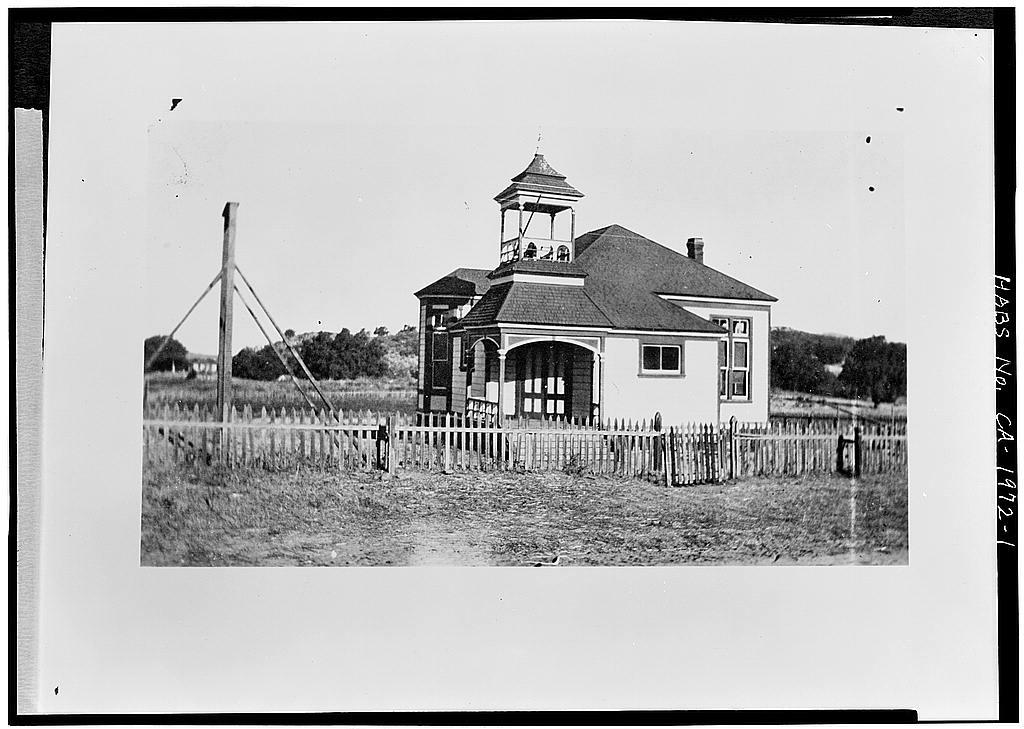
A photograph of the Santa Ysabel School in 1890, Library of Congress. (Public Domain)
Delicious Roots
On the walking tour are plenty of false-front-style buildings with the business names lettered above the awnings. The popular false-front style was established in the 19th-century West and is indicated by a two-story vertical façade that conceals a gabled roof. Some of the old stores on the tour, like the Wilcox Building, sport historical markers.
The Wilcox building, crafted in 1872 of hand-hewn beam logs from nearby Volcan Mountains, has been a general mercantile store, post office, stage coach stop, and telephone exchange (switchboard office). Today, a shop selling locally made goat-milk soaps and lotions occupies the building.
However, most enticing for history lovers is the Julian Pioneer Museum and Santa Ysabel School. They are both located just around the corner from Main Street’s historic Town Hall. Originally built in 1890 as a smithy, or blacksmith shop, the wood-shake-siding, barn-style Pioneer Museum houses countless artifacts from life in the 19th and early 20th centuries.
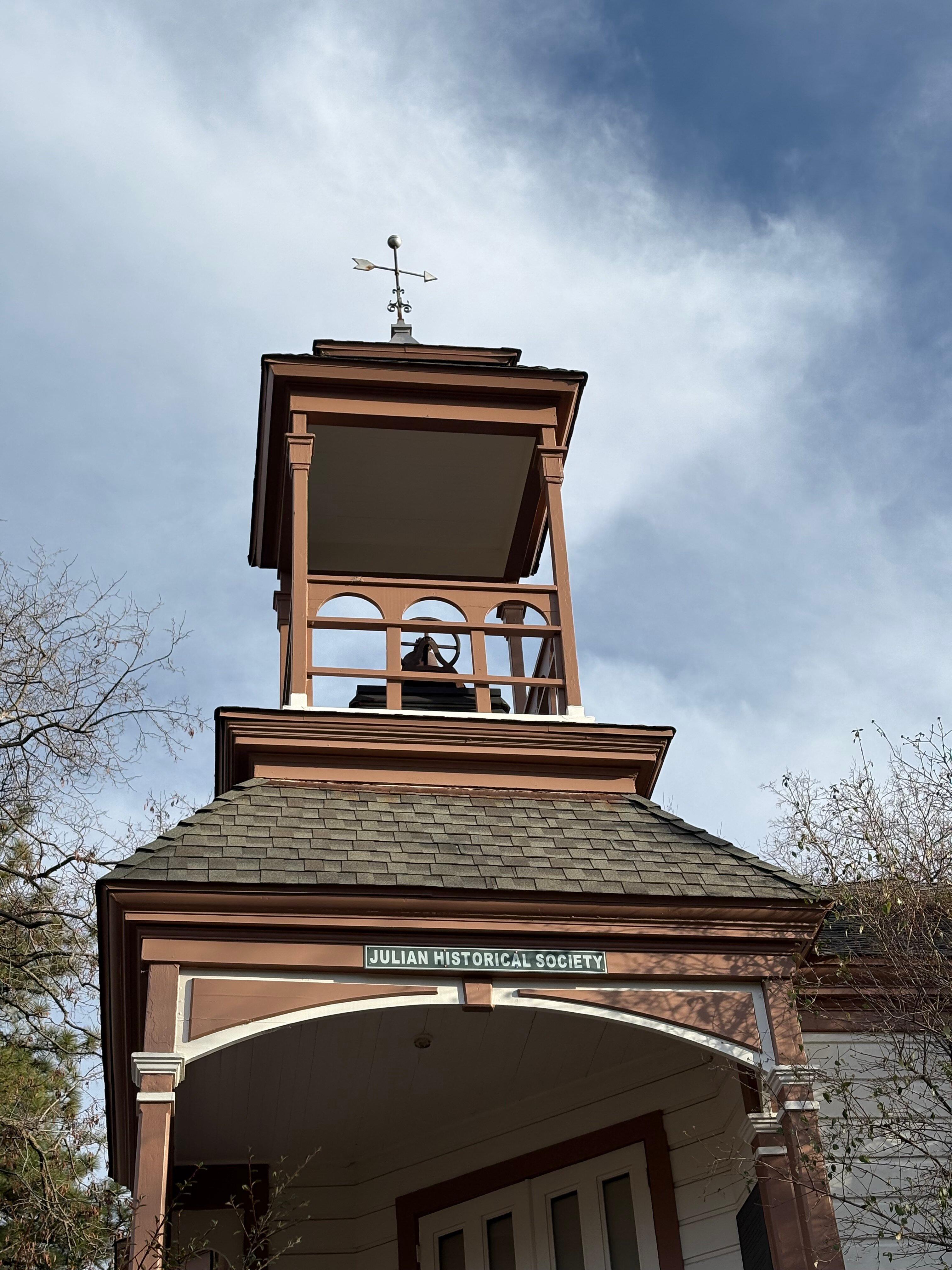
The bell tower on the one-room schoolhouse, which is now the Julian Historical Society, in Julian, Calif. (Deena Bouknight)
Just next door is a one-room schoolhouse that was constructed in 1888. It’s the last one that still stands in the 4,206-square-mile county. The school’s official name was Santa Ysabel, named for the valley in which Julian sits. Locals and regular tourists know it as the Witch Creek School, because of the creek beside its original location, 10 miles away, before it was moved to its current location in 1969.
The first through eighth grade, one-teacher school operated until 1954 and eventually became a library. Today, it houses the Julian Historical Society. Perched on a hill on Julian’s 4th Street, the school has more impressive architecture than that of the simple and practical false-front buildings dominating the town. Its main feature is a weathervane-topped bell tower with slender columns. An arched entryway, adorned with a capstone, is held up by square columns with Tuscan capitals. An octagon-shaped room is another distinct feature.
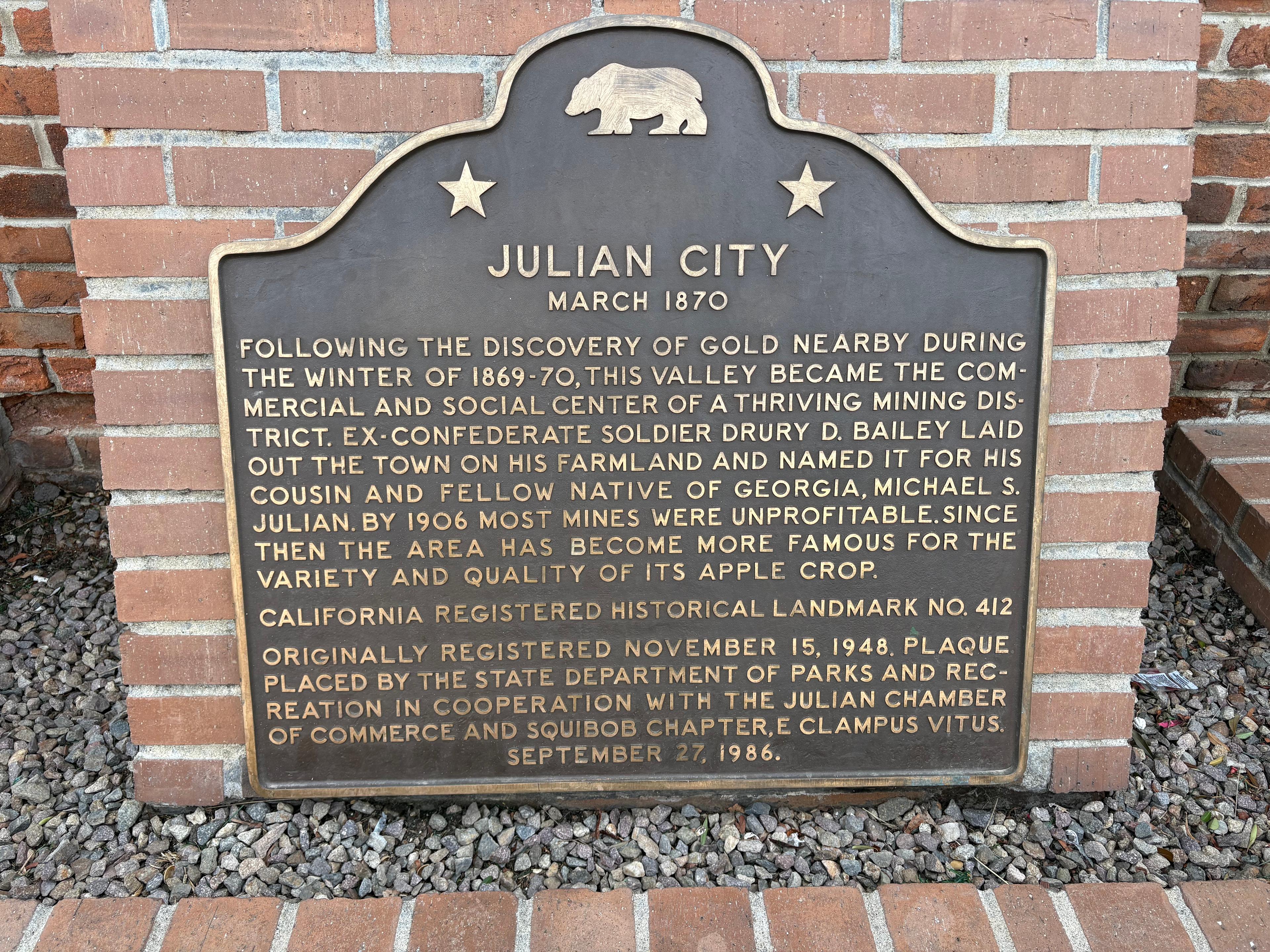
A historical marker in Julian, Calif., explains the history of the town. (Deena Bouknight)
Inside the building is a working wall clock that is the same age as the building. Student desks are lined up in rows. A teacher’s desk, globe, and chalk boards provide a realistic presentation of a one-room schoolhouse setting.
The town is 60 miles from San Diego, and the drive through parts of the Cleveland National Forest and Cuyamaca State Park provides vast views of mostly uninhabited desert-like and rugged mountainous terrain—before the road levels out somewhat and leads to the charming, off-the-beaten-path historic town.
In the fall, many apples varieties grown in long-established orchards and upwards of 10,000 apple pies are sold to visitors. In addition, anyone whose with historical sensibilities won’t be disappointed in Julian.
What arts and culture topics would you like us to cover? Please email ideas or feedback to features@epochtimes.nyc