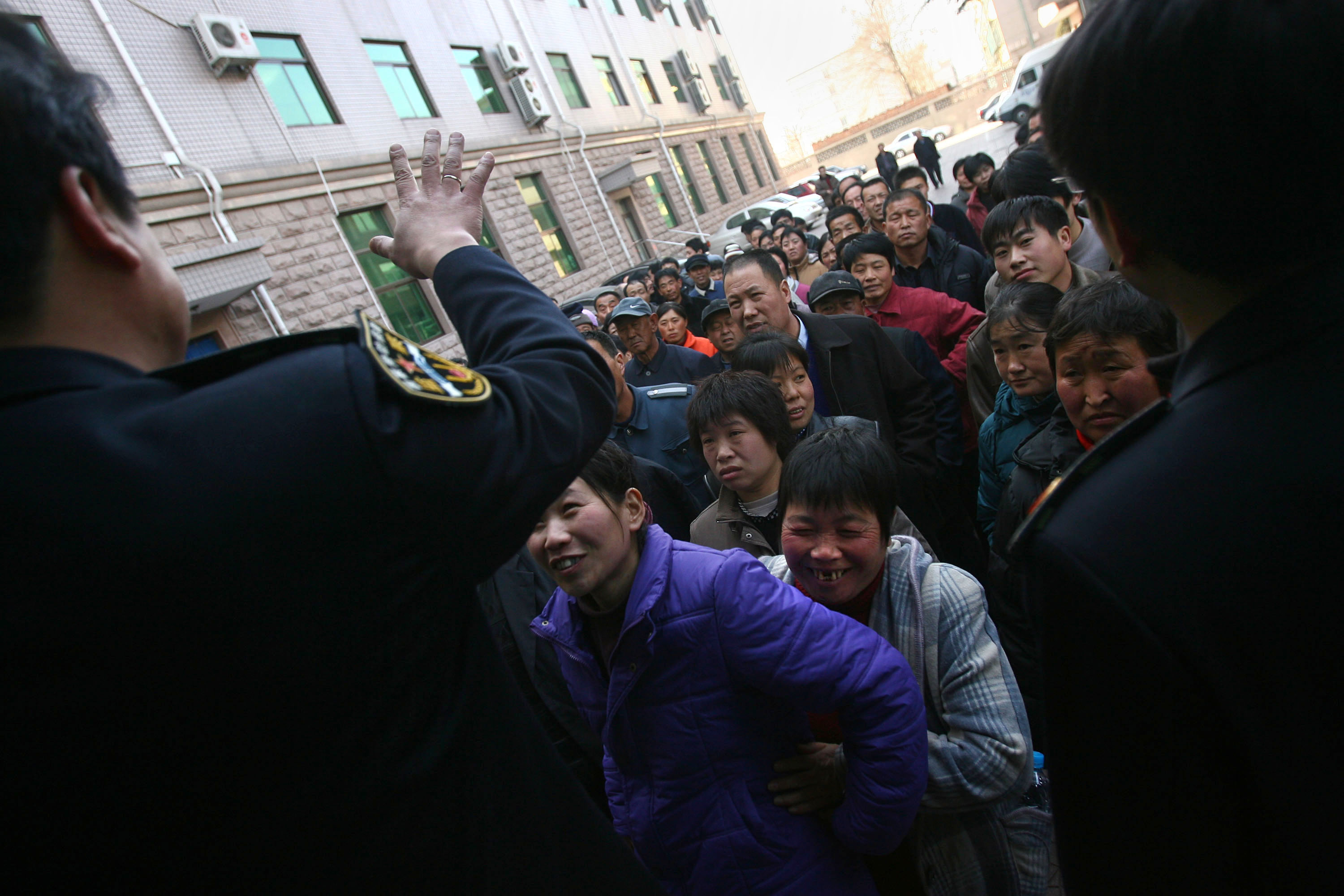

As Lunar New Year approaches, workers across China are taking to the streets over unpaid wages, adding pressure on businesses already strained by a slowing economy and on local authorities tasked with keeping order.
The timing of these protests is sensitive. The weeks before Lunar New Year are typically when migrant workers expect to receive back pay before returning home. This year, however, workers in multiple cities have said that wages have gone unpaid for months. China-based observers told The Epoch Times that the disputes reflect a slowing economy that is squeezing companies’ cash flow and making it harder to meet payroll.
Videos circulating on X and other social media platforms show protests across multiple provinces on Feb. 8. In several cases, workers gathered outside government buildings seeking help but received no response.
In Bagong township, in Jincheng city, Shanxi Province, workers sat at the entrance of the township government building to protest unpaid wages for a project and called on officials to intervene.
In the same province, workers waited inside the Shaanxi Construction Engineering Group Corp. office over wage arrears.
In Xinyi city, in Maoming, Guangdong Province, workers gathered at the marketing center of Wanda Plaza in the Yudu New District, demanding payment of outstanding wages.
At Jinshan North Railway Station in Shanghai’s Jinshan District, a project linked to China Railway Signal & Communication Corp. was accused of failing to pay workers, according to videos dated Feb. 8.
In Shaanxi Province, workers blocked the entrance of Shaanxi Shanjiao Chemical Industry Co., Ltd. At Xi’an Metro, workers gathered at the company’s entrance to demand unpaid wages. In Hanzhong, workers went to the city’s petition bureau to report wage arrears and seek the authorities’ intervention, but to no avail.
In Chengdu, in Sichuan Province, workers involved in a project run by China Gezhouba Group Second Engineering Co., Ltd., climbed to elevated areas of a building in an apparent attempt to pressure the company to provide unpaid wages.
On Feb. 4, workers gathered outside Yalei Exploration Shenzhen Co., Ltd., in Shenzhen, Guangdong Province, alleging that the company withheld pay. Footage shows workers standing at the building entrance while security personnel holding riot shields block the doorway.
“Our wages have been unpaid for several months. We just want to get back the money we earned,” one protester can be heard saying in the video.
Beyond wage arrears, some areas have reported factory shutdowns or company executives becoming unreachable. In recent years, delayed payments for construction and commercial projects have led to bankruptcy or liquidation for some companies. In some cases, company heads have disappeared, leaving workers with little chance of recovering their owed wages.
Broader Economic Slowdown
Liu, a Beijing-based scholar who studies migrant worker issues, linked the wage disputes to broader economic pressures.
“When the economy slows, investment declines, and payment cycles lengthen, small and medium-sized enterprises face broken capital chains and inevitably struggle to pay wages,” he recently told The Epoch Times on the condition of providing only his surname because of fear of reprisal.
“Of the companies that invested in recent years, more than 90 percent are now operating at a loss. If they have no money themselves, how can they pay workers?”
Wang, who has worked with the Shenzhen Chunfeng Labor Dispute Service Center and closely follows labor rights cases, said the period before the Lunar New Year is typically a peak season for wage disputes.
“Recently, there have also been such incidents in Guangdong,” he told The Epoch Times on Feb. 10 on the condition of providing only his surname because of fear of reprisal. “We just received a request for help from Huizhou, where a factory shut down and workers couldn’t obtain compensation.”
When asked whether foreign-funded enterprises face similar problems, Wang said: “So far, I haven’t heard of foreign factories—such as Japanese or American companies—having similar problems. Most Hong Kong- and Taiwan-funded enterprises have already left.”
China’s central authorities have announced inspections ahead of the lunar holidays to check for unpaid wages and ensure that migrant workers are paid on time. The State Council has required local governments to implement a winter campaign to address wage arrears, crack down on illegal wage withholding, and prioritize payments to migrant workers.
However, Liu said that in practice, local governments often side with businesses and overlook the interests of migrant workers.
Labor-related protests are not limited to construction or industrial workers.
Videos circulating online show dozens of former privately employed substitute kindergarten teachers gathered outside the Zhejiang Provincial Department of Education. They chanted slogans and called on authorities to address what they described as a lack of retirement support.
The footages show protesters shouting, “Restore our years of service,” and “We have no money for food.”
Some of the teachers said that because they had worked for decades, authorities should retroactively pay pension and social security contributions for those years and include them in the unified social security system.
In one video, one person at a protest site said: “Not only us—everyone who has worked in the past should be unconditionally included in the social security system. Farming is also work.”
Since January, collective protests have continued in multiple regions across mainland China.
Among the various regulations announced by authorities to take effect this year, Wang said, none have been highlighted as specifically aimed at protecting citizens’ rights. He added that the Chinese communist regime’s legal system is more often used to safeguard the interests of the authorities and to prevent social unrest.
Xing Du contributed to this report.