
TAIPEI, Taiwan—The United States and Taiwan signed a reciprocal trade agreement on Feb. 12, setting a 15 percent U.S. tariff on Taiwanese imports, while granting preferential access to Taiwan’s market for U.S. industrial and agricultural goods, including beef, dairy, pork, wheat, and automobiles.
U.S. Trade Representative Jamieson Greer said in a statement that the signing will expand export opportunities to Taiwan for American farmers, ranchers, fishermen, workers, small businesses, and manufacturers.
“This agreement also builds on our longstanding economic and trade relationship with Taiwan and will significantly enhance the resilience of our supply chains, particularly in high-technology sectors,” Greer said.
The trade deal will remove Taiwan’s tariffs up to 26 percent on a range of U.S. agricultural imports, including beef, corn, and dairy. However, some tariffs, including the 40 percent tariff on pork belly and 32 percent on ham, will be cut to 10 percent, according to the official tariff schedule.
Taiwan will remove nontariff barriers on motor vehicles, medical devices, and pharmaceuticals and will accept U.S. auto safety standards, according to a document from the Office of the U.S. Trade Representative.
Under the agreement, Taiwan is committed to significantly increasing its purchases of U.S. goods from 2025 through 2029, including $44.4 billion of liquefied natural gas and crude oil, $15.2 billion of civil aircraft and engines, and $25.2 billion of generators, power equipment, marine equipment, and steel-making equipment, the USTR’s office said.
“President [Donald] Trump’s leadership in the Asia-Pacific region continues to generate prosperous trade ties for the United States with important partners across Asia, while further advancing the economic and national security interests of the American people,” Greer said.
The trade deal formalizes an agreement that the two sides announced in January that would lower tariffs on goods from Taiwan to 15 percent from the 20 percent initially imposed by Trump. The 15 percent rate puts Taiwan on an equal footing with two close neighbors, South Korea and Japan.
Under the January agreement, Taiwan pledged that its technology companies would invest $250 billion in semiconductors, energy, and artificial intelligence (AI) innovation in the United States, along with an additional $250 billion in credit guarantees provided by the Taiwanese government.
The final language of the trade deal did not provide more details on those investments. However, it stated that Taiwan’s representative office in the United States, called the Taipei Economic and Cultural Representative Office, would collaborate with U.S. authorities to “facilitate additional new greenfield and brownfield investments ... in strategic high-technology manufacturing sectors, including AI, semiconductors, and advanced electronics.”
Rep. Adrian Smith (R-Neb.), chairman of the House Ways and Means trade subcommittee, said the trade deal has “strengthened one of [the United States] most important partnerships in the Indo-Pacific,” according to his X post on Feb. 12.
“I appreciate the administration’s leadership in securing a strong agreement that advances our economic and national security interests,” Smith said.
Taiwan
Under the trade deal, Taiwan’s semiconductors and related goods are granted preferential treatment under Section 232 of the U.S. Trade Expansion Act, according to a statement from Taiwan’s top administrative body, the Executive Yuan.
Additionally, 2,072 product items will be exempt from reciprocal tariffs and will face only the most-favored-nation tariff rate when exported to the United States, the Executive Yuan said. Of these, 261 are agricultural products, including Phalaenopsis orchids, tea, coffee, pineapple cakes, guava, fruit juices, jams, pineapples, and mangoes. These agricultural items account for about 42 percent of Taiwan’s total agricultural exports to the United States, or about $374 million per year, it stated.
The remaining 1,811 product items are industrial goods, including radio navigation equipment, communication instruments, lithium-ion batteries, pharmaceuticals, fertilizers, light oil products, and printed materials, the Executive Yuan said. Together, these industrial goods account for about 36 percent of Taiwan’s total industrial exports to the United States, or roughly $9.56 billion annually.
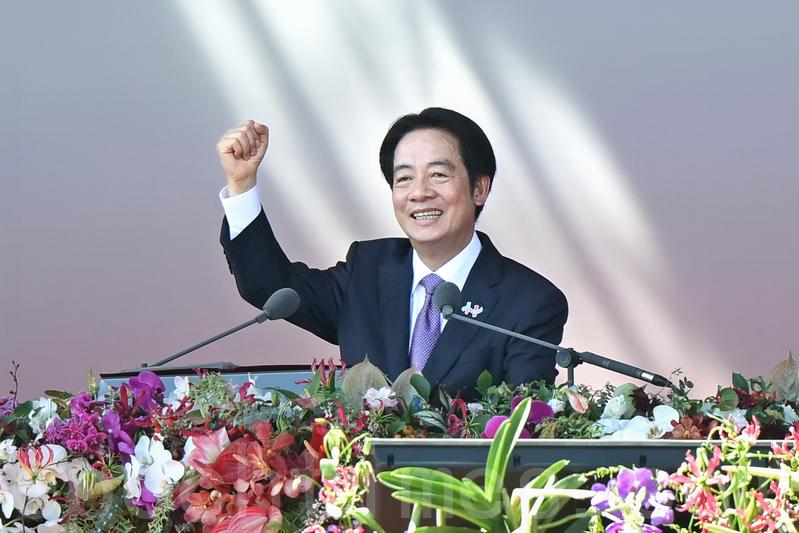
Taiwanese President Lai Ching-te delivers his address during National Day celebrations in front of the Presidential Office in Taipei, Taiwan, on Oct. 10, 2025. (Sung Pi-lung/The Epoch Times)
Taiwanese President Lai Ching-te, who hosted a press conference at the Presidential Office Building on Feb. 13, said that exemptions on the 2,072 product items meant that the average tariffs on U.S. exports will decrease to 12.33 percent.
Lai emphasized that the trade deal also takes into account the need to protect the island’s food security and maintain industrial resilience, ensuring that tariffs on 93 Taiwanese product items will either remain unchanged or be partially reduced.
“Among the major trading partners of the U.S., Taiwan has secured the largest reduction in reciprocal tariffs and the most favorable treatment under Section 232,“ Lai said, according to a translation provided by the Presidential Office. ”This completely reverses the longstanding trade disadvantage caused by the lack of [a free trade agreement] between Taiwan and the U.S., while also creating significant potential business opportunities for our agricultural and traditional industries to enter the U.S. market.”
The trade deal, along with the investment pledge in January, will result in “accelerating the transformation and upgrading of Taiwan’s industries and economy, as well as deepening the Taiwan-U.S. economic and trade strategic partnership,” Lai said.
The trade deal will need to be approved by Taiwan’s parliament, officially known as the Legislative Yuan, where the opposition has a majority.
Lai’s ruling Democratic Progressive Party and the opposition are mired in a rare political crisis. The opposition, which consisted of the Kuomintang party (KMT) and its much smaller ally, the Taiwan People’s Party, has used its majority in the parliament to block key government proposals, including the budget.
In a Facebook post on Feb. 13, the KMT expressed multiple concerns about the trade deal and said that it will protect Taiwanese people’s interests and the future of the island’s industries during the legislative review.
Taiwanese Vice Premier Cheng Li-chiun stressed the importance of U.S.–Taiwan cooperation on technological innovation during a press conference on the trade deal in Washington on Feb. 12.
“This collaboration will not only be mutually beneficial for both sides, but, most importantly, it can help stabilize peace, security, and prosperity in the Indo-Pacific region,” Cheng said, according to a translation.
“I believe that if Taiwan and the U.S. join forces, we can help maintain the leadership position of the democratic camp within the global high-tech development order.”
Reuters contributed to this report.