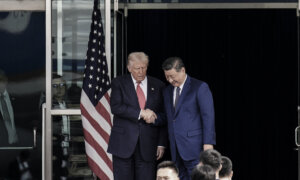

President Donald Trump on Nov. 4 officially reduced the U.S. fentanyl-related tariff on Chinese goods to 10 percent, following an in-person meeting with Chinese leader Xi Jinping in South Korea last month.
The lower tariff, half the current 20 percent rate applied in March, will take effect on Nov. 10, according to an executive order issued by the White House on Nov. 4.
“The PRC has committed to take significant measures to end the flow of fentanyl to the United States, including stopping the shipment of certain designated chemicals to North America and strictly controlling exports of certain other chemicals to all destinations in the world,” Trump said in the executive order, using China’s official name, the People’s Republic of China (PRC).
Trump and Xi met on the sidelines of the Asia-Pacific Economic Cooperation (APEC) summit on Oct. 30 in Busan, South Korea. Following their meeting, Trump expressed confidence that Beijing would take “strong action” to stop the flow of precursor chemicals used in fentanyl production.
The Department of Homeland Security and the State Department will monitor how China implements measures to stop the flow, according to Trump.
If China fails to implement its commitments, he may “modify this order as necessary,” according to the executive order.
In a separate executive order also issued on Nov. 4, Trump formalized another agreement after meeting Xi, lowering the reciprocal U.S. tariff on China to 10 percent from 34 percent. The reduction will also take effect on Nov. 10.
The new tariffs were part of a broader agreement between Trump and Xi, including China suspending its plan to impose stringent export controls on rare earth minerals and resuming the purchase of American soybeans.
Following the announcement of the Trump–Xi deal, some lawmakers expressed concerns about China’s commitments.
“President Trump’s meeting with Xi Jinping also brought hopeful progress for our farmers and the fight against fentanyl, but the ultimate measure of success will be whether China upholds its promises or lies and cheats as it usually does,” Rep. John Moolenaar (R-Mich.), chairman of the House Select Committee on the CCP, said in an Oct. 30 statement.
Sen. Pete Ricketts (R-Neb.), who serves on the Committee on Foreign Relations, said that the United States “shouldn’t be dependent on selling soybeans to Communist China,” despite the deal.
“We must continue to diversify our markets, secure our supply chains, and protect our technology to end our reliance on Communist China,” Ricketts said in an Oct. 30 statement.
Sen. Chris Coons (D-Del.), who also serves on the Committee on Foreign Relations, warned that Beijing could still impose export restrictions on its rare earths in the future.
“The PRC’s promised steps to constrain the flow of fentanyl precursor materials, while a step in the right direction, don’t include several actions that would have a real effect,” Coons said in an Oct. 30 statement.
Treasury Secretary Scott Bessent, speaking on Fox News on Nov. 2, said the United States halved the fentanyl-related tariff “as a show of good faith” and warned that U.S. tariffs on China could still change.
“The Chinese have said that they will work on stopping the flow of precursors to North America, that flow into Canada, into Mexico, where they’re made into fentanyl,” Bessent told the media outlet.
“We’re going to set up a very strict quantitative criteria, and we'll revisit it in six or 12 months to see whether they’ve accomplished it. And my sense is the tariffs could go up or down. I hope that the Chinese, for the sake of the American people, will live up to this, and we could see a dramatic drop in fentanyl deaths.”
Separately, also on Nov. 5, China’s customs tariff commission announced that it would suspend an additional 24 percent tariff on U.S. goods for one year, starting on Nov. 10, while maintaining a 10 percent blanket tariff, according to China’s state-run media Xinhua.
Also effective on Nov. 10, Chinese tariffs of up to 15 percent on certain U.S. agricultural goods would be removed, according to Xinhua.
China will maintain a 13 percent tariff on U.S. soybean imports.
Reuters contributed to this report.