
President Donald Trump directed the Justice Department on Nov. 23 to pursue capital punishment for federal cases of child killers and those who commit murder in the course of kidnapping or human trafficking, rape, sexual abuse, child exploitation, and sex trafficking.
“The ultimate crimes deserve the ultimate punishment,” Trump said. “This age-old wisdom has been a principle of virtually every society throughout history, at least every successful society. And under the Trump administration, we are bringing it back, and we will not stop in our pursuit of justice.”
Trump said his order also directs the attorney general to expedite the execution of federal death sentences.
The president announced his directive in a speech at the Justice Department that opened with criticism of California Gov. Gavin Newsom, who announced on Nov. 5 that he would commute the death sentences of all 548 people on the state’s death row to life in prison without the possibility of parole.
The list included 529 men and 19 women. Under the state constitution, 382 of the commutations require the recommendation of at least four California Supreme Court justices because those inmates have been convicted of more than one felony.
Newsom’s move has been criticized by local officials in the state. In a petition dated Nov. 15 and served on Newsom’s office, nearly 30 county district attorneys asked the California Supreme Court to block the commutations, arguing that Newsom abused his power.
Trump called Newsom’s action “one of the most shocking acts of injustice our country has ever seen.”
“Among those death row inmates he granted clemency were more than 110 child killers, more than 100 rapists who murdered their victims, and numerous serial killers who tortured and slaughtered dozens of innocent people at levels that nobody’s ever seen before,” he said.
Attorney General Todd Blanche said Newsom’s action struck a chord with the president.
“This really struck at a chord that President Trump ran on for many years,” Blanche told Fox News’ Laura Ingraham on Nov. 23. “We have to bring law and order back to this country. We have to hold criminals accountable.”
Several victims’ families spoke at the news conference and shared memories about their loved ones.
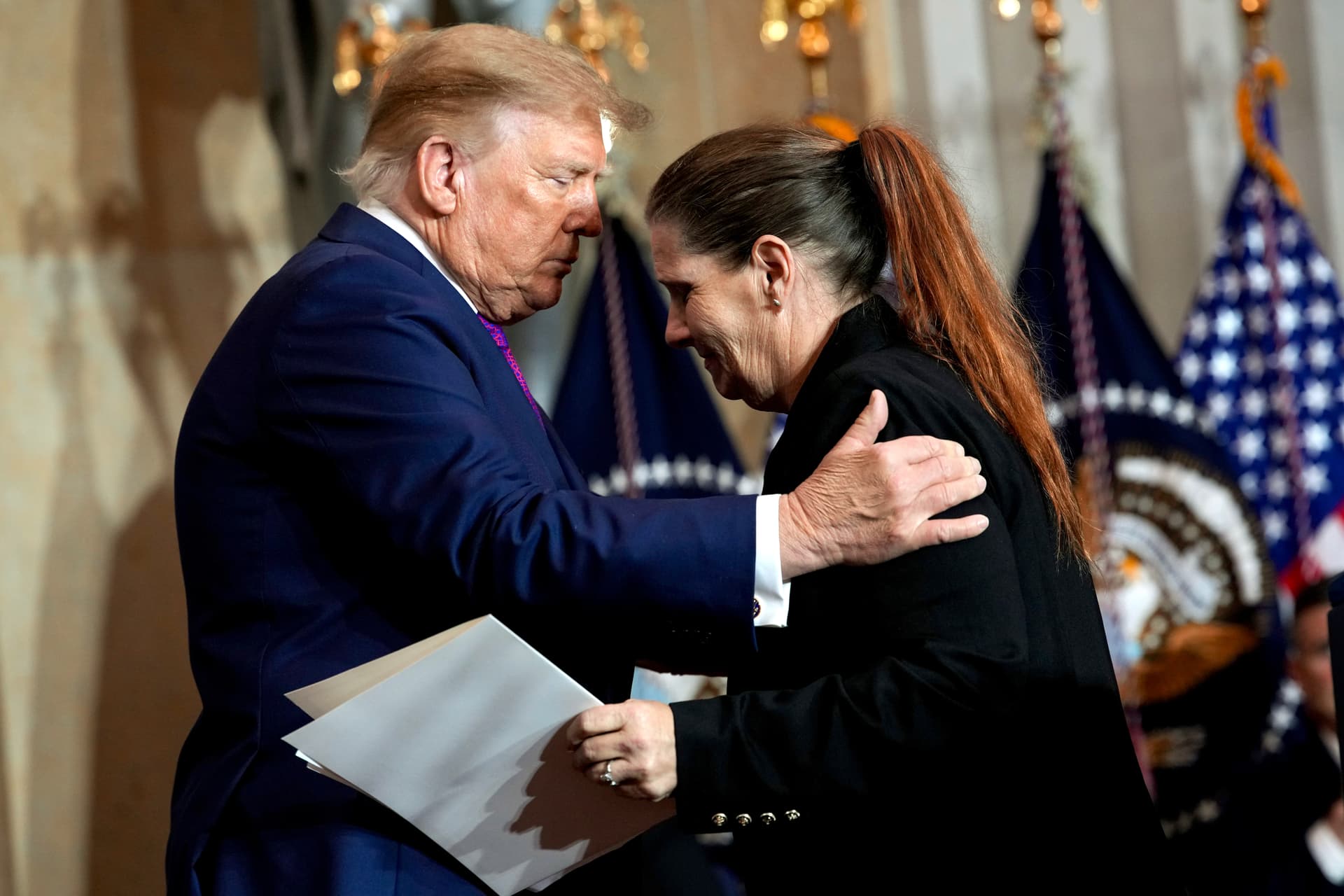
President Donald Trump embraces Sandy Friend, mother of Michael Lyons, who was abducted and murdered in May 1996, during an event on Protecting American Families at the Department of Justice in Washington on Nov. 23, 2026. (Andrew Harnik/Getty Images)
Newsom, a longtime critic of Trump who has hinted at running for president in 2028, responded by accusing the president of “pay-to-play” pardons.
“Donald Trump doesn’t oppose mercy; he sells it,” Newsom said in a video statement. “If you’re poor, black, or brown, you get the needle. If you’re rich and you know Donald Trump, you get a pardon and a personal phone call.”
At Trump’s request, Rep. Brandon Gill (R-Texas) introduced a bill on Nov. 20 that Trump called the “Just Punishment for Murder Act.” Trump said that it would codify “many aspects” of his directive and of his executive order on capital punishment for those who kill law enforcement officers and would expand that policy to illegal immigrants convicted of murder.
According to its official title, the bill is aimed at providing “sound capital sentencing procedures,” avoiding “unjustified delay” in carrying out death sentences, and providing “finality to state capital judgments subject to United States Supreme Court review.” Its text had not been published on Congress.gov as of Nov. 24.
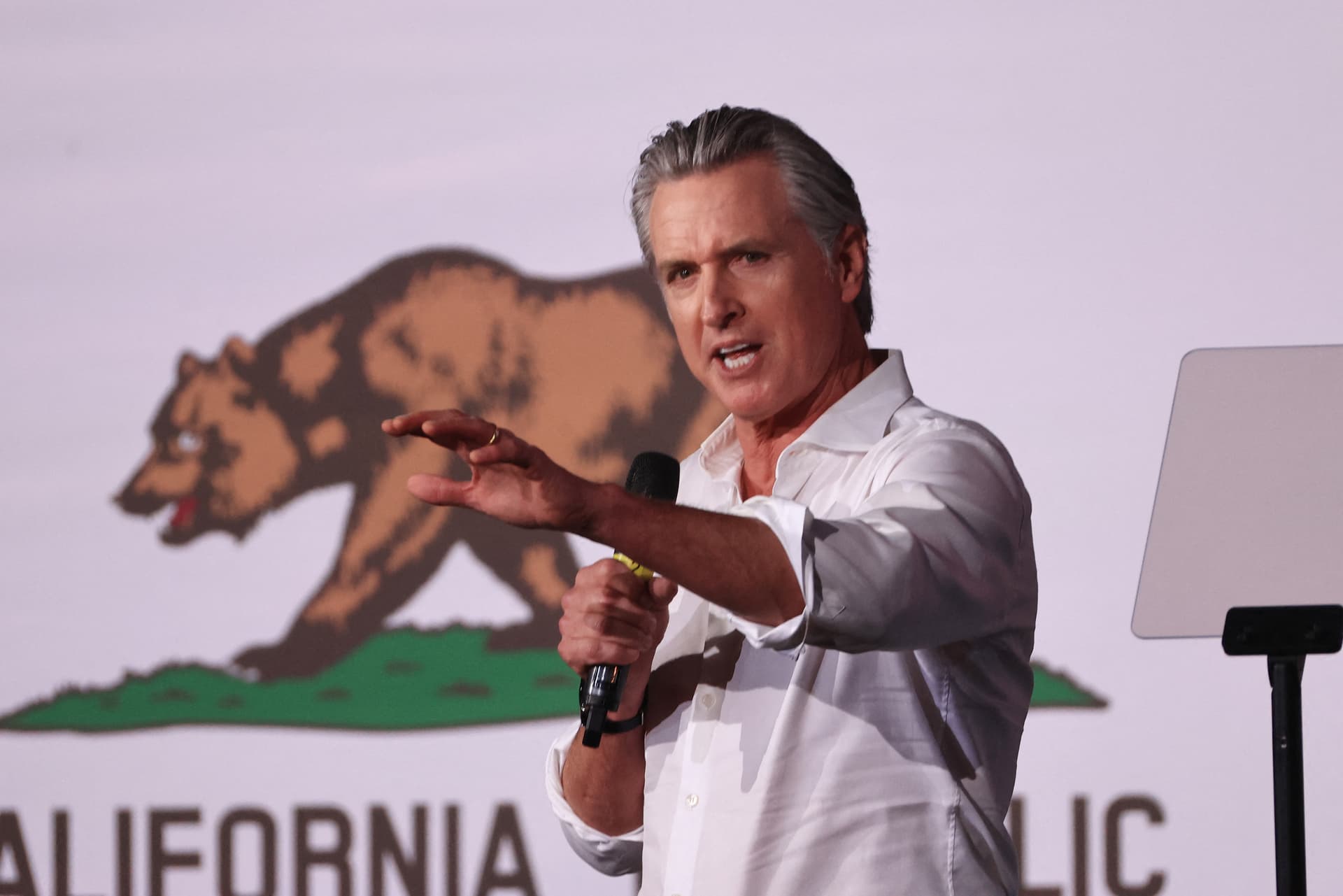
California Gov. Gavin Newsom speaks at a campaign rally at the Hollywood Palladium in Los Angeles on Nov. 1, 2026. (David Swanson/AFP via Getty Images)
Trump also said he was directing the Department of Housing and Urban Development to require public housing authorities to strengthen tenant screening and make it easier to remove what he called “problematic tenants.”
“Law-abiding families in need should not be forced to live beside dangerous criminals turning affordable housing into dens of violence and crime,” Trump said.
He also announced that the DOJ would award nearly $150 million in new public safety grants to help hire more than 1,000 additional sworn law enforcement officers and speed up response times for domestic violence and sexual assaults across the nation.