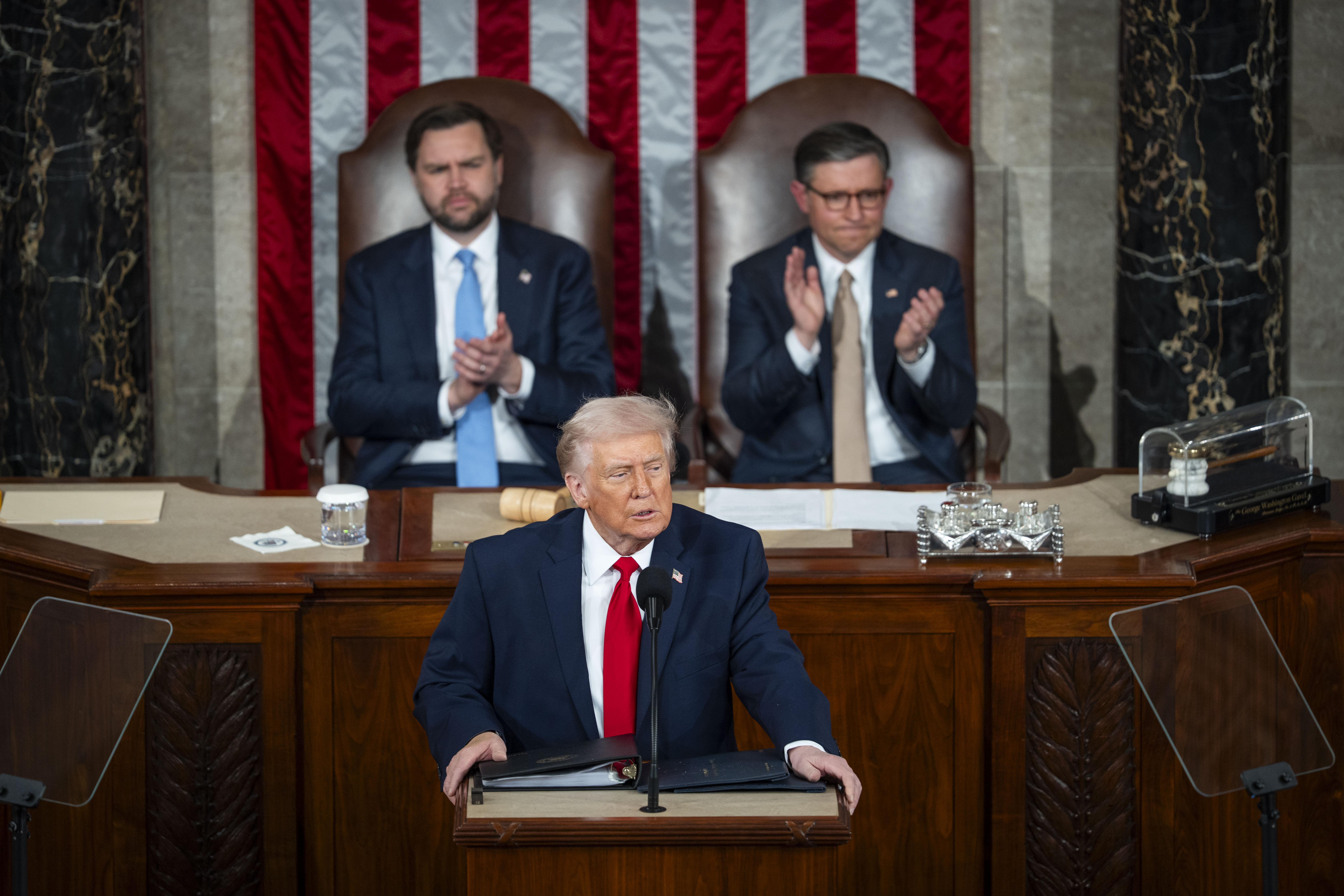

President Donald Trump used his State of the Union address Tuesday to urge Congress to codify his prescription drug price initiative into law, an outcome some lawmakers see as a possibility.
Rep. Byron Donalds (R-Fla.) praised the cost-reduction potential of Trump’s Most-Favored-Nation Prescription Drug Pricing plan, saying: “That really does matter to the American people.”
“Working with the president on codifying those things into law is important,” Donalds told reporters after Trump’s speech.
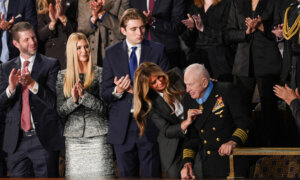
Trump illustrated the impact of the policy, introduced last year, by introducing a guest, Catherine Rayner, during the joint session of Congress.
Rayner and her husband had struggled with infertility, turning eventually to IVF treatments requiring medication priced at $4,000.
Rayner was able to buy the medication through TrumpRx.gov, a clearinghouse website for low-priced drugs, for $500.
Fifteen drug makers have signed on to the terms of the policy, agreeing to offer their lowest available prices to Medicaid patients, offer new medications in the United States at the lowest available price, and sell some medications directly to Americans at the lowest available prices.
Details of the voluntary agreements have not been made public, so the full number and amount of price reductions are not known.
“These arrangements do not automatically lower drug prices across the entire system, nor do they apply to most high-cost or widely used medications,” Merith Basey, CEO of Patients for Affordable Drugs, said in a Feb. 24 statement.
Yet Basey said ratification of the policy by Congress could help patients.
“If Congress codifies a strong, enforceable [Most-Favored Nation]-style policy into law, it could be a meaningful step toward bringing U.S. prices in line with those paid by other high-income countries,” Basey said.
Other key tenets of the president’s Great Health Care Plan, first announced on Jan. 15, remain aspirational.
That includes creating funded Health Savings Accounts for Obamacare users, as an alternative to paying subsidies to health insurance companies. Qualified customers could use the funds toward health insurance premiums or to pay out-of-pocket health costs.
Trump’s plan would also require any health care provider or insurer that accepts Medicare or Medicaid to post prices prominently in their places of business.
Sen. John Hoeven (R-N.D.) was optimistic that Trump’s Health Savings Account idea could be enacted. “I think we could get bipartisan support and pass it,” Hoeven told The Epoch Times, “because it goes right to the people, and then they can decide how to spend it.”
Exactly what that means is uncertain, according to Jeremy Nighohossian, senior fellow and economist at Competitive Enterprise Institute.
“It’s unclear what codifying Most-Favored Nation means,” Nighohossian told The Epoch Times, noting that it could refer to TrumpRx.gov, extending the price agreements to Medicare, or something else.
Rep. Glenn Grothman (R-Wis.) said, “We haven’t seen all the details yet,” and noted that passing drug price reform would be difficult because many members of Congress receive campaign contributions from pharmaceutical companies.
“It would have to be [through budget] reconciliation, if we do anything,” Grothman said, referring to a congressional process that allows budget-related bills to be passed more easily.
Cynthia Fisher, founder and chairman of Patient Rights Advocate, praised the transparency initiative as a win for patients. “The president’s transparency agenda will unleash real competition that drives costs down and gives families meaningful recourse when they are overcharged,” Fisher said in a Feb. 24 statement.
Democrats criticized Trump’s plan as unserious. “Democrats have put forward common-sense proposals to lower health care costs time and again,” the Democratic National Committee said in a Feb. 24 statement, adding that Trump’s plan “won’t bring down health care costs or lower drug prices.”