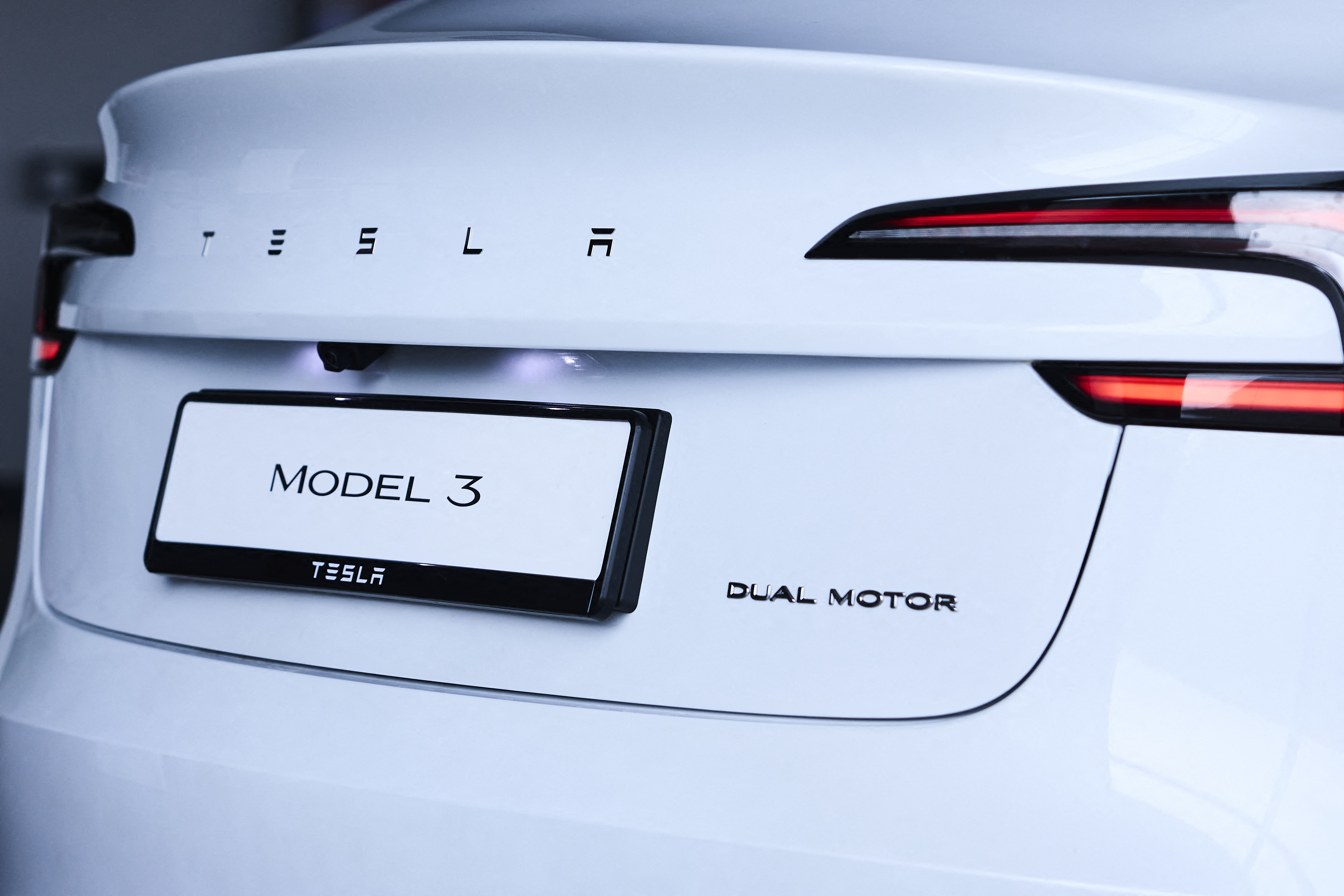

Tesla has stopped taking orders in Canada for its cheapest Model 3—a Shanghai-built version that starts at C$39,490, or around $28,000—citing the government’s limited quota for the company, even though the total government quota for Chinese auto imports has not been filled.
A notice posted Oct. 12 on Tesla’s Canadian website says “high demand exhausted Tesla’s import quota,” referring to the Canadian government’s cap on Chinese-built electric vehicles (EVs), which is 49,000 in its first year and rises each year after that. The company expects to resume orders in March 2027 if Ottawa issues more.
Tesla had shipped the Model 3 to Canada from its California factory until the Canadian government imposed the quota in March. Tesla then switched to Shanghai—Chinese-built EVs inside the quota pay only a 6.1 percent tariff, while many U.S.-built vehicles have faced a 25 percent tariff since April 2025 amid a trade dispute with the United States.
But federal data show that most of the quota remains unused. As of Oct. 9, less than 16,000 of the year’s 49,000 permits had been used, and only 328 vehicles had entered Canada since Sept. 1, according to Global Affairs Canada.
Iain Myrans, Tesla’s public policy lead in Canada, wrote on LinkedIn on Oct. 13 that Global Affairs Canada tells automakers in advance the maximum number of cars they can expect to import in each period. The program “outwardly looks like it is a first-come-first-served model,” he wrote, but “there is a lot more behind it.”
Global Affairs Canada didn’t say whether it had limited Tesla, citing commercial confidentiality. Global Affairs Canada spokeswoman Rachael Dolan told The Epoch Times on Oct. 13 that the department is “consulting with interested companies to optimize remaining quota availability” and reviewing the quota to inform a longer-term policy “designed to catalyze new joint-venture investment on Canadian soil.”
Tesla did not respond to a request for comment by publication time.
The investment Ottawa has in mind is Chinese. Prime Minister Mark Carney’s office said in January it expected his trade deal with Beijing to drive “considerable new Chinese joint-venture investment in Canada” within three years.
The quota is the core of that deal, which Carney reached with Chinese leader Xi Jinping in January. Canada dropped its 100 percent surtax on Chinese EVs within the quota, and Beijing agreed to cut tariffs on Canadian canola.
Room for Chinese Brands
On paper, permits are issued on a “first-come, first-served” basis, and no single company is capped. But the department’s quota notice states it can reserve a portion of the quota for automakers, “including new entrants.” Most of the newcomers lining up to enter Canada are Chinese brands.
Geely, the Chinese group that owns Volvo and Polestar, announced on Oct. 9 that its own brand will enter the Canadian market and begin selling cars in 2027.
Canada’s Industry Minister Mélanie Joly traveled to China in June, meeting with BYD, Chery, and Geely. She told reporters afterward that the companies want to sell more cars at the low tariff than the quota allows, and that those that want more will have to build in Canada.
Dolan said the government’s aim is “to make affordable EVs available to Canadians while ensuring the vehicles of the future are increasingly built by Canadians.”
Margaret McCuaig-Johnston, a senior fellow at the University of Ottawa who spent 37 years in senior federal posts, told The Epoch Times in July that she doubts Carney will hold his ground with Beijing. “He wants to have smooth trade relations with China,” she said.
The Cost for the US
Canada’s 25 percent counter-tariff on U.S.-made vehicles—a response to U.S. tariffs on foreign autos—applies to the full value of vehicles that don’t meet the rules of origin in the U.S.–Mexico–Canada Agreement (USMCA), and to the non-Canadian, non-Mexican content of those that do.
Relief goes only to automakers that build vehicles in Canada, and only for a set number of imports. Tesla doesn’t build cars in Canada.
Ottawa pitched the January deal as part of efforts to build a more independent Canadian economy. One of its first visible effects was to move an American automaker’s supply for Canada from California to China.
Ottawa has also raised costs for two Detroit automakers. Last October, it cut General Motors’ tariff-free allowance for U.S.-built vehicles by 24.2 percent and Stellantis’s by 50 percent, after both scaled back production in Ontario. Stellantis had shifted the production of its next Jeep Compass to Illinois.
Sam Fiorani, vice president of global vehicle forecasting at AutoForecast Solutions, said the Canadian market matters to U.S. factories.
“This year, 64 percent of vehicles sold in Canada will be assembled in North America, down from about 77 percent a decade ago,” he told The Epoch Times in July. “Roughly 10 percent of U.S. production goes to Canada.”
Scott Paul, president of the Alliance for American Manufacturing, a group backed by domestic manufacturers and the United Steelworkers union, said in July that the quota “creates incentives for Chinese automakers to establish broader supply chain, distribution, and production footprints within North America.”
Washington declined on July 1 to renew the USMCA in its current form, and U.S. Trade Representative Jamieson Greer has warned that Canada should not become a “backdoor” for subsidized Chinese autos.
U.S. Sen. Bernie Moreno (R-Ohio) told The Epoch Times in July that his “top priority is protecting our American auto industry and auto workers from unfair foreign predators by sealing off the border permanently.”
Fiorani called Canada’s opening up to Chinese autos a bargaining chip in the USMCA talks. If the tactic fails, he said, “Canadian buyers will get access to more affordable vehicles and push them further away from U.S. vehicles.”